CellNetworks-Cluster of Excellence and Center for Integrative Infectious Diseases Research (CIID), Department of Infectious Diseases, Virology, University Hospital Heidelberg, 69120 Heidelberg, Germany.
Institut National de Recherche Pour l'Agriculture, l'Alimentation et l'Environnement (INRAE), Ecole Pratique des Hautes Etudes (EPHE), Viral Infections and Comparative Pathology (IVPC), UMR754-University Lyon, 69007 Lyon, France.
Viruses. 2021 May 10;13(5):872. doi: 10.3390/v13050872.
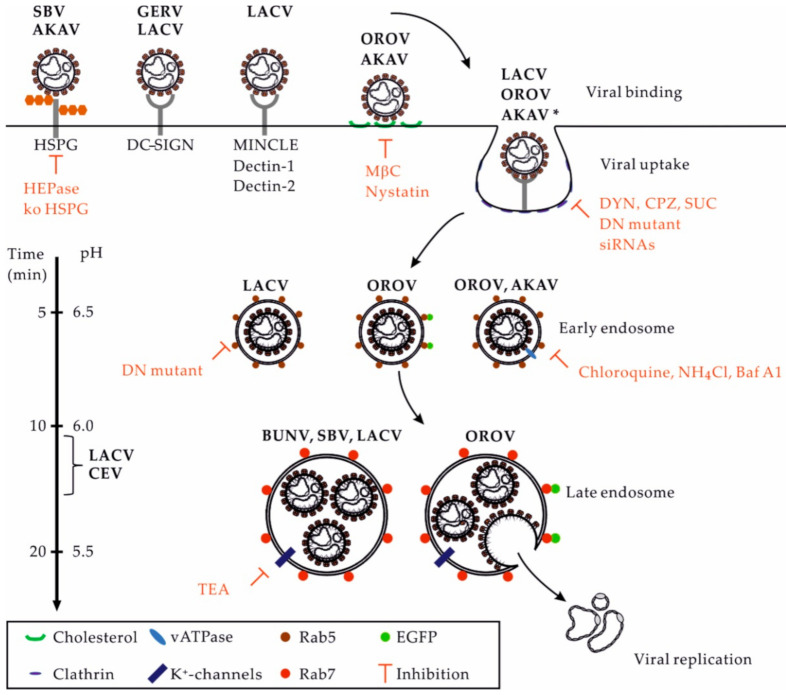
With over 80 members worldwide, is the largest genus in the family. Orthobunyaviruses (OBVs) are arthropod-borne viruses that are structurally simple, with a trisegmented, negative-sense RNA genome and only four structural proteins. OBVs are potential agents of emerging and re-emerging diseases and overall represent a global threat to both public and veterinary health. The focus of this review is on the very first steps of OBV infection in mammalian hosts, from virus binding to penetration and release of the viral genome into the cytosol. Here, we address the most current knowledge and advances regarding OBV receptors, endocytosis, and fusion.
目前全球已有超过 80 个成员,是 科中最大的属。正黏病毒(Orthobunyaviruses,OBVs)是一种节肢动物传播的病毒,结构简单,具有三段、负义 RNA 基因组和仅四种结构蛋白。OBVs 是新出现和重新出现疾病的潜在病原体,总体上对公共卫生和兽医健康构成全球性威胁。本综述的重点是 OBV 在哺乳动物宿主中感染的最初步骤,从病毒结合到穿透和将病毒基因组释放到细胞质中。在这里,我们将讨论有关 OBV 受体、内吞作用和融合的最新知识和进展。