Department of Biological Sciences and Biotechnology, Faculty of Science and Technology, Universiti Kebangsaan Malaysia, Bangi 43,600, Selangor, Malaysia.
Int J Mol Sci. 2021 May 25;22(11):5591. doi: 10.3390/ijms22115591.
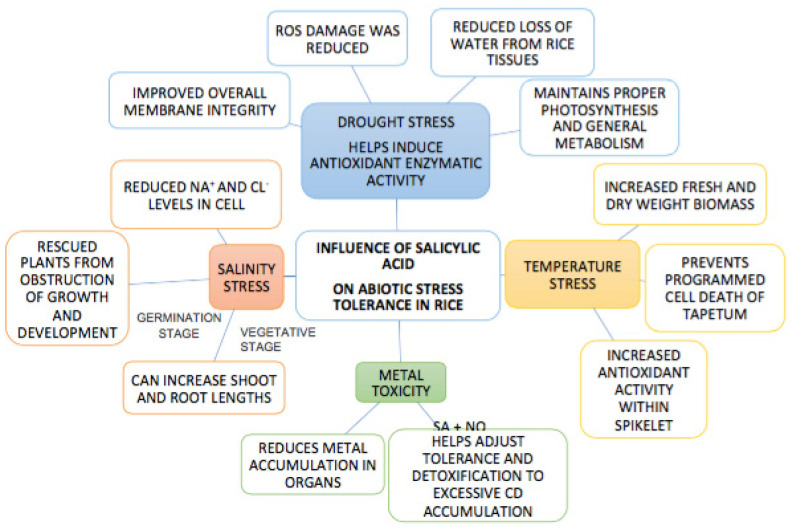
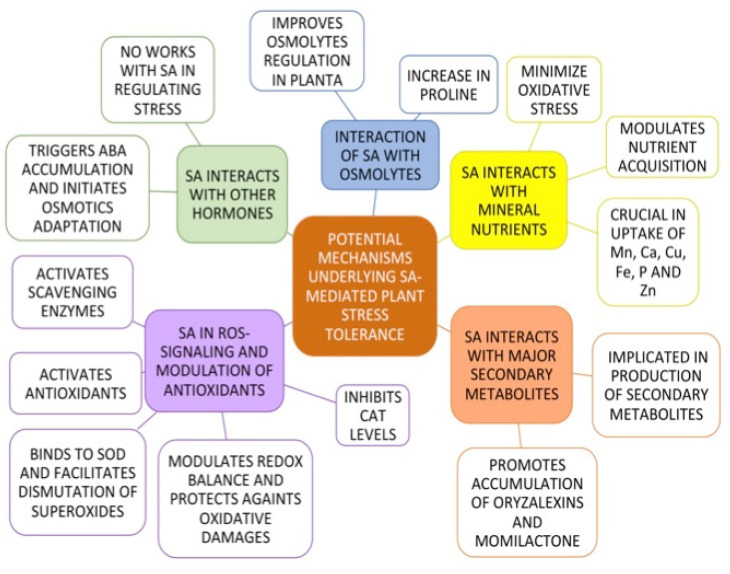
Environmental or abiotic stresses are a common threat that remains a constant and common challenge to all plants. These threats whether singular or in combination can have devastating effects on plants. As a semiaquatic plant, rice succumbs to the same threats. Here we systematically look into the involvement of salicylic acid (SA) in the regulation of abiotic stress in rice. Studies have shown that the level of endogenous salicylic acid (SA) is high in rice compared to any other plant species. The reason behind this elevated level and the contribution of this molecule towards abiotic stress management and other underlying mechanisms remains poorly understood in rice. In this review we will address various abiotic stresses that affect the biochemistry and physiology of rice and the role played by SA in its regulation. Further, this review will elucidate the potential mechanisms that control SA-mediated stress tolerance in rice, leading to future prospects and direction for investigation.
环境或非生物胁迫是一种常见的威胁,对所有植物来说都是一个持续存在的共同挑战。这些威胁无论是单一的还是组合的,都可能对植物造成毁灭性的影响。作为一种半水生植物,水稻也会受到同样的威胁。在这里,我们系统地研究了水杨酸(SA)在调节水稻非生物胁迫中的作用。研究表明,与其他任何植物物种相比,水稻体内的内源水杨酸(SA)水平较高。这种高水平的原因以及该分子在非生物胁迫管理和其他潜在机制中的贡献在水稻中仍知之甚少。在这篇综述中,我们将讨论影响水稻生物化学和生理学的各种非生物胁迫以及 SA 在其调节中的作用。此外,本综述还将阐明控制水稻中 SA 介导的胁迫耐受性的潜在机制,为未来的研究提供前景和方向。