Lefevere Hannes, Bauters Lander, Gheysen Godelieve
Department of Biotechnology, Faculty of Bioscience Engineering, Ghent University, Ghent, Belgium.
Front Plant Sci. 2020 Apr 17;11:338. doi: 10.3389/fpls.2020.00338. eCollection 2020.
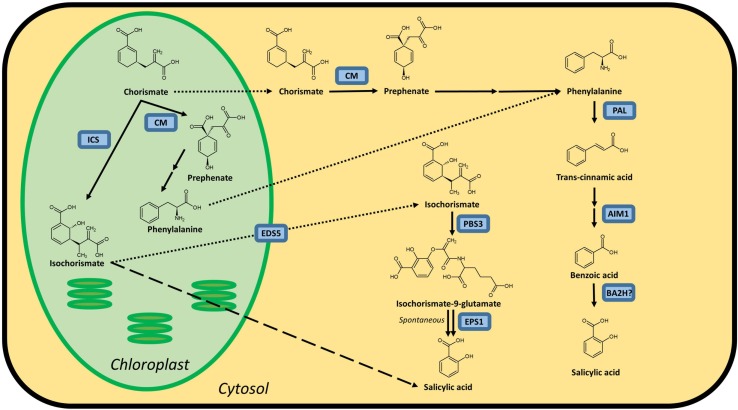
Salicylic acid (SA) is an important plant hormone that is best known for mediating host responses upon pathogen infection. Its role in plant defense activation is well established, but its biosynthesis in plants is not fully understood. SA is considered to be derived from two possible pathways; the ICS and PAL pathway, both starting from chorismate. The importance of both pathways for biosynthesis differs between plant species, rendering it hard to make generalizations about SA production that cover the entire plant kingdom. Yet, understanding SA biosynthesis is important to gain insight into how plant pathogen responses function and how pathogens can interfere with them. In this review, we have taken a closer look at how SA is synthesized and the importance of both biosynthesis pathways in different plant species.
水杨酸(SA)是一种重要的植物激素,因其在病原体感染后介导宿主反应而最为人所知。其在植物防御激活中的作用已得到充分证实,但其在植物中的生物合成尚未完全了解。SA被认为来自两条可能的途径;ICS和PAL途径,均从分支酸开始。这两条途径对生物合成的重要性在不同植物物种之间有所不同,因此很难对涵盖整个植物界的SA产生情况进行概括。然而,了解SA生物合成对于深入了解植物病原体反应如何发挥作用以及病原体如何干扰这些反应非常重要。在这篇综述中,我们更仔细地研究了SA是如何合成的以及这两条生物合成途径在不同植物物种中的重要性。