Su Shih-Chi, Lin Chiao-Wen, Ju Po-Chung, Chang Lun-Ching, Chuang Chun-Yi, Liu Yu-Fan, Hsieh Ming-Ju, Yang Shun-Fa
Whole-Genome Research Core Laboratory of Human Diseases, Chang Gung Memorial Hospital, Keelung 204, Taiwan.
Department of Dermatology, Drug Hypersensitivity Clinical and Research Center, Chang Gung Memorial Hospital, Linkou 333, Taiwan.
J Pers Med. 2021 May 25;11(6):468. doi: 10.3390/jpm11060468.
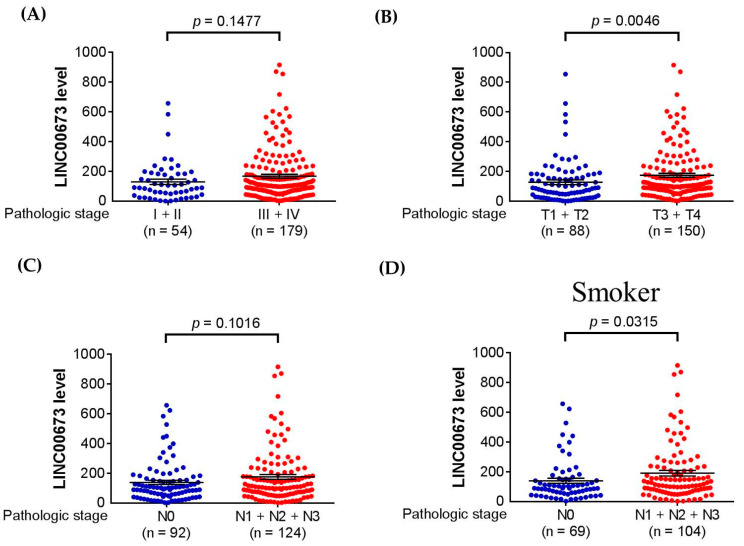
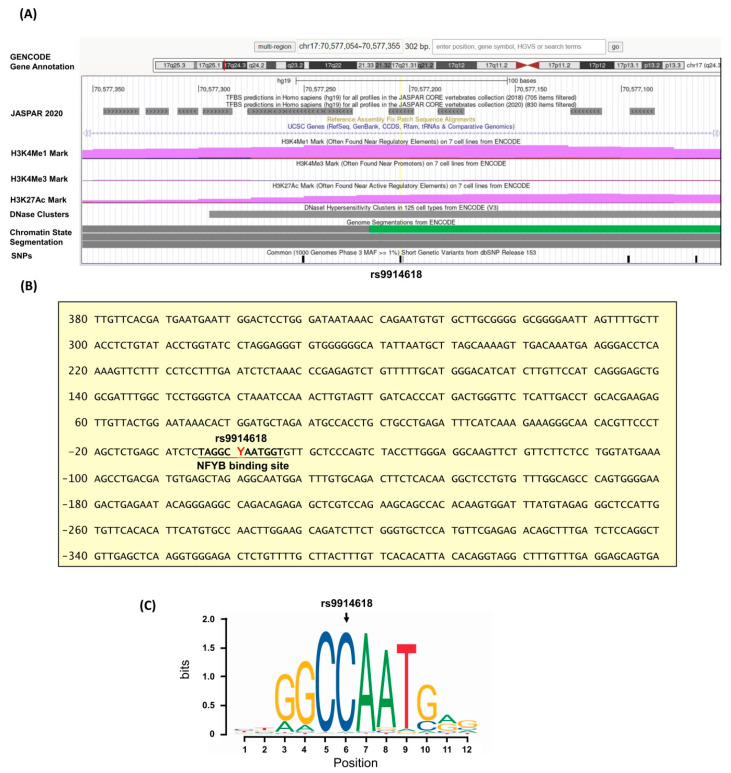
Oral squamous cell carcinoma (OSCC) is a multifactorial malignancy, and its high incidence and mortality rate remain a global public health burden. Polymorphisms in the long intergenic noncoding RNA 673 () have been currently connected to the predisposition to various cancer types. The present study attempted to explore the impact of gene polymorphisms on the risk and progression of OSCC. Three single-nucleotide polymorphisms (SNPs), including rs11655237, rs9914618, and rs6501551, were evaluated in 1231 OSCCC cases and 1194 cancer-free controls. We did not observe any significant association of three individual SNPs with the risk of OSCC between the case and control group. However, while assessing the clinicopathological parameters, patients carrying at least one minor allele of rs9914618 (GA and AA; OR, 1.286; 95% CI, 1.008-1.642; = 0.043) were found to develop lymph node metastasis more often compared to those who are homozygous for the major allele. Further stratification analyses revealed that this genetic correlation with increased risk of lymphatic spread was further fortified in habitual betel quid chewers (OR, 1.534; 95% CI, 1.160-2.028; = 0.003) or smokers (OR, 1.320; 95% CI, 1.013-1.721; = 0.040). Moreover, through analyzing the dataset from The Cancer Genome Atlas (TCGA), we found that elevated levels were associated with the development of large tumors in patients with head and neck squamous cell carcinoma and the risk of lymphatic spread in smokers. These data demonstrate a joint effect of rs9914618 with betel nut chewing or smoking on the progression of oral cancer.
口腔鳞状细胞癌(OSCC)是一种多因素导致的恶性肿瘤,其高发病率和死亡率仍然是全球公共卫生负担。长链基因间非编码RNA 673()的多态性目前已与多种癌症类型的易感性相关。本研究试图探讨基因多态性对OSCC风险和进展的影响。在1231例OSCC病例和1194例无癌对照中评估了三个单核苷酸多态性(SNP),包括rs11655237、rs9914618和rs6501551。我们未观察到病例组和对照组中三个个体SNP与OSCC风险有任何显著关联。然而,在评估临床病理参数时,发现携带rs9914618至少一个次要等位基因(GA和AA;OR,1.286;95%CI,1.008 - 1.642; = 0.043)的患者与那些主要等位基因纯合的患者相比,更常发生淋巴结转移。进一步的分层分析显示,在习惯嚼槟榔者(OR,1.534;95%CI,1.160 - 2.028; = 0.003)或吸烟者(OR,1.320;95%CI,1.013 - 1.721; = 0.040)中,这种与淋巴转移风险增加的遗传相关性进一步增强。此外,通过分析来自癌症基因组图谱(TCGA)的数据集,我们发现水平升高与头颈部鳞状细胞癌患者的大肿瘤发生以及吸烟者的淋巴转移风险相关。这些数据表明rs9914618与嚼槟榔或吸烟对口腔癌进展有联合作用。