Leary Mark, Pursey Kirrilly M, Verdejo-Garcia Antonio, Burrows Tracy L
School of Health Sciences, College of Medicine, Health and Wellbeing, University of Newcastle, Callaghan, NSW 2308, Australia.
Priority Research Centre for Physical Activity and Nutrition, University of Newcastle, Callaghan, NSW 2308, Australia.
Behav Sci (Basel). 2021 May 23;11(6):80. doi: 10.3390/bs11060080.
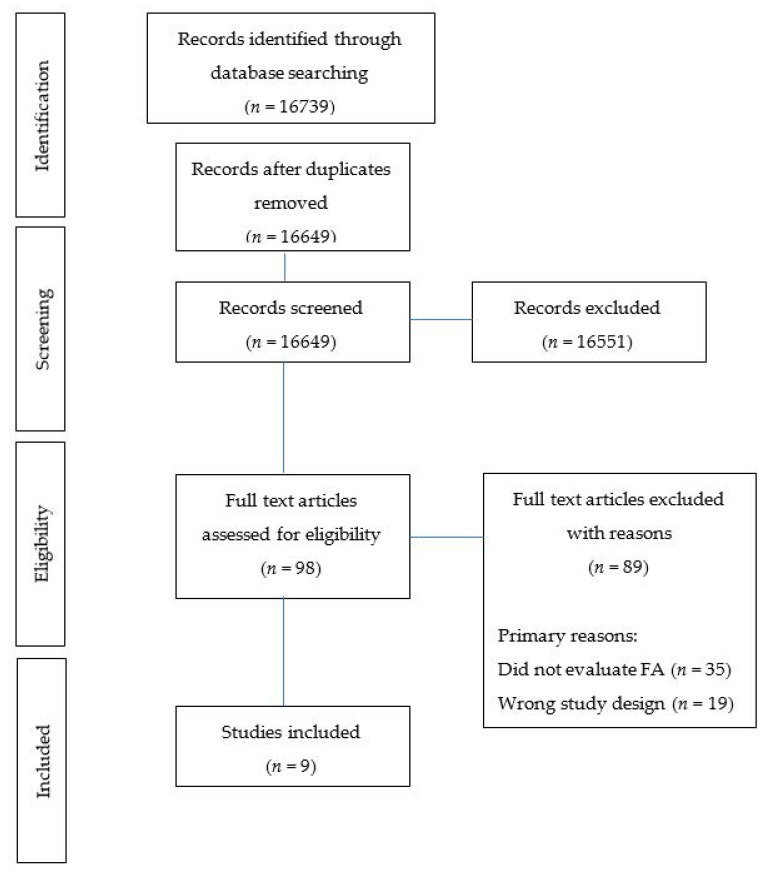
Research on the concept of food addiction (FA) has steadily grown and, based on a widely used self-report, FA is estimated to affect between 16-20% of the adult population. However, there are few interventions available for people with self-reported FA, and their efficacy is unclear. The primary aim of the review was to examine the efficacy of different interventions, including behavioural/lifestyle, medication and surgical approaches, for reducing symptoms and/or changing diagnosis of FA among adolescents and adults. A secondary aim was to examine the influence of sex as a moderator of intervention effects. A systematic search was performed from 2008-2020 to identify studies that used the YFAS to assess the effectiveness of interventions on FA. Nine studies were identified ( = 7 adults, = 2 adolescents) including a total of 812 participants (range 22-256) with an average of 69% females per study. The types of interventions included medications ( = 3), lifestyle modification ( = 3), surgical ( = 2) and behavioural ( = 1), with FA being assessed as a secondary outcome in all studies. Five studies in adults reported a significant reduction in FA symptoms or diagnosis from pre to post-intervention, two when compared to a control group and three in the intervention group only. Efficacious interventions included: medication (combination of naltrexone and bupropion, as well as pexacerfont), bariatric surgery and lifestyle modification. No significant changes in FA were reported in adolescent studies. Given few studies were identified by the review, there is insufficient evidence to provide clear recommendations for practice; however, some interventions show potential for reducing self-reported FA outcomes in adults. Future research should explore the longer-term efficacy of interventions and the effectiveness of treatments with sufficient sample sizes.
关于食物成瘾(FA)概念的研究一直在稳步增长,根据一项广泛使用的自我报告,估计FA影响16%-20%的成年人口。然而,针对自我报告有FA的人群,可用的干预措施很少,其效果也不明确。该综述的主要目的是研究不同干预措施(包括行为/生活方式、药物和手术方法)在减轻青少年和成年人FA症状和/或改变FA诊断方面的效果。次要目的是研究性别作为干预效果调节因素的影响。我们进行了一项从2008年至2020年的系统检索,以识别使用耶鲁食物成瘾量表(YFAS)评估干预措施对FA有效性的研究。共识别出9项研究(7项针对成年人,2项针对青少年),包括总共812名参与者(范围为22-256人),每项研究平均69%为女性。干预措施的类型包括药物治疗(3项)、生活方式改变(3项)、手术治疗(2项)和行为治疗(1项),在所有研究中,FA均作为次要结果进行评估。5项针对成年人的研究报告称,干预前后FA症状或诊断有显著减轻,2项是与对照组相比,3项仅在干预组中。有效的干预措施包括:药物治疗(纳曲酮和安非他酮联合使用,以及培沙色酚)、减肥手术和生活方式改变。青少年研究中未报告FA有显著变化。鉴于该综述识别出的研究较少,没有足够的证据提供明确的实践建议;然而,一些干预措施在降低成年人自我报告的FA结果方面显示出潜力。未来的研究应探索干预措施的长期效果以及样本量充足的治疗方法的有效性。