Elfers Kristin, Armbrecht Yvonne, Mazzuoli-Weber Gemma
Institute for Physiology and Cell Biology, University of Veterinary Medicine Hannover, Foundation, 30173 Hannover, Germany.
Animals (Basel). 2021 May 28;11(6):1593. doi: 10.3390/ani11061593.
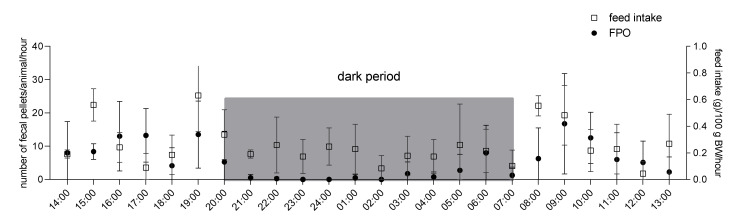
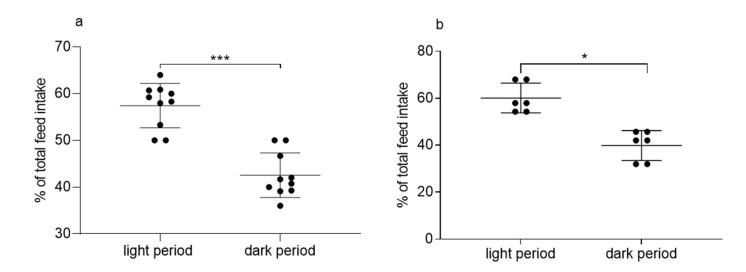
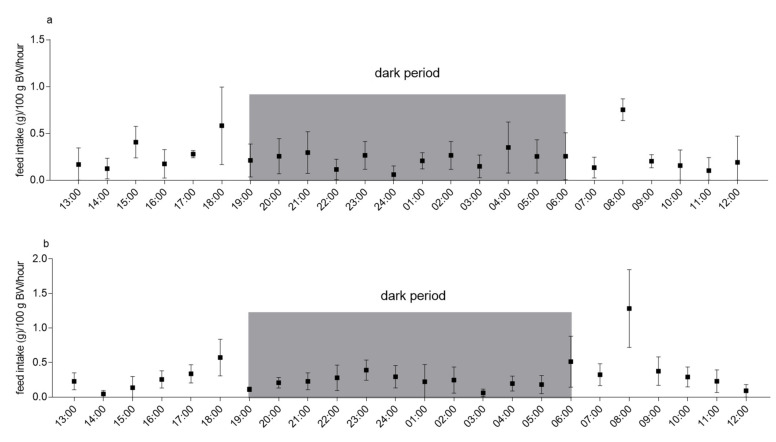
Guinea pigs are a traditional and frequently used species in gastrointestinal research. Comprehensive knowledge of basic parameters connected with their intestinal function, such as feed intake, fecal pellet output and gastrointestinal transit time, is important for evaluating results from basic gastrointestinal research that may be applied to practical problems in human and veterinary medicine, for example, when establishing diagnostic tools. Our study revealed that over a 24-h period, single-housed guinea pigs showed a continual but day-accentuated feeding activity, consuming 57% of the total feed during the light period, with pronounced peaks of feed intake during the beginning and end of the light period. This was mirrored by fecal pellet output during the light period and almost no defecation during the dark period, while potential coprophagy not measured in this study needs to be considered. A highly comparable feeding activity was recorded in pair-housed guinea pigs, with 60% of overall feed intake within the light period, indicating that such differences in housing conditions did not influence guinea pigs' feeding behavior. Intestinal transit time was successfully recorded by oral administration of carmine red and counted 5 h on average. Hence, this study provides important information on the basic functional parameters of guinea pigs' gastrointestinal tract physiology.
豚鼠是胃肠道研究中一种传统且常用的物种。全面了解与其肠道功能相关的基本参数,如采食量、粪便颗粒排出量和胃肠通过时间,对于评估基础胃肠道研究的结果很重要,这些结果可能应用于人类和兽医学的实际问题,例如在建立诊断工具时。我们的研究表明,在24小时内,单笼饲养的豚鼠表现出持续但白天更为突出的进食活动,在光照期消耗了总饲料量的57%,在光照期开始和结束时采食量有明显峰值。这在光照期的粪便颗粒排出量中得到反映,而在黑暗期几乎没有排便,同时需要考虑本研究未测量的潜在食粪行为。成对饲养的豚鼠记录到了高度可比的进食活动,光照期内总采食量的60%,表明这种饲养条件的差异并未影响豚鼠的进食行为。通过口服胭脂红成功记录了肠道通过时间,平均为5小时。因此,本研究提供了关于豚鼠胃肠道生理基本功能参数的重要信息。