Kuo Po-Jan, Yen Hsiu-Ju, Lin Chi-Yu, Lai Hsuan-Yu, Chen Chun-Hung, Wang Shwu-Huey, Chang Wei-Jen, Lee Sheng-Yang, Huang Haw-Ming
School of Dentistry, Department of Periodontology, National Defense Medical Center and Tri-Service General Hospital, Taipei 11490, Taiwan.
Department of Dentistry, Division of Prosthodontics, Taipei Medical University Hospital, Taipei 11031, Taiwan.
Polymers (Basel). 2021 May 24;13(11):1708. doi: 10.3390/polym13111708.
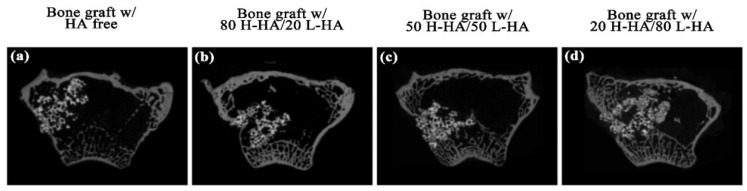
Osteoconduction is an important consideration for fabricating bio-active materials for bone regeneration. For years, hydroxyapatite and β-calcium triphosphate (β-TCP) have been used to develop bone grafts for treating bone defects. However, this material can be difficult to handle due to filling material sagging. High molecular weight hyaluronic acid (H-HA) can be used as a carrier to address this problem and improve operability. However, the effect of H-HA on bone formation is still controversial. In this study, low molecular weight hyaluronic acid (L-HA) was fabricated using gamma-ray irradiation. The viscoelastic properties and chemical structure of the fabricated hybrids were evaluated by a rheological analysis nuclear magnetic resonance (NMR) spectrum. The L-MH was mixed with H-HA to produce H-HA/L-HA hybrids at ratios of 80:20, 50:50 and 20:80 (/). These HA hybrids were then combined with hydroxyapatite and β-TCP to create a novel bone graft composite. For animal study, artificial bone defects were prepared in rabbit femurs. After 12 weeks of healing, the rabbits were scarified, and the healing statuses were observed and evaluated through micro-computer tomography (CT) and tissue histological images. Our viscoelastic analysis showed that an HA hybrid consisting 20% H-HA is sufficient to maintain elasticity; however, the addition of L-HA dramatically decreases the dynamic viscosity of the HA hybrid. Micro-CT images showed that the new bone formations in the rabbit femur defect model treated with 50% and 80% L-HA were 1.47 ( < 0.05) and 2.26 ( < 0.01) times higher than samples filled with HA free bone graft. In addition, a similar tendency was observed in the results of HE staining. These results lead us to suggest that the material with an H-HA/L-HA ratio of 50:50 exhibited acceptable viscosity and significant new bone formation. Thus, it is reasonable to suggest that it may be a potential candidate to serve as a supporting system for improving the operability of granular bone grafts and enhancing new bone formations.
骨传导性是制造用于骨再生的生物活性材料时的一个重要考量因素。多年来,羟基磷灰石和β-磷酸三钙(β-TCP)一直被用于开发治疗骨缺损的骨移植材料。然而,由于填充材料下垂,这种材料可能难以操作。高分子量透明质酸(H-HA)可作为载体来解决这一问题并提高可操作性。然而,H-HA对骨形成的影响仍存在争议。在本研究中,通过γ射线辐照制备了低分子量透明质酸(L-HA)。通过流变学分析和核磁共振(NMR)光谱对制备的杂化物的粘弹性性质和化学结构进行了评估。将L-MH与H-HA以80:20、50:50和20:80(/)的比例混合以制备H-HA/L-HA杂化物。然后将这些HA杂化物与羟基磷灰石和β-TCP结合以创建一种新型骨移植复合材料。在动物研究中,在兔股骨中制备人工骨缺损。愈合12周后,对兔子实施安乐死,并通过微型计算机断层扫描(CT)和组织组织学图像观察和评估愈合状态。我们的粘弹性分析表明,由20% H-HA组成的HA杂化物足以保持弹性;然而,添加L-HA会显著降低HA杂化物的动态粘度。微型CT图像显示,用50%和80% L-HA处理的兔股骨缺损模型中的新骨形成分别比填充无HA骨移植材料的样本高1.47倍(<0.05)和2.26倍(<0.01)。此外,苏木精-伊红(HE)染色结果也观察到了类似趋势。这些结果使我们认为,H-HA/L-HA比例为50:50的材料表现出可接受的粘度和显著的新骨形成。因此,有理由认为它可能是一种潜在的候选材料,可作为一种支持系统,用于提高颗粒状骨移植材料的可操作性并促进新骨形成。