Department of Medicine I, University Medical Center Hamburg-Eppendorf, Martinistr. 52, D-20246, Hamburg, Germany.
Semin Immunopathol. 2021 Aug;43(4):563-575. doi: 10.1007/s00281-021-00867-8. Epub 2021 Jun 1.
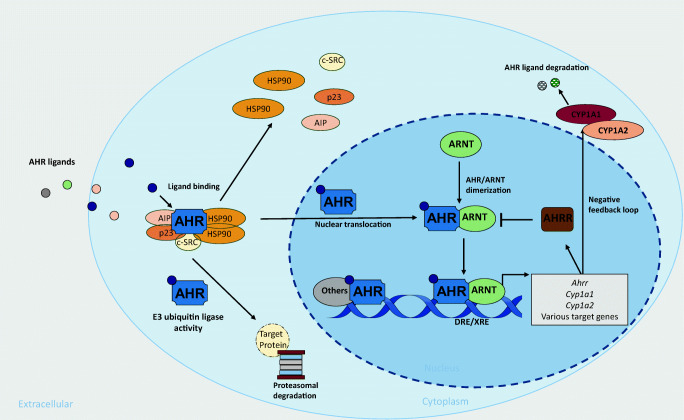
The aryl hydrocarbon receptor (AHR) is a ubiquitously expressed ligand-activated transcription factor with multifaceted physiological functions. In the immune system, AHR has been unequivocally identified as a key regulatory factor that can integrate environmental, dietary, or microbial signals into innate and adaptive immune responses. Correspondingly, AHR activity seems to be most important at barrier organs, such as the gut, skin, and lung. The liver is likewise prominently exposed to gut-derived dietary or microbial AHR ligands and, moreover, generates plenty of AHR ligands itself. Yet, surprisingly little is known about the role of AHR in the regulation of hepatic immune responses, which are normally biased towards tolerance, preventing harmful inflammation in response to innocuous stimuli. In this review, we summarize the current knowledge about the role of AHR in hepatic immune responses in the healthy liver as well as in inflammatory liver disease. Moreover, we discuss AHR as a potential therapeutic target in hepatic disorders, including autoimmune liver disease, liver fibrosis, and liver cancer.
芳香烃受体(AHR)是一种广泛表达的配体激活转录因子,具有多方面的生理功能。在免疫系统中,AHR 已被明确鉴定为一种关键的调节因子,能够将环境、饮食或微生物信号整合到先天和适应性免疫反应中。相应地,AHR 活性似乎在屏障器官中最为重要,如肠道、皮肤和肺部。肝脏同样容易受到来自肠道的饮食或微生物 AHR 配体的影响,而且肝脏本身也会产生大量的 AHR 配体。然而,令人惊讶的是,人们对 AHR 在调节肝脏免疫反应中的作用知之甚少,肝脏免疫反应通常偏向于耐受,防止对无害刺激产生有害的炎症。在这篇综述中,我们总结了目前关于 AHR 在健康肝脏和炎症性肝病中调节肝脏免疫反应的作用的知识。此外,我们还讨论了 AHR 作为治疗肝脏疾病的潜在靶点的可能性,包括自身免疫性肝病、肝纤维化和肝癌。