Department of Dermatology, University Hospital Centre Nice, Côte d'Azur University, Nice, France.
INSERM U1065, team 12, C3M, Nice, France.
J Eur Acad Dermatol Venereol. 2021 Oct;35(10):1963-1975. doi: 10.1111/jdv.17432. Epub 2021 Jun 24.
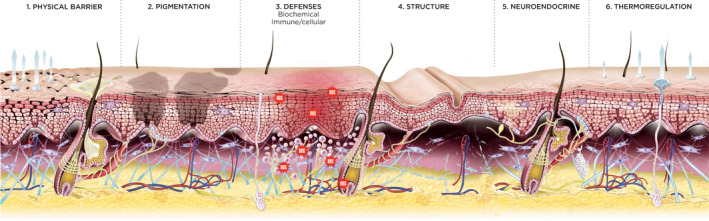
Exposome factors that lead to stressed skin can be defined as any disturbance to homeostasis from environmental (meteorological factors, solar radiation, pollution or tobacco smoke) and/or internal exposure (unhealthy diet, hormonal variations, lack of sleep, psychosocial stress). The clinical and biological impact of chronic exposome effects on skin functions has been extensively reviewed, whereas there is a paucity of information on the impact of short-term acute exposure. Acute stress, which would typically last minutes to hours (and generally no more than a week), provokes a transient but robust neuroendocrine-immune and tissue remodelling response in the skin and can alter the skin barrier. Firstly, we provide an overview of the biological effects of various acute stressors on six key skin functions, namely the skin physical barrier, pigmentation, defences (antioxidant, immune cell-mediated, microbial and microbiome maintenance), structure (extracellular matrix and appendages), neuroendocrine and thermoregulation functions. Secondly, we describe the biological and clinical effects on adult skin from individual exposome factors that elicit an acute stress response and their consequences in skin health maintenance. Clinical manifestations of acutely stressed skin may include dry skin that might accentuate fine lines, oily skin, sensitive skin, pruritus, erythema, pale skin, sweating, oedema and flares of inflammatory skin conditions such as acne, rosacea, atopic dermatitis, pigmentation disorders and skin superinfection such as viral reactivation. Acute stresses can also induce scalp sensitivity, telogen effluvium and worsen alopecia.
导致皮肤压力的外核因素可以定义为任何对内环境(气象因素、太阳辐射、污染或烟草烟雾)和/或内暴露(不健康饮食、激素变化、睡眠不足、心理社会压力)的平衡干扰。慢性外核因素对皮肤功能的影响的临床和生物学影响已经得到了广泛的综述,而关于短期急性暴露影响的信息却很少。急性应激通常持续数分钟到数小时(一般不超过一周),会引起皮肤短暂但强烈的神经内分泌-免疫和组织重塑反应,并可能改变皮肤屏障。首先,我们概述了各种急性应激源对皮肤的六个关键功能的生物学影响,即皮肤物理屏障、色素沉着、防御(抗氧化、免疫细胞介导、微生物和微生物组维持)、结构(细胞外基质和附属物)、神经内分泌和体温调节功能。其次,我们描述了引起急性应激反应的个体外核因素对成人皮肤的生物学和临床影响及其对皮肤健康维持的后果。急性压力皮肤的临床表现可能包括干燥皮肤,可能使细纹更加明显,油性皮肤,敏感皮肤,瘙痒,红斑,苍白皮肤,出汗,水肿和炎症性皮肤病(如痤疮、酒渣鼻、特应性皮炎、色素沉着障碍和皮肤超感染,如病毒再激活)的爆发。急性应激还会引起头皮敏感、休止期脱发和加重脱发。