Peters Eva M J, Schedlowski Manfred, Watzl Carsten, Gimsa Ulrike
Psychoneuroimmunology Laboratory, Department of Psychosomatic Medicine and Psychotherapy, Justus-Liebig University Giessen, Giessen and Universitätsmedizin-Charité, Berlin, Germany.
Institute of Medical Psychology and Behavioral Immunobiology, University Hospital Essen, Germany and Department of Clinical Neuroscience, Osher Center for Integrative Medicine, Karolinska Institutet, Stockholm, Sweden.
Neurobiol Stress. 2021 May;14:100296. doi: 10.1016/j.ynstr.2021.100296. Epub 2021 Jan 27.
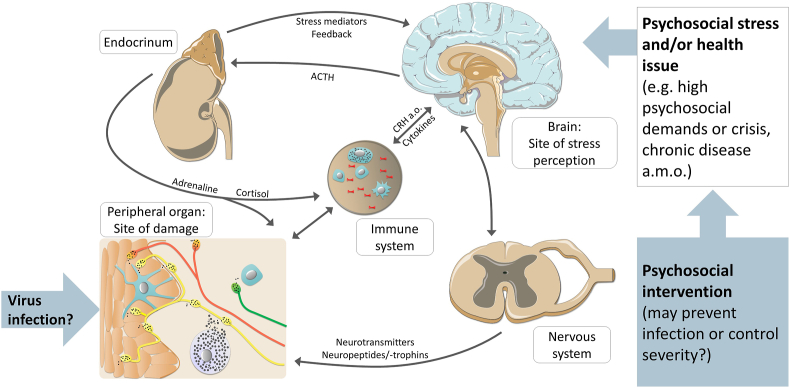
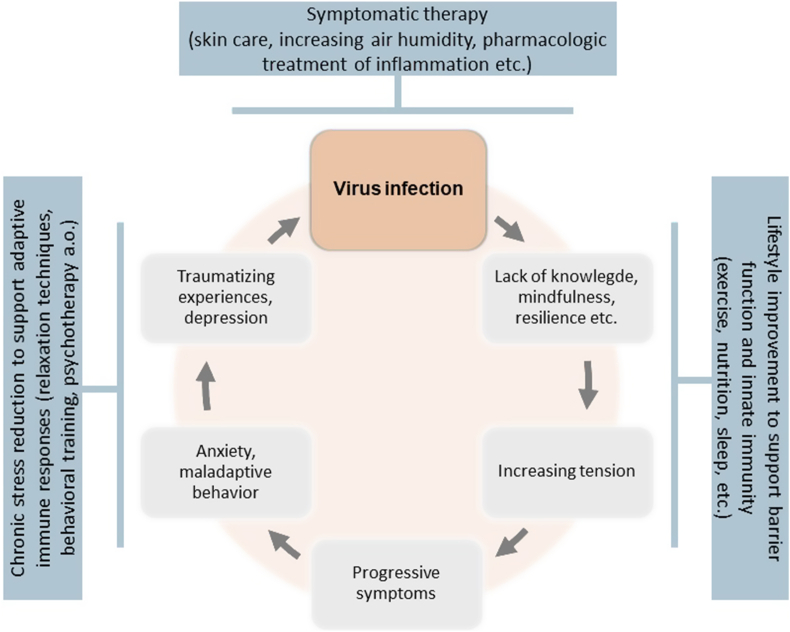
The COVID-19 pandemic continues to strongly affect people with health disadvantages, creating a heavy burden on medical systems and societies worldwide. Research is growing rapidly and recently revealed that stress-related factors such as socio-economic status, may also play a pivotal role. However, stress research investigating the underlying psychoneuroimmune interactions is missing. Here we address the question whether stress-associated neuroendocrine-immune mechanisms can possibly contribute to an increase in SARS-CoV-2 infections and influence the course of COVID-19 disease. Additionally, we discuss that not all forms of stress (e.g. acute versus chronic) are detrimental and that some types of stress could attenuate infection-risk and -progression. The overall aim of this review is to motivate future research efforts to clarify whether psychosocial interventions have the potential to optimize neuroendocrine-immune responses against respiratory viral infections during and beyond the COVID-19 pandemic. The current state of research on different types of stress is summarized in a comprehensive narrative review to promote a psychoneuroimmune understanding of how stress and its mediators cortisol, (nor)adrenaline, neuropeptides and neurotrophins can shape the immune defense against viral diseases. Based on this understanding, we describe how people with high psychosocial stress can be identified, which behaviors and psychosocial interventions may contribute to optimal stress management, and how psychoneuroimmune knowledge can be used to improve adequate care for COVID-19 and other patients with viral infections.
新冠疫情继续对健康状况不佳的人群产生严重影响,给全球医疗系统和社会带来沉重负担。相关研究迅速增加,最近有研究表明,社会经济地位等与压力相关的因素可能也起着关键作用。然而,针对潜在心理神经免疫相互作用的压力研究尚付阙如。在此,我们探讨压力相关的神经内分泌免疫机制是否可能促使新冠病毒感染增加,并影响新冠疾病的病程。此外,我们还讨论了并非所有形式的压力(如急性压力与慢性压力)都是有害的,某些类型的压力可能会降低感染风险和疾病进展。本综述的总体目标是激发未来的研究工作,以阐明心理社会干预措施在新冠疫情期间及之后是否有可能优化针对呼吸道病毒感染的神经内分泌免疫反应。本文通过一篇全面的叙述性综述总结了不同类型压力的研究现状,以促进从心理神经免疫学角度理解压力及其介质皮质醇、(去)甲肾上腺素、神经肽和神经营养因子如何塑造针对病毒性疾病的免疫防御。基于这一理解,我们描述了如何识别心理社会压力大的人群,哪些行为和心理社会干预措施可能有助于实现最佳压力管理,以及如何利用心理神经免疫学知识改善对新冠患者及其他病毒感染患者的适当护理。