Quan YanXiu, Zhao YongXing, Musa Rabiu Muazu, Morgans Ryland, Silva Rui Miguel, Hung Chin-Hwai, Chen Yung-Sheng
College of Physical Education, China West Normal University, Nanchong, Sichuan, China.
College of Physical Education, Chizhou University, Chizhou, Anhui, China.
Front Physiol. 2024 Sep 11;15:1466386. doi: 10.3389/fphys.2024.1466386. eCollection 2024.
To evaluate the effects of a 4-week intervention combining small-sided games (SSGs) and high-intensity interval training (HIIT) on physical fitness in collegiate male soccer players.
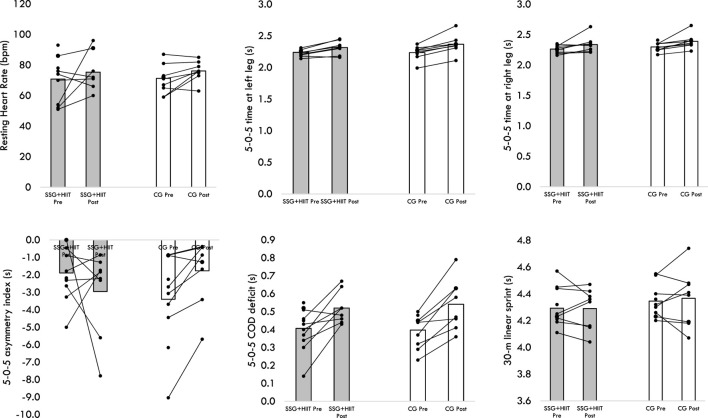
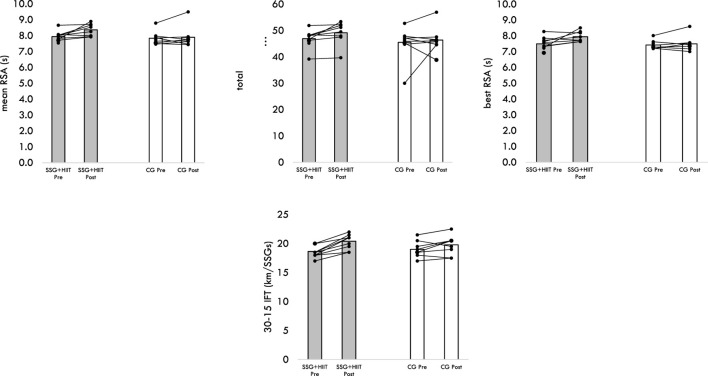
Twenty-one soccer players were randomly assigned to either the HIIT + SSGs group (n = 11) or a control group (n = 10). Physical fitness was assessed at baseline and 1-week post-intervention, including countermovement jump (CMJ), change of direction (COD) test, sprint test, repeated sprint ability (RSA) test, and 30-15 Intermittent Fitness Test (30-15IFT). The intervention comprised eight sessions over 4 weeks: four SSGs and four HIIT.
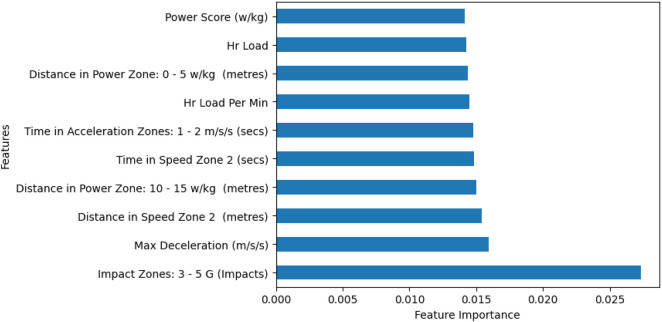
The intervention group showed small to moderate improvements: mean RSA improved by 4.5% ( = 0.07), CMJ increased by 3.2% ( = 0.12), and 30-15IFT scores enhanced by 6.8% ( = 0.09). Key predictors of group membership included heart rate load per minute (OR 1.602) and various GPS variables.
The 4-week intervention combining SSGs with HIIT did not produce statistically significant improvements in most physical fitness variables compared to the control group. Although there were positive trends in variables such as RSA and 30-15IFT, these changes were modest and not statistically significant. The results suggest that while the combined SSGs and HIIT approach shows potential, its impact on physical fitness over a 4-week period is limited, with some variables, like CMJ, even showing decreases.
评估为期4周的小型比赛(SSG)与高强度间歇训练(HIIT)相结合的干预措施对大学男子足球运动员身体素质的影响。
21名足球运动员被随机分为HIIT + SSG组(n = 11)或对照组(n = 10)。在基线和干预后1周评估身体素质,包括反向纵跳(CMJ)、变向(COD)测试、短跑测试、重复冲刺能力(RSA)测试和30 - 15间歇体能测试(30 - 15IFT)。干预包括4周内的8次训练:4次SSG和4次HIIT。
干预组显示出小到中度的改善:平均RSA提高了4.5%(P = 0.07),CMJ增加了3.2%(P = 0.12),30 - 15IFT得分提高了6.8%(P = 0.09)。分组的关键预测因素包括每分钟心率负荷(OR 1.602)和各种GPS变量。
与对照组相比,为期4周的将SSG与HIIT相结合的干预措施在大多数身体素质变量上并未产生统计学上的显著改善。尽管在RSA和30 - 15IFT等变量上有积极趋势,但这些变化较小且无统计学意义。结果表明,虽然SSG和HIIT相结合的方法显示出潜力,但其在4周内对身体素质的影响有限,一些变量,如CMJ,甚至出现下降。