Fortún-Rabadán Rocío, Jiménez-Sánchez Carolina, Flores-Yaben Olatz, Bellosta-López Pablo
iPhysio Research Group, Department of Physical Therapy, Universidad San Jorge, Villanueva de Gállego, Zaragoza, Spain.
Hospital Mutua de Accidentes de Zaragoza, Zaragoza, Spain.
J Educ Health Promot. 2021 Feb 27;10:75. doi: 10.4103/jehp.jehp_888_20. eCollection 2021.
Musculoskeletal pain is highly prevalent among office workers and causes high costs to the public health system. Strategies including education and exercise are recommended, with major benefits when conducted by physical therapists in the occupational environment. However, the required investment is uncommon among companies. This study aimed to evaluate the efficacy of a multimodal physiotherapy intervention to relieve musculoskeletal pain in office workers.
The study employed a single group study with a pre-post study design and was conducted at Universidad San Jorge in 2018. Outcome variables were: workplace ergonomics (INSHT Guide), existence and severity of musculoskeletal disorders (Nordic Musculoskeletal Questionnaire), musculoskeletal pain intensity (Numeric Rating Scale), and Clinical Global Impression Scale. Office workers in a university setting ( = 24, 19 females) were assessed at baseline, after 4 weeks of in-person sessions and following 3 weeks of autonomous performance. The physiotherapy program included education, ergonomic supervision, self-treatment, strengthening, and stretching exercises. A repeated-measures ANOVA or Friedman test (with comparisons) and Chi-squared test were used to compare the study variables.
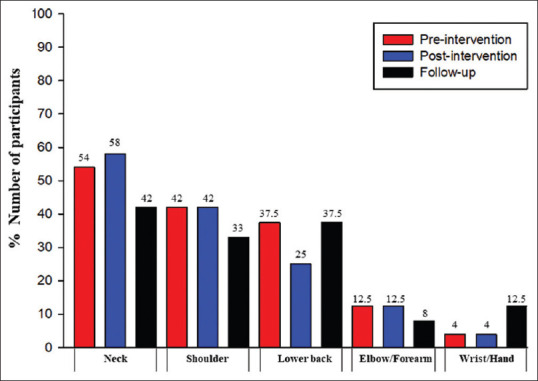
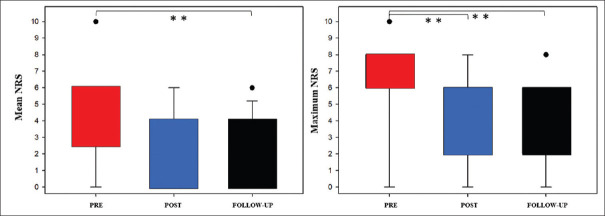
At baseline, cervical spine (54%), shoulder (42%), and lumbar regions (37.5%) were the most symptomatic regions according to the Nordic Musculoskeletal Questionnaire. Even if the proportion of symptomatic areas did not decrease significantly after the intervention, a great reduction of musculoskeletal pain intensity was observed after the program in the cervical ( < 0.001), lower back ( = 0.005), shoulder ( = 0.006) regions, and in the overall pain level ( < 0.001).
These results support that a multimodal physiotherapy program can relieve work-related musculoskeletal pain in office workers and serve as a basis for future controlled trials.
肌肉骨骼疼痛在上班族中极为普遍,给公共卫生系统带来高昂成本。建议采取包括教育和锻炼在内的策略,由物理治疗师在职业环境中实施时效果更佳。然而,企业中所需的投资并不常见。本研究旨在评估多模式物理治疗干预缓解上班族肌肉骨骼疼痛的疗效。
本研究采用单组前后对照研究设计,于2018年在圣豪尔赫大学开展。结果变量包括:工作场所人体工程学(INSHT指南)、肌肉骨骼疾病的存在情况和严重程度(北欧肌肉骨骼问卷)、肌肉骨骼疼痛强度(数字评分量表)以及临床整体印象量表。对大学环境中的上班族(n = 24,19名女性)在基线、面对面治疗4周后以及自主训练3周后进行评估。物理治疗方案包括教育、人体工程学监督、自我治疗、强化训练和伸展运动。采用重复测量方差分析或Friedman检验(进行多重比较)以及卡方检验来比较研究变量。
根据北欧肌肉骨骼问卷,基线时颈椎(54%)、肩部(42%)和腰椎区域(37.5%)是症状最明显的区域。尽管干预后症状区域的比例没有显著下降,但在该方案实施后,颈椎(P < 0.001)、下背部(P = 0.005)、肩部(P = 0.006)区域以及总体疼痛水平(P < 0.001)的肌肉骨骼疼痛强度大幅降低。
这些结果支持多模式物理治疗方案可缓解上班族与工作相关的肌肉骨骼疼痛,并为未来的对照试验提供依据。