Statens Serum Institut, Department of Bacteria, Parasites and Fungi, Copenhagen, Denmark.
Danish Veterinary and Food Administration, Glostrup, Denmark.
Euro Surveill. 2021 Jun;26(22). doi: 10.2807/1560-7917.ES.2021.26.22.2001396.
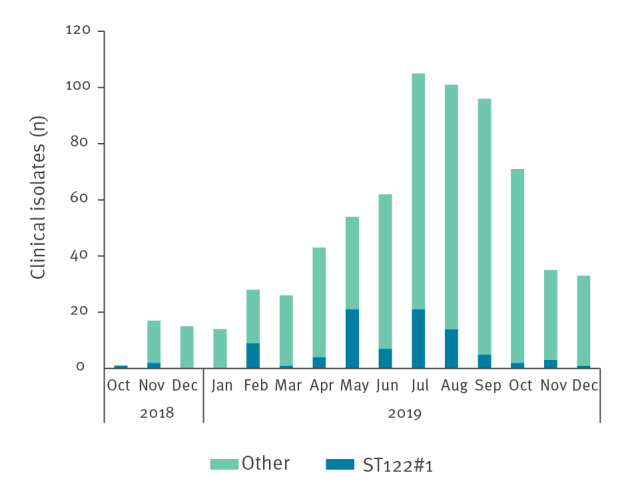
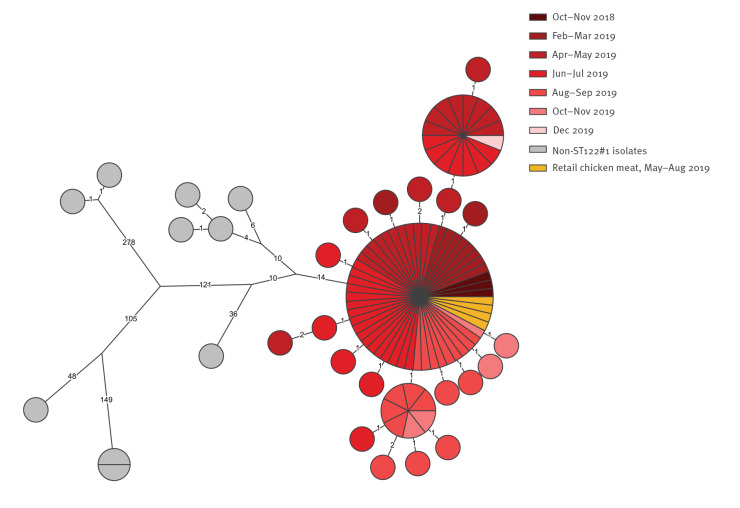
Background is one of the most frequent causes of bacterial gastroenteritis. outbreaks are rarely reported, which could be a reflection of a surveillance without routine molecular typing. We have previously shown that numerous small outbreak-like clusters can be detected when whole genome sequencing (WGS) data of clinical isolates was applied.AimTyping-based surveillance of infections was initiated in 2019 to enable detection of large clusters of clinical isolates and to match them to concurrent retail chicken isolates in order to react on ongoing outbreaks.MethodsWe performed WGS continuously on isolates from cases (n = 701) and chicken meat (n = 164) throughout 2019. Core genome multilocus sequence typing was used to detect clusters of clinical isolates and match them to isolates from chicken meat.ResultsSeventy-two clusters were detected, 58 small clusters (2-4 cases) and 14 large clusters (5-91 cases). One third of the clinical isolates matched isolates from chicken meat. One large cluster persisted throughout the whole year and represented 12% of all studied cases. This cluster type was detected in several chicken samples and was traced back to one slaughterhouse, where interventions were implemented to control the outbreak.ConclusionOur WGS-based surveillance has contributed to an improved understanding of the dynamics of the occurrence of strains in chicken meat and the correlation to clusters of human cases.
背景是导致细菌性肠胃炎最常见的原因之一。爆发很少被报道,这可能反映了没有常规进行分子分型的监测。我们之前已经表明,当应用临床分离株的全基因组测序 (WGS) 数据时,可以检测到许多小的爆发样簇。
为了能够检测到大量临床分离株的集群,并将其与同期零售鸡肉分离株相匹配,以应对正在发生的疫情,我们于 2019 年启动了基于分型的 感染监测。
我们在 2019 年全年对病例(n=701)和鸡肉(n=164)分离株进行了连续的 WGS。核心基因组多位点序列分型用于检测临床分离株的集群,并将其与鸡肉分离株相匹配。
共检测到 72 个集群,其中 58 个小集群(2-4 例)和 14 个大集群(5-91 例)。三分之一的临床分离株与鸡肉分离株相匹配。一个大集群全年持续存在,占所有研究病例的 12%。该集群类型在多个鸡肉样本中被检测到,并追溯到一个屠宰场,在那里实施了干预措施来控制疫情。
我们的基于 WGS 的监测有助于更好地了解鸡肉中 菌株的发生动态及其与人类病例集群的相关性。