Cho So Mi Jemma, Lee Hokyou, Lee Hyeok-Hee, Baek Jongmin, Heo Ji Eun, Joo Hyung Joon, Hong Soon Jun, Kim Hyeon Chang
Department of Public Health, Yonsei University Graduate School, Seoul, Korea.
Department of Preventive Medicine, Yonsei University College of Medicine, Seoul, Korea.
J Lipid Atheroscler. 2021 May;10(2):202-209. doi: 10.12997/jla.2021.10.2.202. Epub 2021 Apr 2.
The Korean Society of Lipid and Atherosclerosis (KSoLA) has published the Dyslipidemia Fact Sheets in Korea 2020 to provide an overview of magnitude and management status of dyslipidemia and their recent trends therein.
The Fact Sheets were based on the analyses of Korean adults aged 20 years or older of the 2007-2018 Korea National Health and Nutrition Examination Survey (KNHANES) and the 2002-2018 National Health Insurance Big Data (NHI-BD).
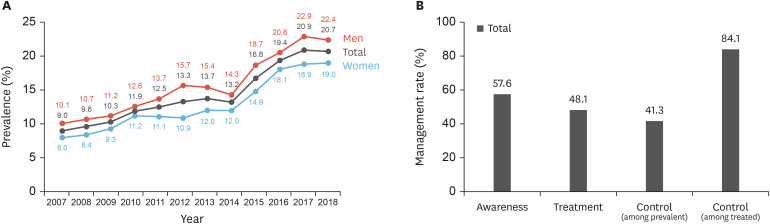
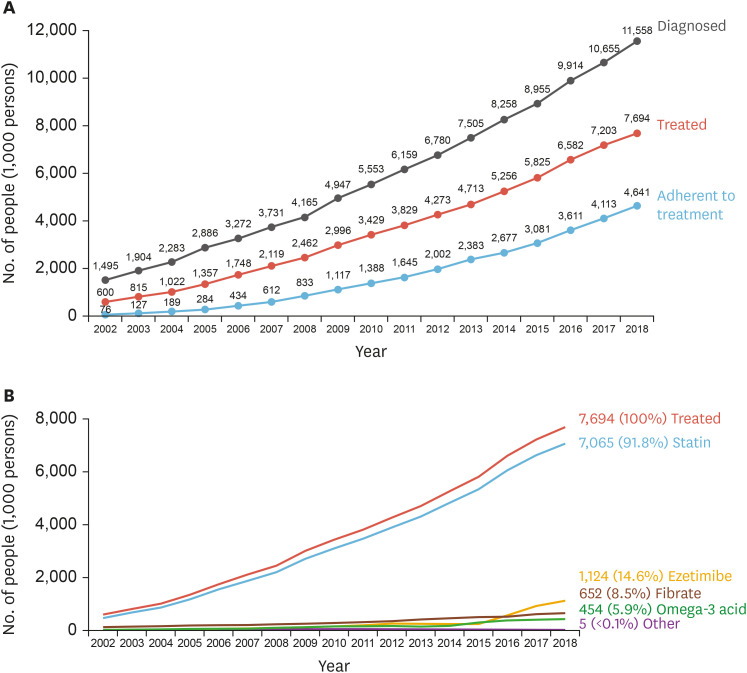
Between 2007 and 2018, the crude prevalence of hypercholesterolemia increased from 9.0% to 20.7%. During the same period, its management rate also improved yet remained unsatisfactory. In 2018, the prevalence of dyslipidemia was 45.6% in men and 31.3% in women, which increased with older age and presence of metabolic abnormalities. Indeed, the number of people diagnosed with dyslipidemia has increased nearly 8-fold from 1.5 million in 2002 to 11.6 million in 2018; alongside, the number of people receiving pharmacological treatment for dyslipidemia has also risen. Of the 7.7 million people treated for dyslipidemia in 2018, statin accounted for the majority (91.8%) of lipid-lowering drug prescriptions, followed by ezetimibe (14.6%), fibrate (8.5%), and omega-3 acid (5.9%). The most frequently used combination therapy was statin plus ezetimibe, accounting for 72% of dual therapy prescriptions.
Dyslipidemia continues to impose a substantial disease burden in Korea. Both healthcare practitioners and patients need to actively adopt guideline-recommended lifestyle modification and pharmacological treatment for comprehensive, timely, and sustained management.
韩国脂质与动脉粥样硬化学会(KSoLA)发布了《2020年韩国血脂异常情况说明书》,以概述韩国血脂异常的严重程度、管理状况及其近期趋势。
该说明书基于对2007 - 2018年韩国国民健康与营养检查调查(KNHANES)中20岁及以上韩国成年人以及2002 - 2018年国家健康保险大数据(NHI - BD)的分析。
2007年至2018年期间,高胆固醇血症的粗患病率从9.0%增至20.7%。在此期间,其管理率虽有改善,但仍不尽人意。2018年,男性血脂异常患病率为45.6%,女性为31.3%,患病率随年龄增长和代谢异常情况而增加。事实上,被诊断为血脂异常的人数从2002年的150万增加到2018年的1160万,增长了近8倍;与此同时,接受血脂异常药物治疗的人数也有所上升。在2018年接受血脂异常治疗的770万人中,他汀类药物占降脂药物处方的大多数(91.8%),其次是依折麦布(14.6%)、贝特类药物(8.5%)和ω-3酸(5.9%)。最常用的联合治疗是他汀类药物加依折麦布,占双联治疗处方的72%。
血脂异常在韩国仍然造成沉重的疾病负担。医疗从业者和患者都需要积极采取指南推荐的生活方式改变和药物治疗,以进行全面、及时和持续的管理。