Faculty of Medicine, Chulalongkorn University, Bangkok, Thailand.
Department of Computer Engineering, Faculty of Engineering, Chulalongkorn University, Bangkok, Thailand.
PLoS One. 2021 Jun 8;16(6):e0252882. doi: 10.1371/journal.pone.0252882. eCollection 2021.
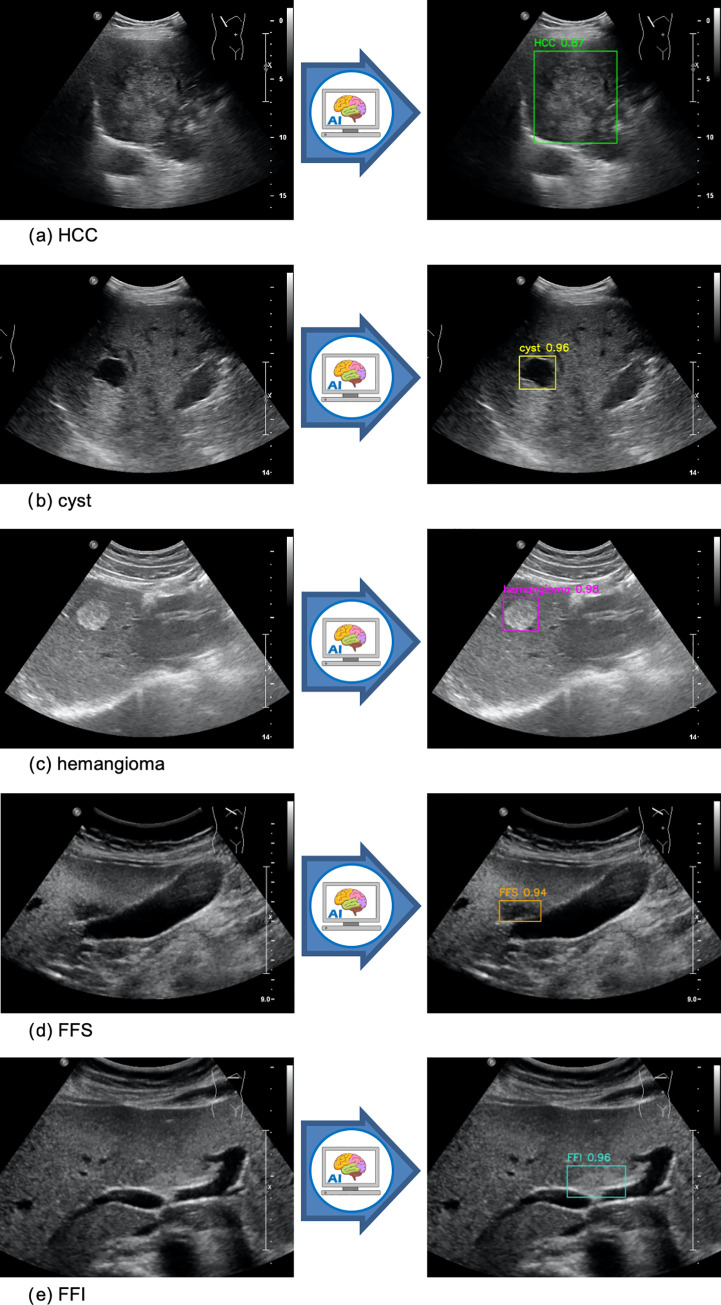
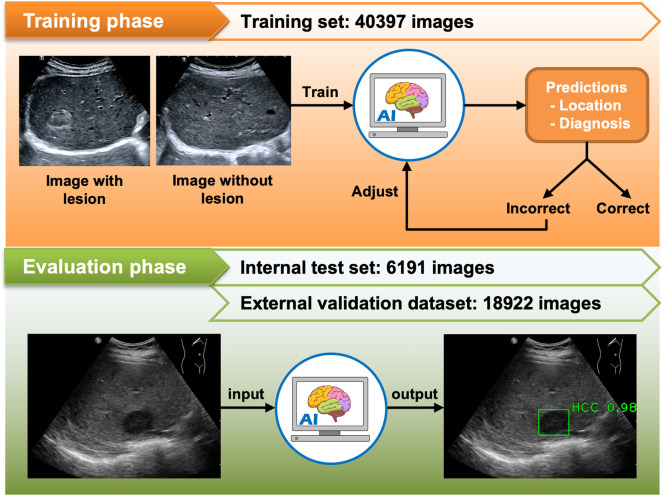
Artificial intelligence (AI) using a convolutional neural network (CNN) has demonstrated promising performance in radiological analysis. We aimed to develop and validate a CNN for the detection and diagnosis of focal liver lesions (FLLs) from ultrasonography (USG) still images. The CNN was developed with a supervised training method using 40,397 retrospectively collected images from 3,487 patients, including 20,432 FLLs (hepatocellular carcinomas (HCCs), cysts, hemangiomas, focal fatty sparing, and focal fatty infiltration). AI performance was evaluated using an internal test set of 6,191 images with 845 FLLs, then externally validated using 18,922 images with 1,195 FLLs from two additional hospitals. The internal evaluation yielded an overall detection rate, diagnostic sensitivity and specificity of 87.0% (95%CI: 84.3-89.6), 83.9% (95%CI: 80.3-87.4), and 97.1% (95%CI: 96.5-97.7), respectively. The CNN also performed consistently well on external validation cohorts, with a detection rate, diagnostic sensitivity and specificity of 75.0% (95%CI: 71.7-78.3), 84.9% (95%CI: 81.6-88.2), and 97.1% (95%CI: 96.5-97.6), respectively. For diagnosis of HCC, the CNN yielded sensitivity, specificity, and negative predictive value (NPV) of 73.6% (95%CI: 64.3-82.8), 97.8% (95%CI: 96.7-98.9), and 96.5% (95%CI: 95.0-97.9) on the internal test set; and 81.5% (95%CI: 74.2-88.8), 94.4% (95%CI: 92.8-96.0), and 97.4% (95%CI: 96.2-98.5) on the external validation set, respectively. CNN detected and diagnosed common FLLs in USG images with excellent specificity and NPV for HCC. Further development of an AI system for real-time detection and characterization of FLLs in USG is warranted.
人工智能(AI)使用卷积神经网络(CNN)在放射分析中表现出了有前景的性能。我们旨在开发和验证一种用于从超声(USG)静态图像中检测和诊断局灶性肝病变(FLL)的 CNN。该 CNN 是使用 40397 张来自 3487 名患者的回顾性采集图像,通过监督训练方法开发的,包括 20432 个 FLL(肝细胞癌(HCC)、囊肿、血管瘤、局灶性脂肪保留和局灶性脂肪浸润)。使用来自另外两家医院的 18922 张图像和 1195 个 FLL 的内部测试集评估 AI 性能,然后使用该测试集进行外部验证。内部评估的总体检出率、诊断灵敏度和特异性分别为 87.0%(95%CI:84.3-89.6)、83.9%(95%CI:80.3-87.4)和 97.1%(95%CI:96.5-97.7)。该 CNN 在外部验证队列中的表现也一直很稳定,其检出率、诊断灵敏度和特异性分别为 75.0%(95%CI:71.7-78.3)、84.9%(95%CI:81.6-88.2)和 97.1%(95%CI:96.5-97.6)。对于 HCC 的诊断,该 CNN 在内部测试集上的灵敏度、特异性和阴性预测值(NPV)分别为 73.6%(95%CI:64.3-82.8)、97.8%(95%CI:96.7-98.9)和 96.5%(95%CI:95.0-97.9);在外部验证集上的灵敏度、特异性和 NPV 分别为 81.5%(95%CI:74.2-88.8)、94.4%(95%CI:92.8-96.0)和 97.4%(95%CI:96.2-98.5)。CNN 能够在 USG 图像中检测和诊断常见的 FLL,并且对 HCC 具有出色的特异性和 NPV。因此,有必要进一步开发一种用于实时检测和特征描述 USG 中 FLL 的人工智能系统。