Geraldino Barbara R, Nunes Rafaella F N, Gomes Juliana B, da Poça Katia S, Giardini Isabela, Silva Paula V B, Souza Helen P, Otero Ubirani B, Sarpa Marcia
Technical Area of Environment, Work and Cancer, Prevention and Surveillance Coordination, National Cancer Institute José Alencar Gomes da Silva (INCA), Rua Marquês de Pombal 125, 5º Andar-Centro, Rio de Janeiro CEP 20230-240, Brazil.
Environmental Mutagenesis Laboratory, Department of Biochemistry, Biomedical Institute, Federal University of Rio de Janeiro State (UNIRIO), Rua Frei Caneca 94, 4º Andar-Centro, Rio de Janeiro CEP 20211-040, Brazil.
Adv Prev Med. 2021 May 20;2021:5553633. doi: 10.1155/2021/5553633. eCollection 2021.
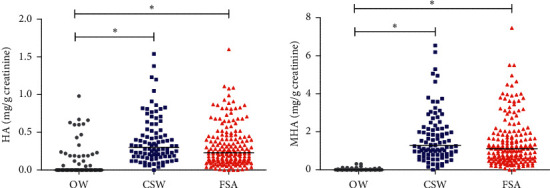
The main volatile organic compounds found at gasoline stations are benzene, toluene, ethylbenzene, and xylene isomers (BTEX). They cause several harmful effects on human health. Regulatory Norm 7 (1978) provides that, in Brazil, biological monitoring of toluene and xylene is carried out by measuring the urinary metabolites hippuric acid (HA) and methylhippuric acid (MHA), respectively. The objective of this study was to assess the exposure to toluene and xylene and to identify related signs and symptoms in gasoline station workers. A cross-sectional epidemiological study was conducted with workers occupationally exposed to fuels. These gasoline station workers were divided into two groups: 94 workers exposed mainly by inhalation (convenience store workers (CSWs)) and 181 workers exposed by inhalation and dermal route (filling station attendants (FSAs)). A comparison group was formed by 119 workers not occupationally exposed to fuels (office workers (OWs)). Workers exposed to fuels had higher average levels of these exposure biomarkers (HA and MHA), which were also higher in convenience store workers than in filling station attendants. In addition, individuals exposed to the solvents present in gasoline had altered mood/depression, cramps, dizziness, drowsiness, headaches, irritability/nervousness, weakness, weight loss, and other symptoms more frequently and had higher urinary levels of HA and MHA compared to the comparison group. Gasoline station workers showed high levels of HA and MHA, reflecting high occupational exposure to the solvents toluene and xylene present in gasoline, demonstrating that changes in the current legislation and in the work environment are necessary to ensure better health protection for these workers.
在加油站发现的主要挥发性有机化合物是苯、甲苯、乙苯和二甲苯异构体(BTEX)。它们会对人体健康造成多种有害影响。巴西第7号监管规范(1978年)规定,在巴西,通过分别测量尿代谢产物马尿酸(HA)和甲基马尿酸(MHA)来对甲苯和二甲苯进行生物监测。本研究的目的是评估加油站工作人员对甲苯和二甲苯的暴露情况,并识别相关的体征和症状。对职业性接触燃料的工人进行了一项横断面流行病学研究。这些加油站工作人员被分为两组:94名主要通过吸入接触的工人(便利店工作人员(CSW))和181名通过吸入和皮肤途径接触的工人(加油站服务员(FSA))。一个对照组由119名非职业性接触燃料的工人(办公室工作人员(OW))组成。接触燃料的工人这些暴露生物标志物(HA和MHA)的平均水平较高,便利店工作人员中的这些生物标志物水平也高于加油站服务员。此外,与对照组相比,接触汽油中存在的溶剂的个体更频繁地出现情绪改变/抑郁、痉挛、头晕、嗜睡、头痛、易怒/紧张、虚弱、体重减轻及其他症状,并且尿中HA和MHA水平更高。加油站工作人员的HA和MHA水平较高,反映出他们职业性地大量接触汽油中存在的溶剂甲苯和二甲苯,这表明有必要对现行法规和工作环境进行变革,以确保为这些工人提供更好的健康保护。