Sumner Rachel C, Kinsella Elaine L
Health, Environmental Responsibility & Action (HERA) Lab, School of Natural & Social Sciences, University of Gloucestershire, Cheltenham, United Kingdom.
Research on Influence, Social Networks, & Ethics (RISE) Lab, Department of Psychology, Centre for Social Issues Research, Health Research Institute, University of Limerick, Limerick, Ireland.
Front Psychol. 2021 May 25;12:645504. doi: 10.3389/fpsyg.2021.645504. eCollection 2021.
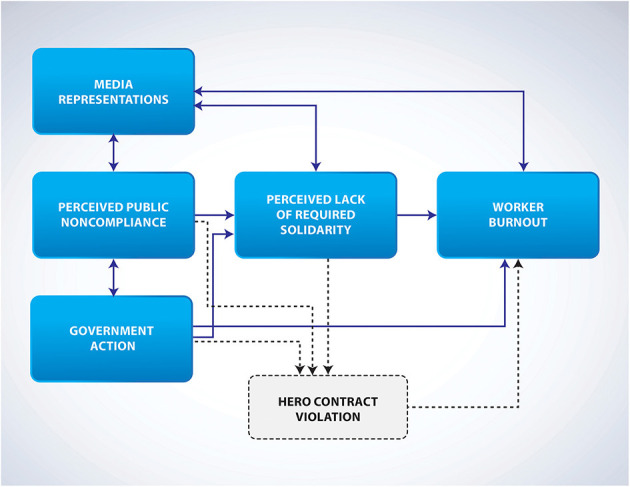
The context of Covid-19 has offered an unusual cultural landscape for examining how workers view their own position relative to others, and how individuals respond to prolonged exposure to workplace stress across different sectors and cultures. Through our recent work tracking the well-being of frontline workers in the UK and Ireland (the CV19 Heroes project), we have uncovered additional psychological factors that have not been accounted for in previous models of occupational stress or burnout. In recent months, frontline workers have worked to protect the community from the threat of SARS-CoV-2 and, simultaneously, have evaluated their perceptions of collective efforts of others as either congruent or incongruent with collective goals (e.g., lowered mortality and morbidity): we call this novel aspect . These frontline workers have been hailed as heroes, which we argue has led to the creation of an implicit psychological contract () between frontline workers and the public. Here, the heroes are willing to "go above and beyond" for the greater good, with the expectation that we (the public) do our part by adhering to public health guidelines. Where frontline workers perceive incongruence between the words and actions of others in working toward collective goals this drives negative affect and subsequent burnout. In this perspective article, we evaluate the cultural context of the pandemic in the UK and Ireland and suggest important socio-cultural factors that contribute to perceptions of solidarity, and how this may relate to burnout and worker welfare during and beyond the pandemic context.
新冠疫情的背景为研究员工如何看待自己相对于他人的地位,以及个人如何应对不同部门和文化背景下长期的工作场所压力提供了一个不同寻常的文化景观。通过我们最近追踪英国和爱尔兰一线工作者福祉的工作(CV19英雄项目),我们发现了一些先前职业压力或倦怠模型中未考虑到的额外心理因素。近几个月来,一线工作者努力保护社区免受SARS-CoV-2的威胁,同时,他们评估了自己对他人集体努力的看法,认为这些努力与集体目标(如降低死亡率和发病率)是一致还是不一致:我们将这一新方面称为 。这些一线工作者被誉为英雄,我们认为这导致了一线工作者与公众之间形成了一种隐性心理契约( )。在这里,英雄们愿意“超越职责”以实现更大的利益,期望我们(公众)通过遵守公共卫生指南尽自己的一份力量。当一线工作者察觉到他人在朝着集体目标努力时言行不一致,这会引发负面影响并导致随后的倦怠。在这篇观点文章中,我们评估了英国和爱尔兰疫情的文化背景,并提出了有助于形成团结感的重要社会文化因素,以及这在疫情期间及之后如何与倦怠和员工福祉相关联。