Animal and Human Health Program, International Livestock Research Institute, Nairobi, Kenya.
College of Agriculture and Veterinary Sciences, University of Nairobi, Nairobi, Kenya.
PLoS Negl Trop Dis. 2021 Jun 11;15(6):e0009470. doi: 10.1371/journal.pntd.0009470. eCollection 2021 Jun.
Taenia solium (T. solium), is a zoonotic helminth causing three diseases namely; taeniasis (in humans), neurocysticercosis (NCC, in humans) and porcine cysticercosis (PCC, in pigs) and is one of the major foodborne diseases by burden. The success or failure of control options against this parasite in terms of reduced prevalence or incidence of the diseases may be attributed to the contextual factors which underpin the design, implementation, and evaluation of control programmes.
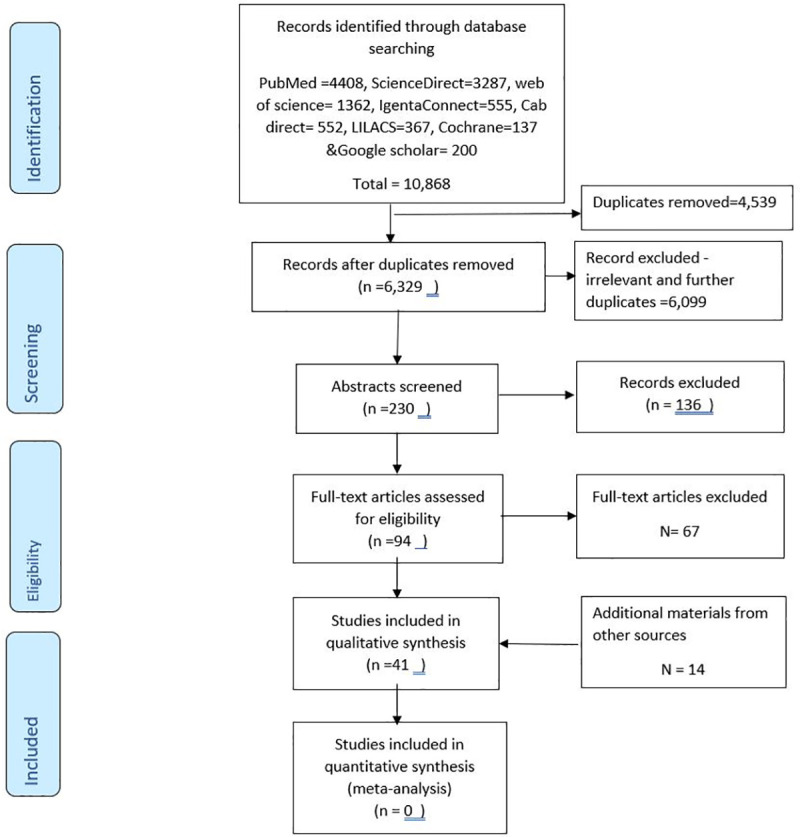
METHODOLOGY/PRINCIPAL FINDINGS: The study used a mixed method approach combining systematic literature review (SLR) and key informant interviews (KII). The SLR focused on studies which implemented T. solium control programmes and was used to identify the contextual factors and enabling environment relevant to successful inception, planning and implementation of the interventions. The SLR used a protocol pre-registered at the International prospective register of systematic reviews (PROSPERO) number CRD42019138107 and followed PRISMA guidelines on reporting of SLR. To further highlight the importance and interlinkage of these contextual factors, KII were conducted with researchers/implementers of the studies included in the SLR. The SLR identified 41 publications that had considerations of the contextual factors. They were grouped into efficacy (10), effectiveness (28) and scale up or implementation (3) research studies. The identified contextual factors included epidemiological, socioeconomic, cultural, geographical and environmental, service and organizational, historical and financial factors. The enabling environment was mainly defined by policy and strategies supporting T. solium control.
CONCLUSION/SIGNIFICANCE: Failure to consider the contextual factors operating in target study sites was shown to later present challenges in project implementation and evaluation that negatively affected expected outcomes. This study highlights the importance of fully considering the various domains of the context and integrating these explicitly into the plan for implementation and evaluation of control programmes. Explicit reporting of these aspects in the resultant publication is also important to guide future work. The contextual factors highlighted in this study may be useful to guide future research and scale up of disease control programmes and demonstrates the importance of close multi-sectoral collaboration in a One Health approach.
猪带绦虫(T. solium)是一种人畜共患的寄生虫,可引起三种疾病,即带绦虫病(在人类中)、脑囊虫病(在人类中)和猪囊虫病(在猪中),是主要的食源性疾病之一。控制该寄生虫的成功与否取决于降低疾病流行率或发病率的背景因素,这些因素是控制规划的设计、实施和评估的基础。
方法/主要发现:本研究采用混合方法,结合系统文献综述(SLR)和关键知情人访谈(KII)。SLR 侧重于实施猪带绦虫控制方案的研究,用于确定与干预措施的成功启动、规划和实施相关的背景因素和有利环境。SLR 使用在国际前瞻性系统评价注册库(PROSPERO)上预先注册的方案,编号为 CRD42019138107,并遵循 PRISMA 关于 SLR 报告的指南。为了进一步强调这些背景因素的重要性和相互关联性,对 SLR 中包含的研究的研究人员/实施者进行了 KII。SLR 确定了 41 篇考虑了背景因素的出版物。它们分为疗效(10)、效果(28)和扩大规模或实施(3)研究。确定的背景因素包括流行病学、社会经济、文化、地理和环境、服务和组织、历史和财务因素。有利环境主要由支持猪带绦虫控制的政策和战略定义。
结论/意义:未能考虑目标研究地点的背景因素会在项目实施和评估中造成挑战,从而对预期结果产生负面影响。本研究强调了充分考虑各个领域的背景因素并将其明确纳入控制方案的实施和评估计划的重要性。在研究结果的出版物中明确报告这些方面也很重要,可以为未来的工作提供指导。本研究强调的背景因素可能有助于指导未来的疾病控制研究和扩大规模,并展示了在“同一健康”方法中密切的多部门合作的重要性。