Koç University, School of Medicine, Department of Public Health, Istanbul, Turkey.
Koç University, School of Nursing, Department of Public Health, Istanbul, Turkey.
Clin Microbiol Infect. 2021 Sep;27(9):1242-1249. doi: 10.1016/j.cmi.2021.05.036. Epub 2021 Jun 8.
The prevalence of SARS-CoV-2 infection among health care workers (HCWs) provides information about the spread of COVID-19 within health care facilities, and the risk groups.
We aimed to describe the rate of SARS-CoV-2 seroprevalence and its determinants among HCWs.
We used Web of Science, PubMed, Scopus, MEDLINE, EBSCOhost and Cochrane Library.
We included the reports of SARS-CoV-2 seroprevalence with a sample size of minimum 1000 HCWs.
The study was registered at the International Prospective Register of Systematic Reviews (PROSPERO, no. CRD42021230456). We used PRISMA (Preferred Reporting Items for Systematic Reviews and Meta-Analyses) statement. The keywords were "COVID-19", "SARS-CoV-2", "Coronavirus", "seroprevalence", "health care workers" and "risk factors".
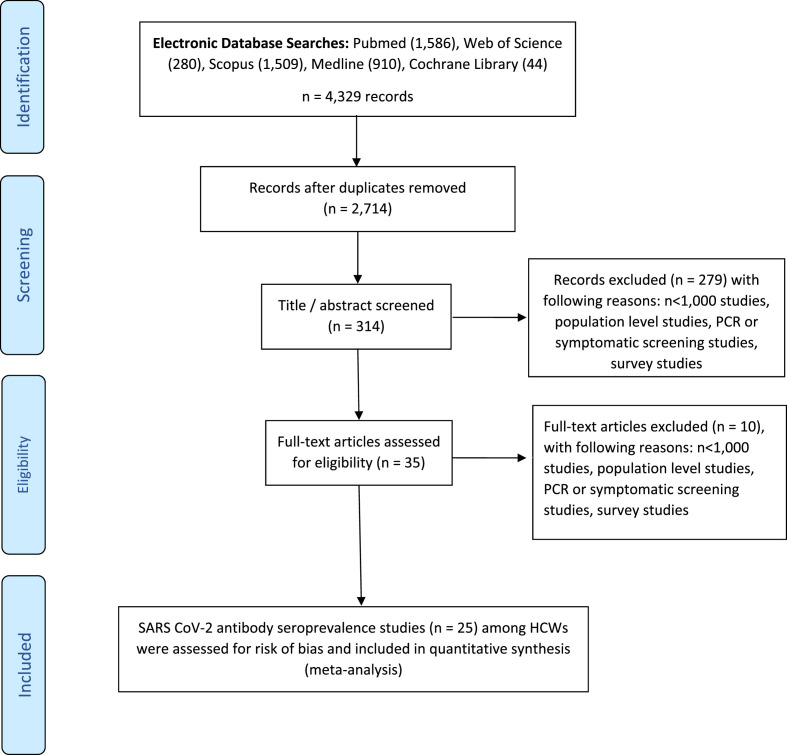
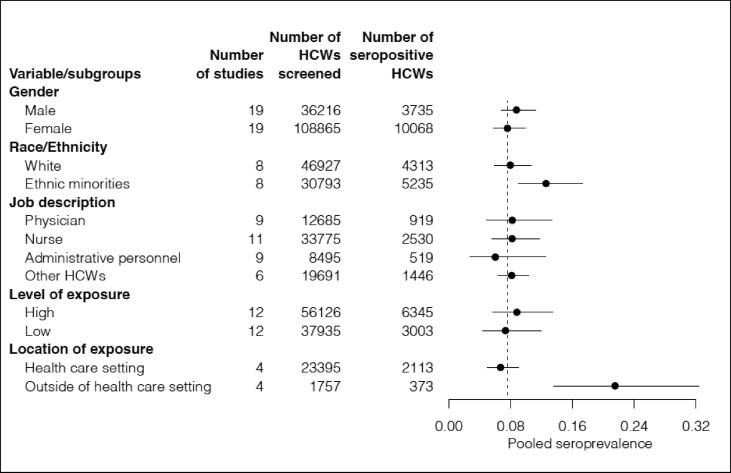
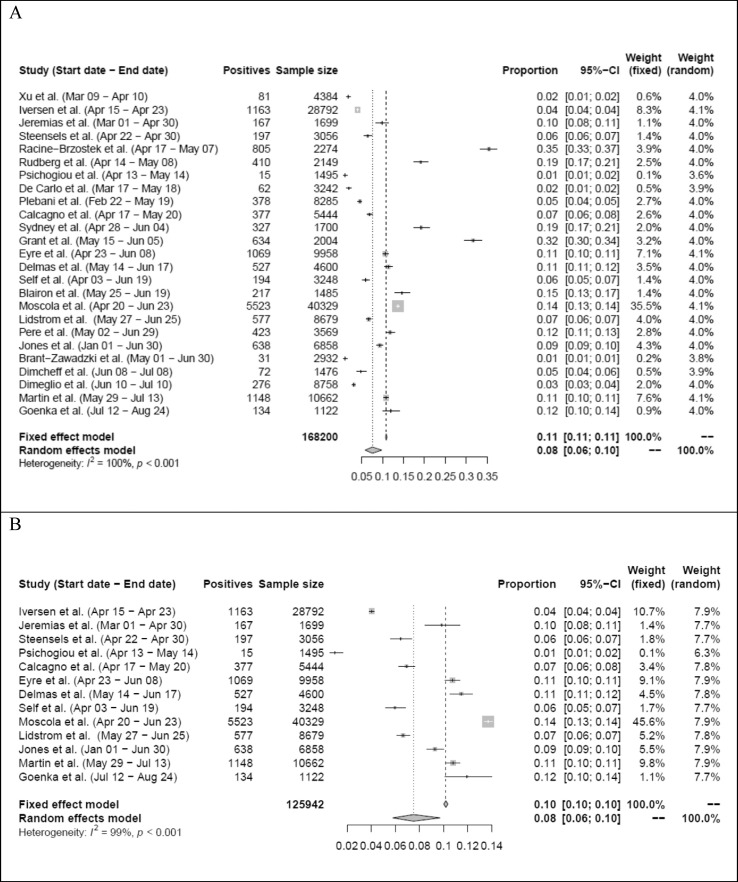
In total 4329 reports were retrieved, duplications were removed; after filtering according to the title and abstract, 25 studies were selected. Risk of bias was assessed in 25 studies; it was low in 13 studies, medium in four studies, and high in eight studies. In meta-analysis using the random effect model, the weighted average of seroprevalence was calculated as 8% (95% CI 6-10%). The pooled seroprevalence rates of the selected variables that have a rate above the average were male HCWs with 9% (95% CI 7-11%); HCWs from ethnic minorities with 13% (95% CI 9-17%); high exposure 9% (95% CI 6-13%); exposure to the virus outside the health care setting 22% (95% CI 14-32%).
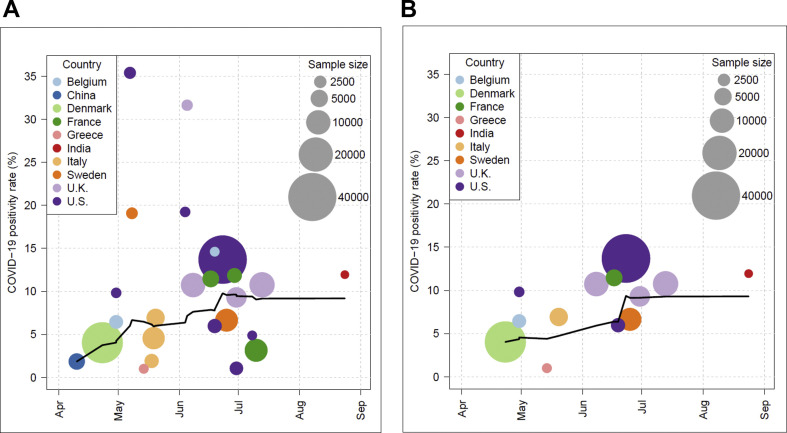
Our analysis indicates a SARS-CoV-2 seroprevalence rate of 8% among studies that included >1000 HCWs for the year 2020, before vaccinations started. The most common risk factors associated with higher seroprevalence rate were ethnicity, male gender and having a higher number of household contacts. Working as a frontline HCW was inconsistent in its association with higher seroprevalence.
医护人员(HCWs)中 SARS-CoV-2 感染的流行情况提供了有关 COVID-19 在医疗机构内传播和风险群体的信息。
我们旨在描述 HCWs 中 SARS-CoV-2 血清流行率及其决定因素。
我们使用了 Web of Science、PubMed、Scopus、MEDLINE、EBSCOhost 和 Cochrane Library。
我们纳入了 SARS-CoV-2 血清流行率报告,样本量最小为 1000 名 HCWs。
该研究在国际前瞻性系统评价注册库(PROSPERO,编号:CRD42021230456)中进行。我们使用 PRISMA(系统评价和荟萃分析的首选报告项目)声明。关键词为“COVID-19”、“SARS-CoV-2”、“冠状病毒”、“血清流行率”、“医护人员”和“危险因素”。
共检索到 4329 篇报告,剔除重复项;根据标题和摘要进行筛选后,选择了 25 项研究。25 项研究均进行了偏倚风险评估;其中 13 项研究的偏倚风险较低,4 项研究的偏倚风险为中等,8 项研究的偏倚风险较高。采用随机效应模型进行荟萃分析,计算出加权平均血清流行率为 8%(95%CI 6-10%)。选择的变量的汇总血清流行率高于平均值,包括男性 HCWs 的 9%(95%CI 7-11%);少数民族 HCWs 的 13%(95%CI 9-17%);高暴露率的 9%(95%CI 6-13%);在医疗机构外接触病毒的 22%(95%CI 14-32%)。
我们的分析表明,在接种疫苗之前的 2020 年,纳入了>1000 名 HCWs 的研究中,SARS-CoV-2 血清流行率为 8%。与较高血清流行率相关的最常见危险因素是种族、男性和更多的家庭接触者。作为一线 HCW 与较高的血清流行率之间的关联并不一致。