Department of Agricultural and Consumer Economics, University of Illinois at Urbana-Champaign, Urbana, IL, USA.
Department of Agricultural Economics and Rural Sociology, Auburn University, Auburn, AL, USA.
Sci Rep. 2021 Jun 11;11(1):12351. doi: 10.1038/s41598-021-91192-5.
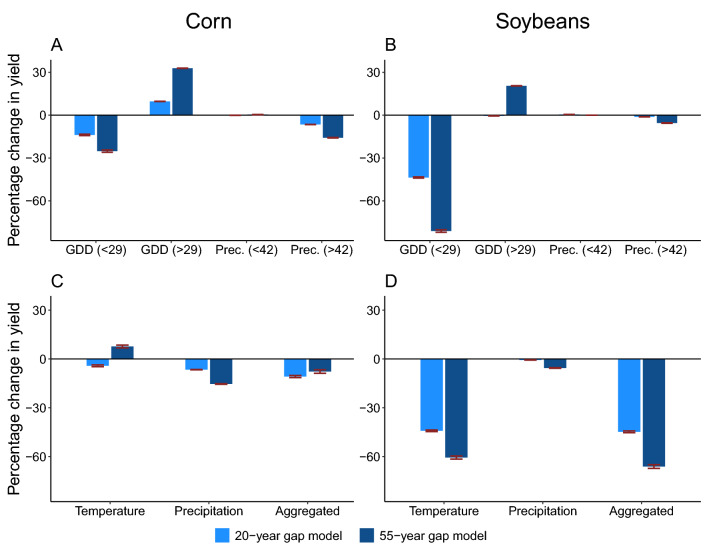
We quantify long-run adaptation of U.S. corn and soybean yields to changes in temperature and precipitation over 1951-2017. Results show that although the two crops became more heat- and drought-tolerant, their productivity under normal temperature and precipitation conditions decreased. Over 1951-2017, heat- and drought-tolerance increased corn and soybean yields by 33% and 20%, whereas maladaptation to normal conditions reduced yields by 41% and 87%, respectively, with large spatial variations in effects. Changes in climate are projected to reduce average corn and soybean yields by 39-68% and 86-92%, respectively, by 2050 relative to 2013-2017 depending on the warming scenario. After incorporating estimated effects of climate-neutral technological advances, the net change in yield ranges from (-)13 to 62% for corn and (-)57 to (-)26% for soybeans in 2050 relative to 2013-2017. Our analysis uncovers the inherent trade-offs and limitations of existing approaches to crop adaptation.
我们量化了 1951 年至 2017 年间美国玉米和大豆产量对温度和降水变化的长期适应性。结果表明,尽管这两种作物的耐热性和耐旱性都有所提高,但在正常温度和降水条件下,它们的生产力却有所下降。在 1951 年至 2017 年间,耐热性和耐旱性使玉米和大豆的产量分别提高了 33%和 20%,而对正常条件的不适应则使产量分别降低了 41%和 87%,其影响在空间上存在很大差异。根据变暖情景的不同,预计到 2050 年,与 2013-2017 年相比,气候变化将使玉米和大豆的平均产量分别减少 39%-68%和 86%-92%。在纳入估计的气候中性技术进步的影响后,与 2013-2017 年相比,2050 年玉米的产量净变化范围为(-)13%至 62%,大豆的产量净变化范围为(-)57%至(-)26%。我们的分析揭示了现有作物适应方法所固有的权衡和局限性。