You Xin-Yu, Zhang Han-Yu, Han Xu, Wang Fang, Zhuang Peng-Wei, Zhang Yan-Jun
Tianjin Key Laboratory of Chinese medicine Pharmacology, Tianjin University of Traditional Chinese Medicine, Tianjin, China.
State Key Laboratory of Component-based Chinese Medicine, Tianjin University of Traditional Chinese Medicine, Tianjin, China.
Front Pharmacol. 2021 May 31;12:659716. doi: 10.3389/fphar.2021.659716. eCollection 2021.
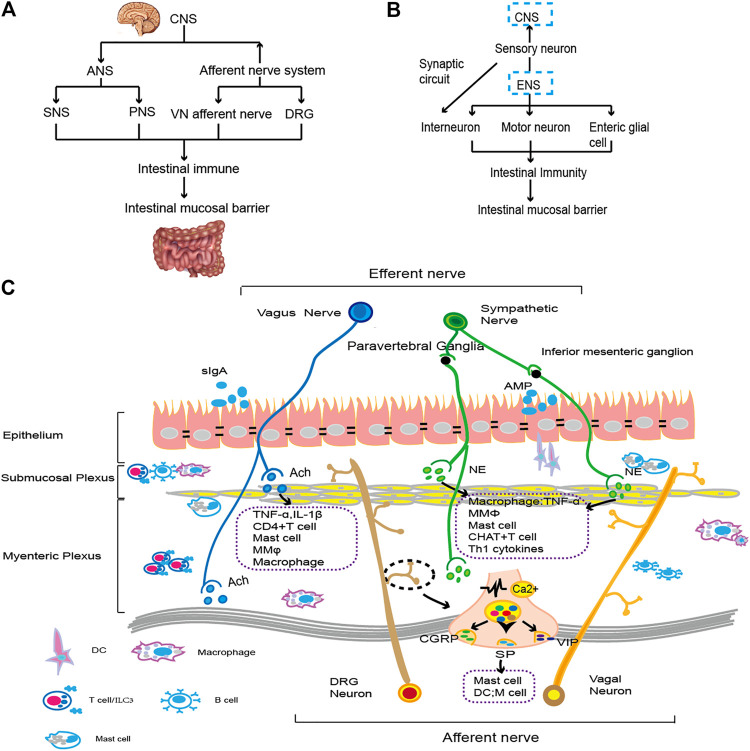
Inflammatory bowel disease, irritable bowel syndrome and severe central nervous system injury can lead to intestinal mucosal barrier damage, which can cause endotoxin/enterobacteria translocation to induce infection and is closely related to the progression of metabolic diseases, cardiovascular and cerebrovascular diseases, tumors and other diseases. Hence, repairing the intestinal barrier represents a potential therapeutic target for many diseases. Enteral afferent nerves, efferent nerves and the intrinsic enteric nervous system (ENS) play key roles in regulating intestinal physiological homeostasis and coping with acute stress. Furthermore, innervation actively regulates immunity and induces inherent and adaptive immune responses through complex processes, such as secreting neurotransmitters or hormones and regulating their corresponding receptors. In addition, intestinal microorganisms and their metabolites play a regulatory role in the intestinal mucosal barrier. This paper primarily discusses the interactions between norepinephrine and β-adrenergic receptors, cholinergic anti-inflammatory pathways, nociceptive receptors, complex ENS networks, gut microbes and various immune cells with their secreted cytokines to summarize the key roles in regulating intestinal inflammation and improving mucosal barrier function.
炎症性肠病、肠易激综合征和严重中枢神经系统损伤可导致肠黏膜屏障受损,进而引起内毒素/肠杆菌移位,诱发感染,且与代谢性疾病、心脑血管疾病、肿瘤等疾病的进展密切相关。因此,修复肠道屏障是许多疾病潜在的治疗靶点。肠传入神经、传出神经和固有肠神经系统(ENS)在调节肠道生理稳态和应对急性应激方面发挥着关键作用。此外,神经支配通过分泌神经递质或激素以及调节其相应受体等复杂过程,积极调节免疫并诱导固有免疫和适应性免疫反应。此外,肠道微生物及其代谢产物对肠黏膜屏障起调节作用。本文主要探讨去甲肾上腺素与β-肾上腺素能受体、胆碱能抗炎途径、伤害性感受器、复杂的肠神经系统网络、肠道微生物以及各种免疫细胞与其分泌的细胞因子之间的相互作用,以总结它们在调节肠道炎症和改善黏膜屏障功能中的关键作用。