Zhao Qiuzi, Du Ping, Wang Xiaoyong, Huang Mengqian, Sun Ling-Dong, Wang Tao, Wang Zhiyun
School of Life Sciences, Tianjin University, 92 Weijin Road, Nankai District, Tianjin 300072, China.
Beijing National Laboratory for Molecular Sciences, State Key Laboratory of Rare Earth Materials Chemistry and Applications, PKU-HKU Joint Laboratory in Rare Earth Materials and Bioinorganic Chemistry, College of Chemistry and Molecular Engineering, Peking University, 202 Chengfu Road, Haidian District, Beijing 100871, China.
ACS Omega. 2021 Jun 4;6(23):15236-15245. doi: 10.1021/acsomega.1c01491. eCollection 2021 Jun 15.
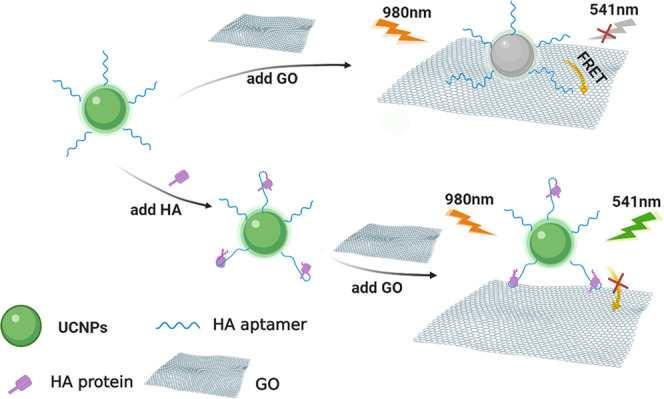
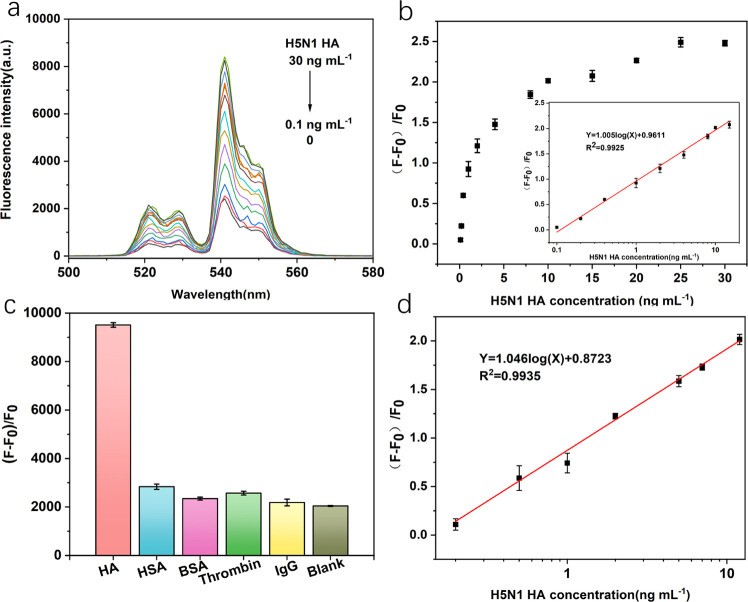
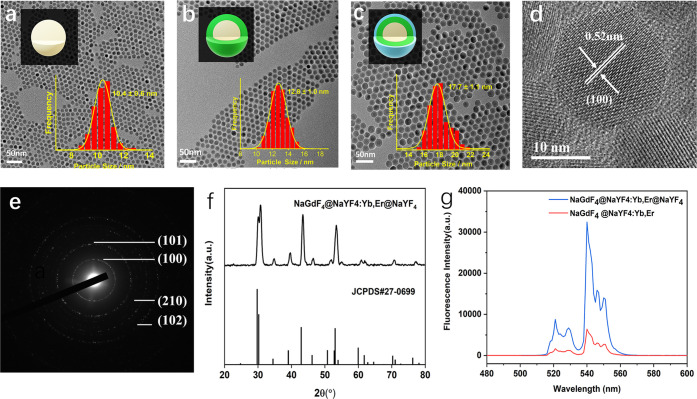
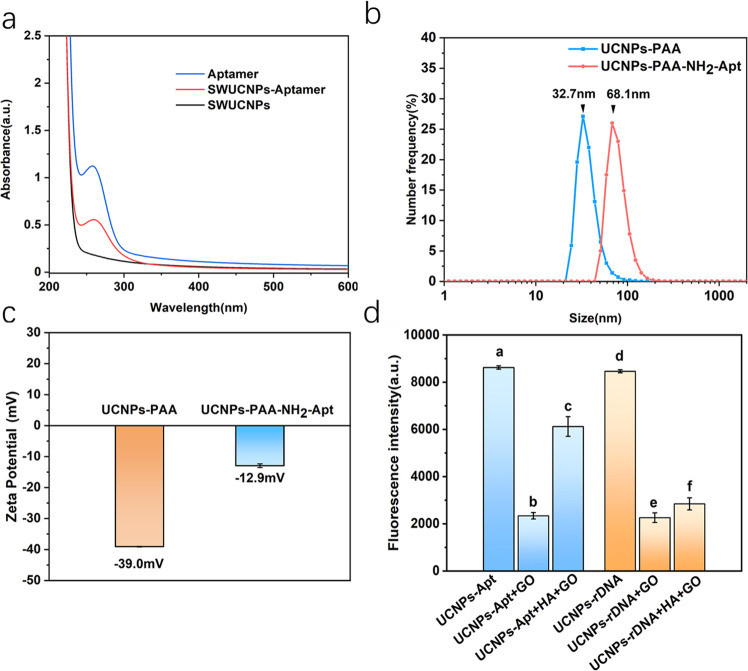
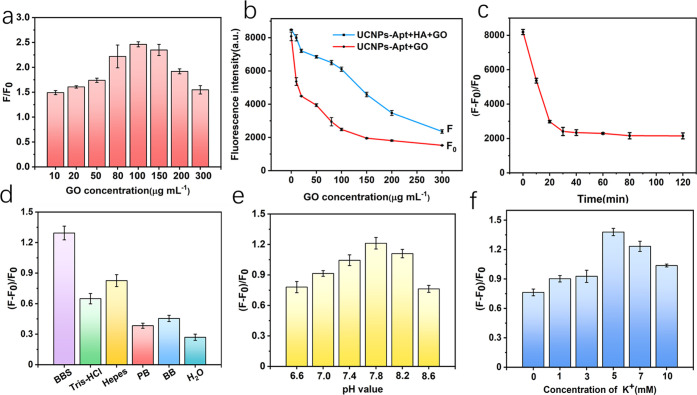
Influenza A virus (IAV) poses a significant threat to human health, which calls for the development of efficient detection methods. The present study constructed a fluorescence resonance energy transfer (FRET) system based on novel fluorescent probes and graphene oxide (GO) for detecting H5N1 IAV hemagglutinin (HA). Here, we synthesized small (sub-20 nm) sandwich-structured upconversion nanoparticles (UCNPs) (SWUCNPs for short) with a high energy transfer efficiency, which allows for controlling the emitter in a thin shell. The π-π stacking interaction between the aptamer and GO shortens the distance between the fluorescent probe and the receptor, thereby realizing fluorescence resonance energy transfer (FRET). When HA is present, the aptamer enables changes in their conformations and move away from GO surface. Fluorescence signals display a linear relationship between HA quantitation in the range of 0.1-15 ng mL and a limit of detection (LOD) of 60.9 pg mL. The aptasensor was also applicable in human serum samples with a linear range from 0.2 to 12 ng mL and a limit of detection of 114.7 pg mL. This strategy suggested the promising prospect of the aptasensor in clinical applications because of the excellent sensing performance and sensitivity. This strategy may be promising for vitro diagnostics and provides new insights into the functioning of the SWUCNPs system.
甲型流感病毒(IAV)对人类健康构成重大威胁,这就需要开发高效的检测方法。本研究构建了一种基于新型荧光探针和氧化石墨烯(GO)的荧光共振能量转移(FRET)系统,用于检测H5N1 IAV血凝素(HA)。在此,我们合成了具有高能量转移效率的小尺寸(小于20 nm)夹心结构上转换纳米颗粒(简称为SWUCNPs),其能够在薄壳中控制发射体。适体与GO之间的π-π堆积相互作用缩短了荧光探针与受体之间的距离,从而实现荧光共振能量转移(FRET)。当存在HA时,适体使其构象发生变化并从GO表面移开。荧光信号在0.1 - 15 ng/mL的HA定量范围内呈现线性关系,检测限(LOD)为60.9 pg/mL。该适体传感器也适用于人血清样本,线性范围为0.2至12 ng/mL,检测限为114.7 pg/mL。由于其优异的传感性能和灵敏度,该策略表明适体传感器在临床应用中具有广阔前景。该策略可能在体外诊断方面具有前景,并为SWUCNPs系统的功能提供了新的见解。