Postolache Teodor T, Wadhawan Abhishek, Rujescu Dan, Hoisington Andrew J, Dagdag Aline, Baca-Garcia Enrique, Lowry Christopher A, Okusaga Olaoluwa O, Brenner Lisa A
Department of Psychiatry, Mood and Anxiety Program, University of Maryland School of Medicine, Baltimore, MD, United States.
Veterans Health Administration, Rocky Mountain Mental Illness Research Education and Clinical Center (MIRECC), Military and Veteran Microbiome: Consortium for Research and Education (MVM-CoRE), Aurora, CO, United States.
Front Psychiatry. 2021 Jun 11;12:665682. doi: 10.3389/fpsyt.2021.665682. eCollection 2021.
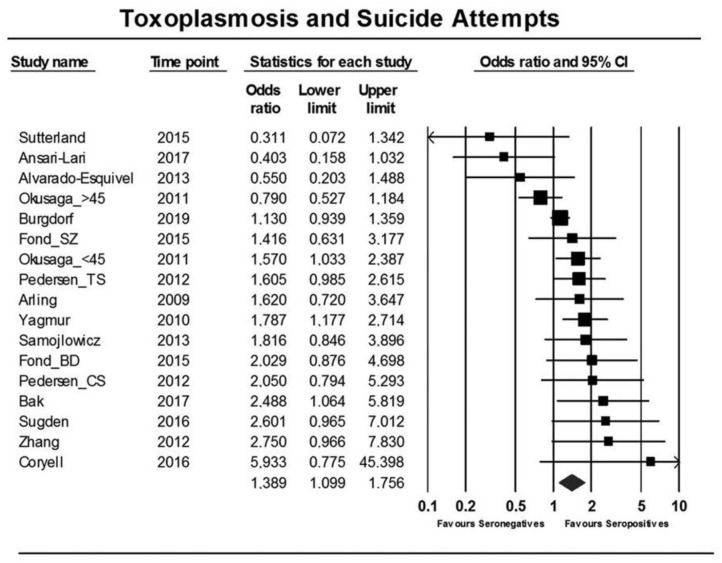
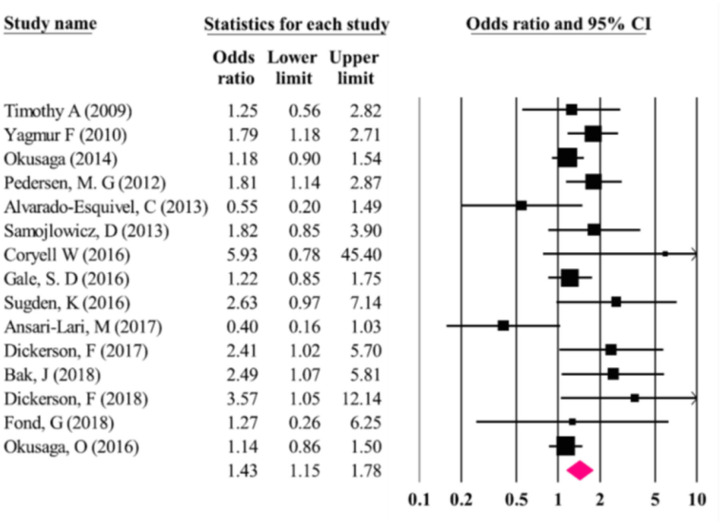
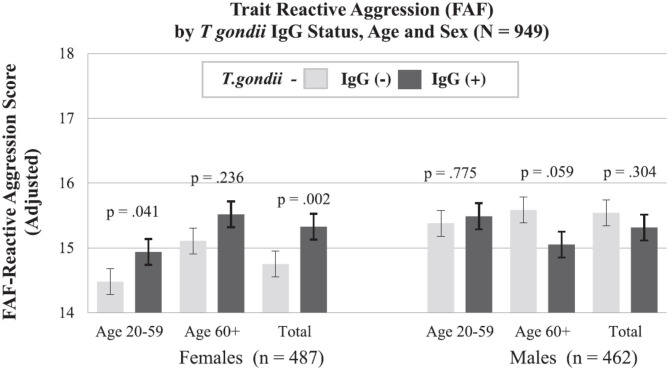
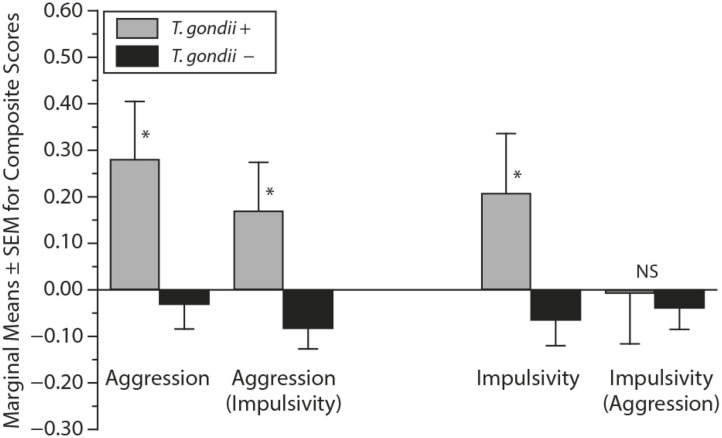
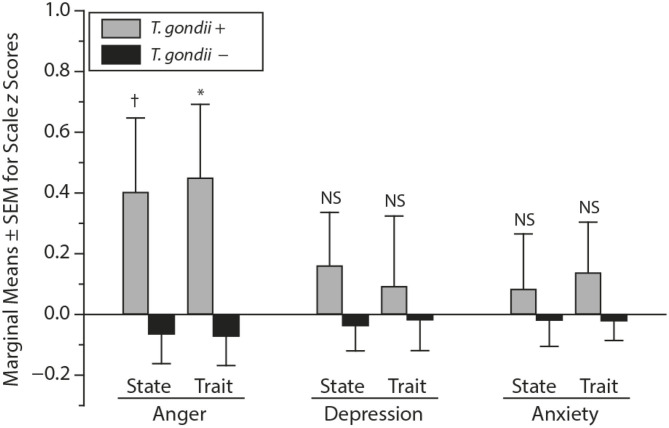
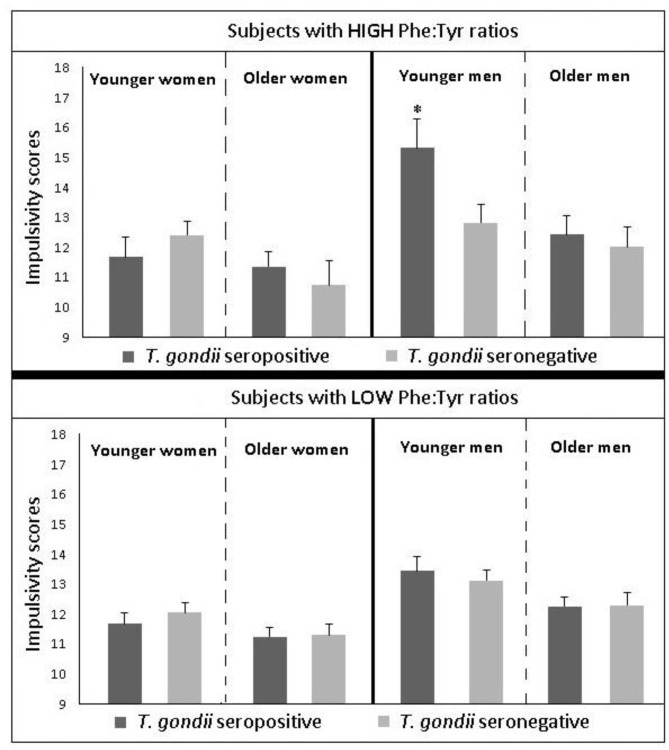
Within the general literature on infections and suicidal behavior, studies on () occupy a central position. This is related to the parasite's neurotropism, high prevalence of chronic infection, as well as specific and non-specific behavioral alterations in rodents that lead to increased risk taking, which are recapitulated in humans by associations with suicidal behavior, as well as trait impulsivity and aggression, mental illness and traffic accidents. This paper is a detailed review of the associations between serology and suicidal behavior, a field of study that started 15 years ago with our publication of associations between IgG serology and suicidal behavior in persons with mood disorders. This "legacy" article presents, chronologically, our primary studies in individuals with mood disorders and schizophrenia in Germany, recent attempters in Sweden, and in a large cohort of mothers in Denmark. Then, it reviews findings from all three meta-analyses published to date, confirming our reported associations and overall consistent in effect size [ranging between 39 and 57% elevation of odds of suicide attempt in immunoglobulin (IgG) positives]. Finally, the article introduces certain links between and biomarkers previously associated with suicidal behavior (kynurenines, phenylalanine/tyrosine), intermediate phenotypes of suicidal behavior (impulsivity, aggression) and state-dependent suicide risk factors (hopelessness/dysphoria, sleep impairment). In sum, an abundance of evidence supports a positive link between suicide attempts (but not suicidal ideation) and IgG (but not IgM) seropositivity and serointensity. Trait impulsivity and aggression, endophenotypes of suicidal behavior have also been positively associated with seropositivity in both the psychiatrically healthy as well as in patients with Intermittent Explosive Disorder. Yet, causality has not been demonstrated. Thus, randomized interventional studies are necessary to advance causal inferences and, if causality is confirmed, to provide hope that an etiological treatment for a distinct subgroup of individuals at an increased risk for suicide could emerge.
在关于感染与自杀行为的一般文献中,对()的研究占据核心地位。这与该寄生虫的嗜神经性、慢性感染的高患病率以及啮齿动物中导致冒险行为增加的特定和非特定行为改变有关,这些改变在人类中通过与自杀行为、特质冲动性和攻击性、精神疾病以及交通事故的关联而重现。本文是对()血清学与自杀行为之间关联的详细综述,该研究领域始于15年前我们发表的关于情绪障碍患者中()IgG血清学与自杀行为之间的关联。这篇“经典”文章按时间顺序呈现了我们在德国对情绪障碍和精神分裂症个体、瑞典近期有自杀企图者以及丹麦一大群母亲的主要研究。然后,它回顾了迄今为止发表的所有三项荟萃分析的结果,证实了我们报告的关联,并且在效应大小方面总体一致[免疫球蛋白(IgG)阳性者自杀企图的几率升高39%至57%]。最后,文章介绍了()与先前与自杀行为相关的生物标志物(犬尿氨酸、苯丙氨酸/酪氨酸)、自杀行为的中间表型(冲动性、攻击性)以及状态依赖性自杀风险因素(绝望/烦躁、睡眠障碍)之间的某些联系。总之,大量证据支持自杀企图(而非自杀意念)与()IgG(而非IgM)血清阳性和血清强度之间存在正相关。特质冲动性和攻击性,即自杀行为的内表型,在精神健康者以及间歇性爆发障碍患者中也与()血清阳性呈正相关。然而,因果关系尚未得到证实。因此,需要进行随机干预研究以推进因果推断,如果因果关系得到证实,则有望为自杀风险增加的特定亚组个体出现病因性治疗方法。