Savahl Shazly, Casas Ferran, Adams Sabirah
Centre for Interdisciplinary Studies of Children, Families and Society, University of The Western Cape, Cape Town, South Africa.
Research Institute on Quality of Life, University of Girona, Girona, Spain.
Front Psychol. 2021 Jun 11;12:650691. doi: 10.3389/fpsyg.2021.650691. eCollection 2021.
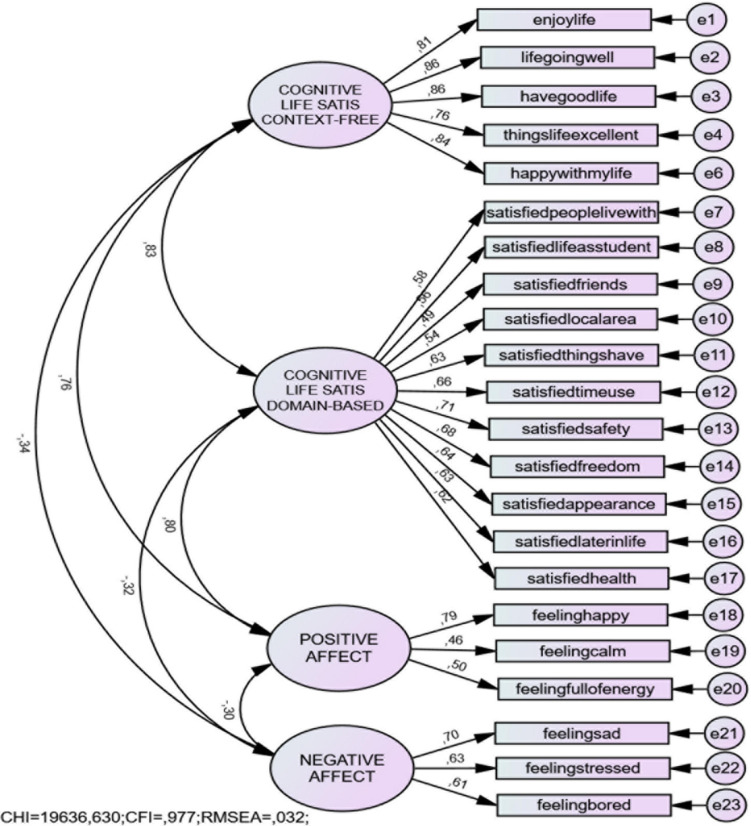
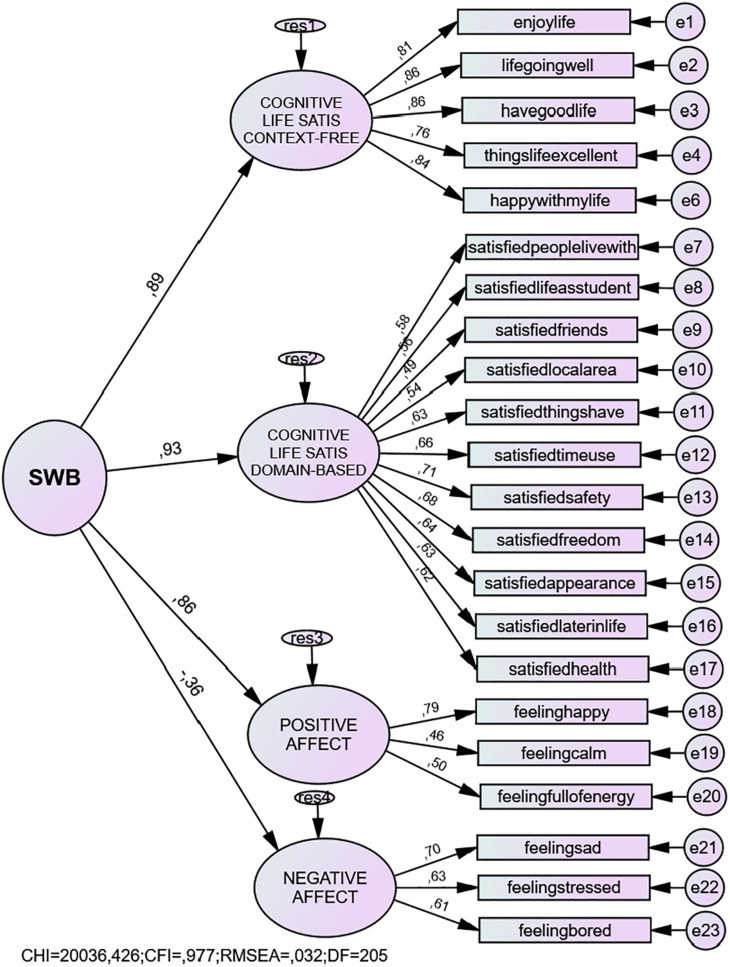
Research on children's quality of life and subjective well-being has advanced over the past decade largely as a result of developments in childhood theory, children's rights legislation, and the shift toward positive social science. However, in line with the uncertainty regarding the conceptualization of subjective well-being, the structural configuration of children's subjective well-being has not been considered in the literature. In the current study, we present and test a model of children's subjective well-being, which includes global (context-free items assessing overall and general well-being, without reference to a specific aspect of life) and specific (domain-based items assessing a specific aspect of life) cognitive components, and positive and negative affect. We further test the fit structure of a hierarchical structural (second-order) model of children's subjective well-being. Finally, we test the measurement invariance of the hierarchical model across age and gender. We use data from the third Wave of the Children's Worlds Survey. The data source includes a sample of 92,782 participants selected from 35 countries (girls = 49.7%) in two age groups (10- and 12-years-old). We found a good fit for the four-factor confirmatory factor model of children's subjective well-being. Correlations between the various latent factors were as anticipated-with positive correlations between the life satisfaction components and positive affect, and negative correlations with negative affect. We further found a good fit for the hierarchical structural model of children's subjective well-being. Finally, we found the tenability of measurement invariance across age and gender. The study extends the generalizability of the hierarchical structural configuration of the subjective well-being to child samples, and provides a viable model to explore correlates and predictors of children's subjective well-being using the full conceptual model. Finally, we propound the tenability of a quadripartite hierarchical conceptual model of children's subjective well-being.
在过去十年中,儿童生活质量和主观幸福感的研究取得了进展,这主要得益于儿童理论、儿童权利立法的发展以及向积极社会科学的转变。然而,鉴于主观幸福感概念化的不确定性,文献中尚未考虑儿童主观幸福感的结构配置。在本研究中,我们提出并检验了一个儿童主观幸福感模型,该模型包括整体(无背景项目,评估总体和一般幸福感,不涉及生活的特定方面)和特定(基于领域的项目,评估生活的特定方面)认知成分,以及积极和消极情绪。我们进一步检验了儿童主观幸福感层次结构(二阶)模型的拟合结构。最后,我们检验了该层次模型在年龄和性别上的测量不变性。我们使用了儿童世界调查第三波的数据。数据源包括从35个国家选取的92782名参与者的样本(女孩占49.7%),分为两个年龄组(10岁和12岁)。我们发现儿童主观幸福感的四因素验证性因素模型拟合良好。各潜在因素之间的相关性符合预期——生活满意度成分与积极情绪呈正相关,与消极情绪呈负相关。我们还发现儿童主观幸福感的层次结构模型拟合良好。最后,我们发现该模型在年龄和性别上具有测量不变性。该研究将主观幸福感层次结构配置的可推广性扩展到儿童样本,并提供了一个可行的模型,以使用完整的概念模型探索儿童主观幸福感的相关因素和预测因素。最后,我们提出了儿童主观幸福感四方层次概念模型的合理性。