Department of Chemistry, Key Laboratory of Bioorganic Phosphorus Chemistry & Chemical Biology, Tsinghua University, Beijing, 100084, P. R. China.
State Key Laboratory of Food Science and Technology, International Joint Laboratory on Food Safety, Jiangnan University, Wuxi, 214122, China.
Adv Sci (Weinh). 2021 Sep;8(17):e2004381. doi: 10.1002/advs.202004381. Epub 2021 Jul 1.
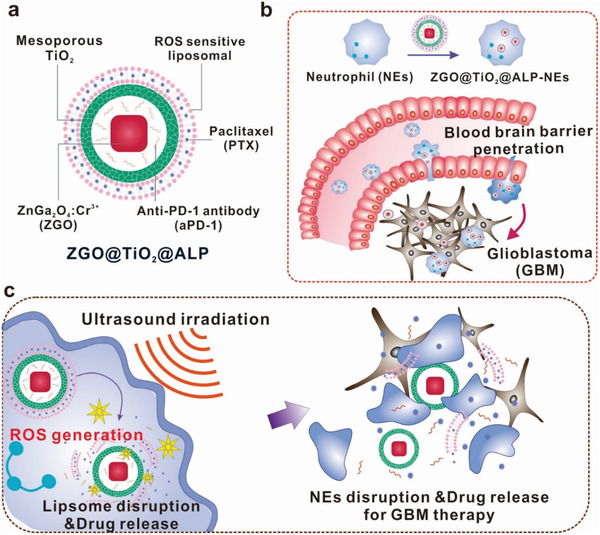
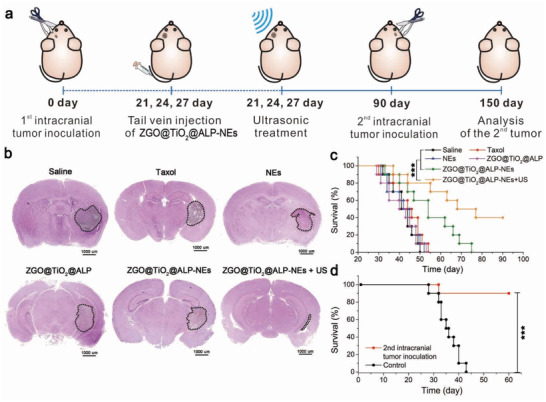
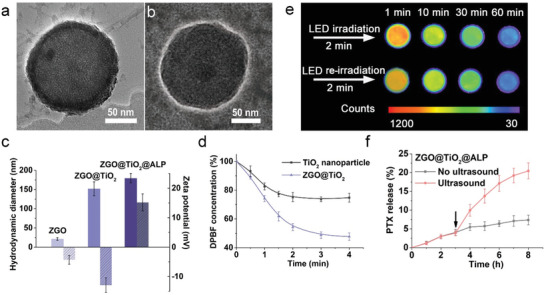
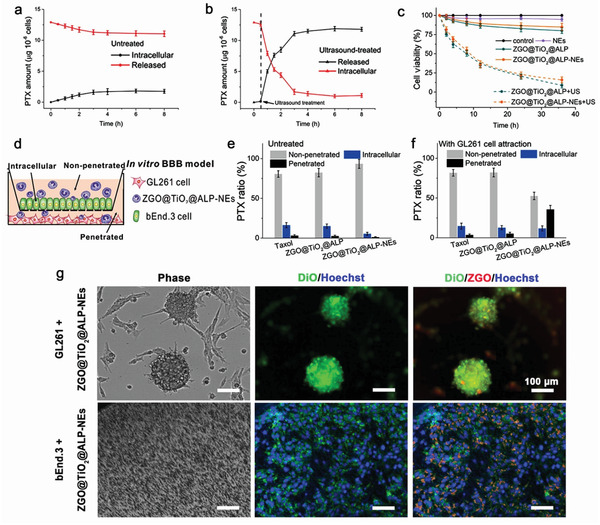
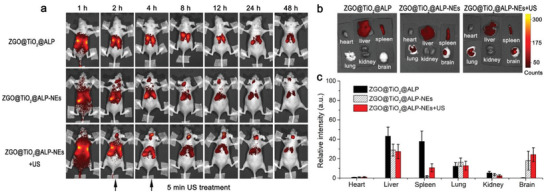
Glioblastoma (GBM) is the most malignant brain tumor with unmet therapeutic demand. The blood-brain-barrier (BBB) and tumor heterogeneity limit the treatment effectiveness of various interventions. Here, an ultrasound augmented chemo/immuno therapy for GBM using a neutrophil-delivered nanosensitizer, is developed. The sensitizer is composed of a ZnGa O :Cr (ZGO) core for persistent luminescence imaging and a hollow sono-sensitive TiO shell to generate reactive oxygen species (ROS) for controlled drug release. Immune checkpoint inhibitor (Anti-PD-1 antibody) is trapped in the interior of the porous ZGO@TiO with paclitaxel (PTX) loaded liposome encapsulation to form ZGO@TiO @ALP. Delivered by neutrophils (NEs), ZGO@TiO @ALP-NEs can penetrate through BBB for GBM accumulation. After intravenous injection, ultrasound irradiation at GBM sites initiates ROS generation from ZGO@TiO @ALP, leading to liposome destruction for PTX and anti-PD-1 antibody release to kill tumors and induce local inflammation, which in-turn attractes more ZGO@TiO @ALP-NEs to migrate into tumor sites for augmented and sustained therapy. The treatment enhances the survival rate of the GBM bearing mice from 0% to 40% and endows them with long-term immuno-surveillance for tumor recurrence, providing a new approach for precision therapy against GBM and other cancers.
胶质母细胞瘤(GBM)是最恶性的脑肿瘤,存在未满足的治疗需求。血脑屏障(BBB)和肿瘤异质性限制了各种干预措施的治疗效果。在这里,开发了一种使用中性粒细胞递送的纳米敏化剂增强超声的胶质母细胞瘤化学/免疫治疗方法。敏化剂由用于持续发光成像的 ZnGa O:Cr(ZGO)核和用于生成用于控制药物释放的活性氧物质(ROS)的中空声敏 TiO 壳组成。免疫检查点抑制剂(抗 PD-1 抗体)被困在具有紫杉醇(PTX)负载脂质体包封的多孔 ZGO@TiO 的内部,形成 ZGO@TiO@ALP。由中性粒细胞(NEs)递送,ZGO@TiO@ALP-NE 可以穿透 BBB 积累 GBM。静脉注射后,GBM 部位的超声辐射从 ZGO@TiO@ALP 中引发 ROS 生成,导致脂质体破坏以释放 PTX 和抗 PD-1 抗体来杀死肿瘤并诱导局部炎症,从而吸引更多的 ZGO@TiO@ALP-NE 迁移到肿瘤部位以增强和持续治疗。该治疗方法将荷瘤小鼠的存活率从 0%提高到 40%,并赋予它们对肿瘤复发的长期免疫监视,为针对 GBM 和其他癌症的精准治疗提供了一种新方法。