Saltykov Yuri V, Kolosova Anna A, Filonova Nadezhda N, Chichkin Alexander N, Feodorova Valentina A
Laboratory for Molecular Biology and NanoBiotechnology, Federal Research Center for Virology and Microbiology, Branch in Saratov, 410028 Saratov, Russia.
Pathogens. 2021 Jun 7;10(6):716. doi: 10.3390/pathogens10060716.
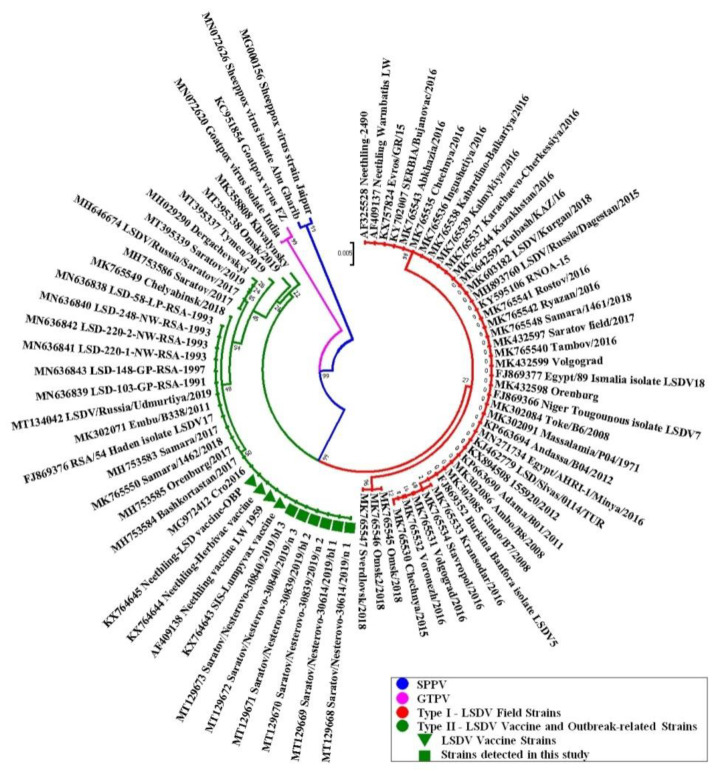
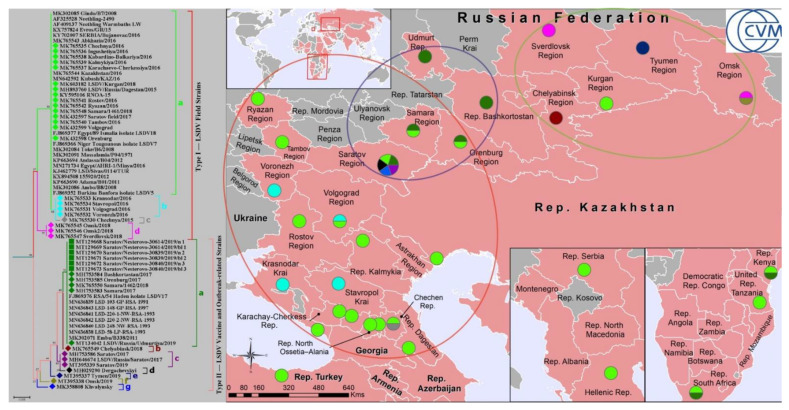
Lumpy skin disease virus (LSDV) is the causative agent of lumpy skin disease (LSD) that has been recently reported in the South-East and North Asian parts of the Russian Federation. During 2017-2019, there were more than 30 LSD outbreaks in Saratov Region despite active inoculation of cattle with heterologous vaccine. Importantly, the first case of the novel recombinant LSDV strain was reported here in 2017. This study aimed to determine the main clonal lineage(s) of LSDV strains circulated within Saratov Region and other regions of Russia since the first introduction of LSDV. The molecular typing and subtyping based on the coding regions of the G-protein-coupled chemokine receptor (GPCR) gene resulted in a discrimination of all outbreak-related LSDV strains into two main types, such as Type I and Type II, and subtypes Ia-d and IIa-g. Phylogenetically, eleven LSDV lineages were revealed in Russia including the five ones in Saratov Region. They were the following: (i) the Neethling wild Type Ia/2017; (ii) the recombinant Saratov IIc/2017/2019; (iii) the specific Dergachevskyi IId/2017; (iv) the Khvalynsky IIg/2018, and (v) the Haden-Type IIa lineage for the six LSDV strains detected in cattle immunized with heterologous vaccine during the last LSD outbreak in the Saratov Region, Nesterovo Village, in 2019 (Nesterovo-2019 strains). A single LSDV strain detected in Saratov Region in 2017 had the same Type Ia that was identified in 2016 in the bordered Republic of Kazakhstan. Phylogeographic analysis demonstrated three nominal clusters of LSDV types in the following Russian Federation territories: (I) the Central European part; (II) the South-East of the European part; (III) the North Asian part. Cluster I was represented by mainly Type I strains, while both Clusters 2 and 3 contained predominantly Type II strains. The Clusters I and II partially overlapped, while Cluster 3 was separate. Multiple introductions of LSDV into Saratov Region in 2017-2019 using GPCR-based molecular typing and subtyping were revealed. This scheme is a promising tool for molecular discrimination of LSDV strains derived from both vaccinated and unvaccinated against LSD cattle as well as for molecular epidemiology.
结节性皮肤病病毒(LSDV)是结节性皮肤病(LSD)的病原体,最近在俄罗斯联邦的东南亚和北亚地区有相关报道。在2017 - 2019年期间,尽管对牛群积极接种了异源疫苗,但萨拉托夫地区仍发生了30多起LSD疫情。重要的是,2017年在此报道了首例新型重组LSDV毒株。本研究旨在确定自LSDV首次传入以来,在萨拉托夫地区和俄罗斯其他地区传播的LSDV毒株的主要克隆谱系。基于G蛋白偶联趋化因子受体(GPCR)基因编码区的分子分型和亚型分析,可将所有与疫情相关的LSDV毒株分为两种主要类型,即I型和II型,以及亚型Ia - d和IIa - g。在系统发育上,俄罗斯发现了11个LSDV谱系,其中包括萨拉托夫地区的5个。它们分别是:(i)内斯林野生型Ia/2017;(ii)重组的萨拉托夫IIc/2017/2019;(iii)特定的杰尔加乔夫斯基IId/2017;(iv)赫瓦林斯克IIg/2018,以及(v)2019年萨拉托夫地区内斯捷罗沃村(内斯捷罗沃 - 2019毒株)最后一次LSD疫情期间,在接种了异源疫苗的牛中检测到的6株LSDV毒株的哈登IIa型谱系。2017年在萨拉托夫地区检测到的一株LSDV毒株与2016年在接壤的哈萨克斯坦共和国鉴定出的Ia型相同。系统地理学分析表明,在俄罗斯联邦以下地区存在LSDV类型的三个名义集群:(I)中欧部分;(II)欧洲部分东南部;(III)北亚部分。集群I主要由I型毒株代表,而集群2和3主要包含II型毒株。集群I和II部分重叠,而集群3是独立的。利用基于GPCR的分子分型和亚型分析揭示了2017 - 2019年LSDV多次传入萨拉托夫地区的情况。该方案是一种有前景的工具,可用于对来自接种和未接种LSD疫苗的牛的LSDV毒株进行分子鉴别以及分子流行病学研究。