Júnior Dario Mendes, Hausen Moema A, Asami Jéssica, Higa Akemi M, Leite Fabio L, Mambrini Giovanni P, Rossi Andre L, Komatsu Daniel, Duek Eliana A de Rezende
Faculty of Medical Sciences and Health, Pontifical Catholic University of São Paulo (PUC/SP), São Paulo 18030-070, Brazil.
Faculty of Mechanical Engineering, State University of Campinas (UNICAMP), São Paulo 13083-860, Brazil.
Antibiotics (Basel). 2021 Jun 19;10(6):742. doi: 10.3390/antibiotics10060742.
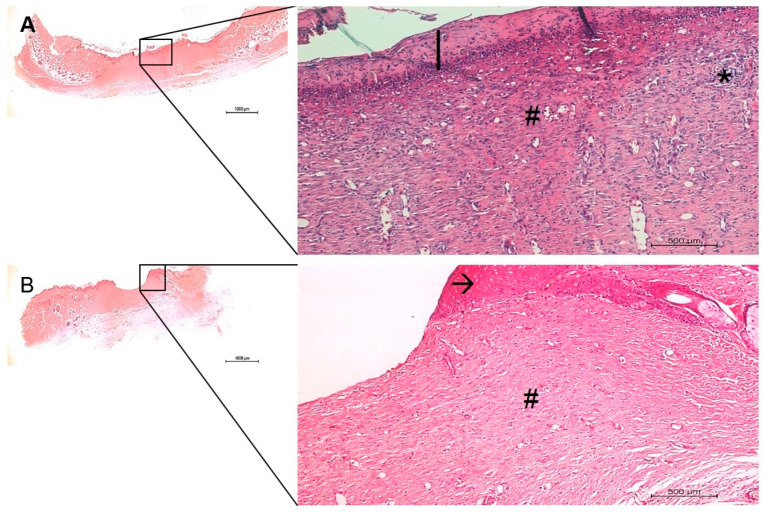
The experimental use of poly (alcohol-vinyl) (PVA) as a skin curative is increasing widely. However, the use of this hydrogel is challenging due to its favorable properties for microbiota growth. The association with silver nanoparticles (AgNPs) as an antimicrobial agent turns the match for PVA as a dressing, as it focuses on creating a physical barrier to avoid wound dehydration. When associated with extracellular components, such as the collagen matrix, the device obtained can create the desired biological conditions to act as a skin substitute. This study aimed to analyze the anti-microbiological activity and the in vitro and in vivo responses of a bilaminar device of PVA containing AgNPs associated with a membrane of collagen-hyaluronic acid (col-HA). Additionally, mesenchymal stem cells were cultured in the device to evaluate in vitro responses and in vivo immunomodulatory and healing behavior. The device morphology revealed a porous pattern that favored water retention and in vitro cell adhesion. Controlled wounds in the dorsal back of rat skins revealed a striking skin remodeling with new epidermis fulfilling all previously injured areas after 14 and 28 days. No infections or significant inflammations were observed, despite increased angiogenesis, and no fibrosis-markers were identified as compared to controls. Although few antibacterial activities were obtained, the addition of AgNPs prevented fungal growth. All results demonstrated that the combination of the components used here as a dermal device, chosen according to previous miscellany studies of low/mid-cost biomaterials, can promote skin protection avoiding infections and dehydration, minimize the typical wound inflammatory responses, and favor the cellular healing responses, features that give rise to further clinical trials of the device here developed.
聚(醇 - 乙烯基)(PVA)作为皮肤治疗剂的实验性应用正在广泛增加。然而,由于这种水凝胶对微生物群生长具有有利特性,其使用具有挑战性。与作为抗菌剂的银纳米颗粒(AgNPs)结合,使PVA成为一种合适的敷料,因为它专注于创建物理屏障以避免伤口脱水。当与细胞外成分(如胶原蛋白基质)结合时,所获得的装置可以创造出所需的生物学条件以充当皮肤替代物。本研究旨在分析一种包含与胶原蛋白 - 透明质酸(col - HA)膜结合的AgNPs的PVA双层装置的抗微生物活性以及体外和体内反应。此外,在该装置中培养间充质干细胞以评估体外反应以及体内免疫调节和愈合行为。该装置的形态显示出一种有利于保水和体外细胞粘附的多孔模式。大鼠背部皮肤的可控伤口显示出显著的皮肤重塑,在14天和28天后新表皮覆盖了所有先前受伤的区域。尽管血管生成增加,但未观察到感染或明显炎症,与对照组相比未发现纤维化标记物。尽管获得的抗菌活性很少,但添加AgNPs可防止真菌生长。所有结果表明,根据先前对低成本/中等成本生物材料的综合研究选择的此处用作真皮装置的成分组合,可以促进皮肤保护,避免感染和脱水,最大限度地减少典型的伤口炎症反应,并有利于细胞愈合反应,这些特性促使对这里开发的装置进行进一步的临床试验。