Marincu Iosif, Bratosin Felix, Vidican Iulia, Bostanaru Andra-Cristina, Frent Stefan, Cerbu Bianca, Turaiche Mirela, Tirnea Livius, Timircan Madalina
Department of Infectious Diseases, "Victor Babes" University of Medicine and Pharmacy, 300041 Timisoara, Romania.
Laboratory of Antimicrobial Chemotherapy, "Ion Ionescu de la Brad" University of Agricultural Sciences and Veterinary Medicine of Iasi, 700490 Iasi, Romania.
J Clin Med. 2021 Jun 16;10(12):2652. doi: 10.3390/jcm10122652.
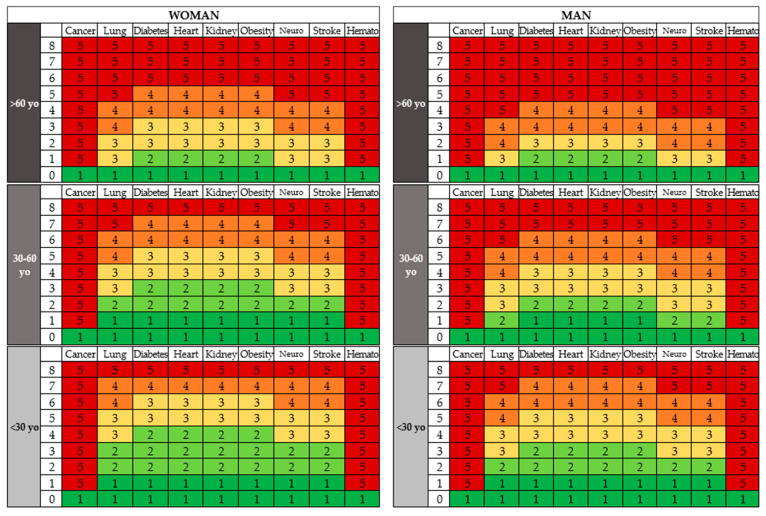
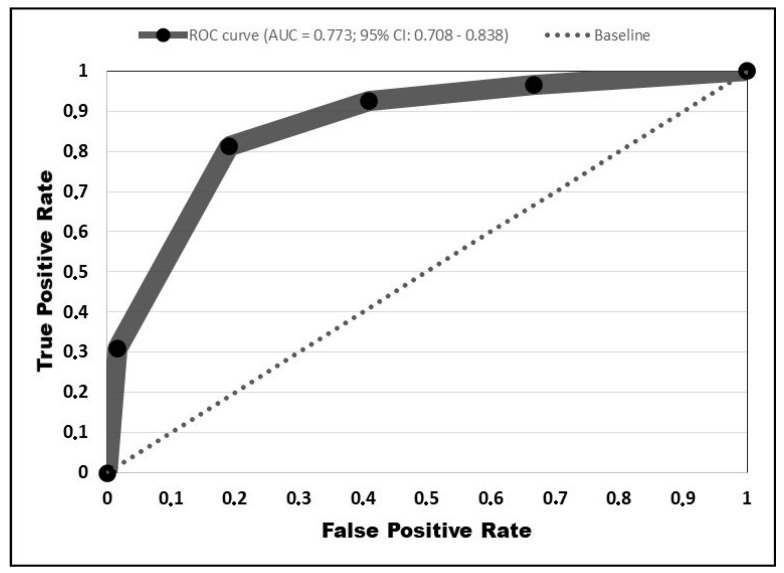
In this paper, we aim at understanding the broad spectrum of factors influencing the survival of infected patients and the correlations between these factors to create a predictive probabilistic score for surviving the COVID-19 disease. Initially, 510 hospital admissions were counted in the study, out of which 310 patients did not survive. A prediction model was developed based on this data by using a Bayesian approach. Following the data collection process for the development study, the second cohort of patients totaling 541 was built to validate the risk matrix previously created. The final model has an area under the curve of 0.773 and predicts the mortality risk of SARS-CoV-2 infection based on nine disease groups while considering the gender and age of the patient as distinct risk groups. To ease medical workers' assessment of patients, we created a visual risk matrix based on a probabilistic model, ranging from a score of 1 (very low mortality risk) to 5 (very high mortality risk). Each score comprises a correlation between existing comorbid conditions, the number of comorbid conditions, gender, and age group category. This clinical model can be generalized in a hospital context and can be used to identify patients at high risk for whom immediate intervention might be required.
在本文中,我们旨在了解影响感染患者生存的广泛因素以及这些因素之间的相关性,以创建一个预测感染新冠病毒疾病患者生存概率的评分系统。最初,该研究统计了510例住院病例,其中310例患者死亡。基于这些数据,采用贝叶斯方法开发了一个预测模型。在完成用于模型开发研究的数据收集过程后,构建了第二个包含541例患者的队列,以验证先前创建的风险矩阵。最终模型的曲线下面积为0.773,在将患者的性别和年龄视为不同风险组的同时,基于九个疾病组预测新冠病毒感染的死亡风险。为便于医护人员对患者进行评估,我们基于概率模型创建了一个视觉风险矩阵,评分范围从1分(极低死亡风险)到5分(极高死亡风险)。每个评分包含现有合并症、合并症数量、性别和年龄组类别之间的相关性。这种临床模型可在医院环境中推广使用,用于识别可能需要立即干预的高危患者。