Department of Comparative Cultural Psychology, Max Planck Institute for Evolutionary Anthropology, Leipzig, Germany.
Department of Psychology, Stanford University, Stanford, CA, USA.
Nat Hum Behav. 2021 Aug;5(8):1046-1054. doi: 10.1038/s41562-021-01145-1. Epub 2021 Jul 1.
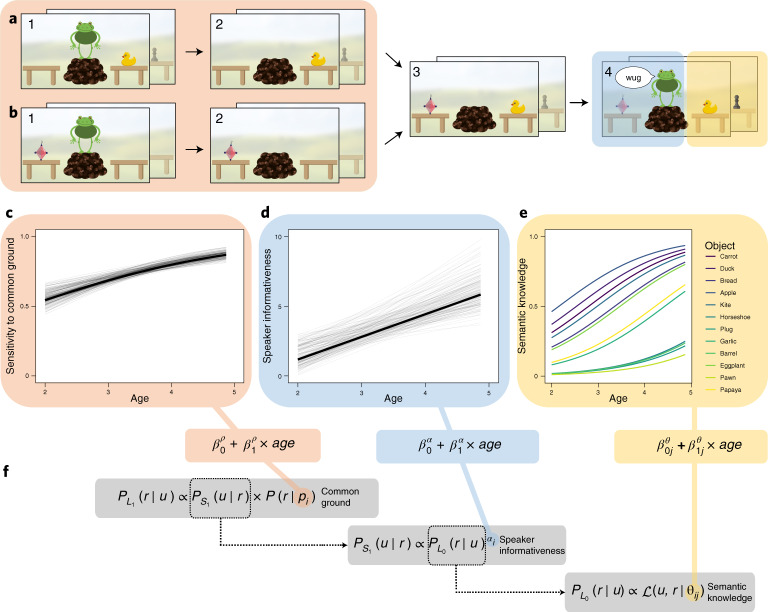
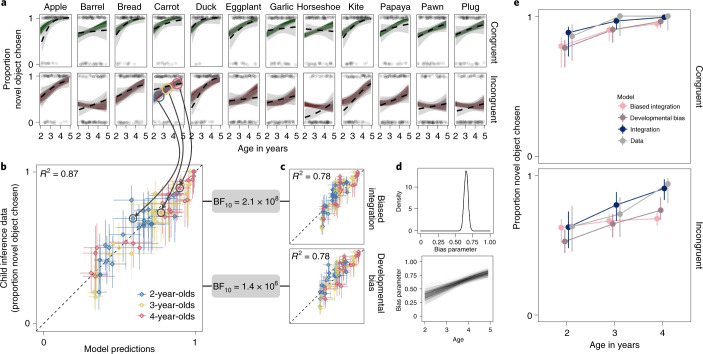
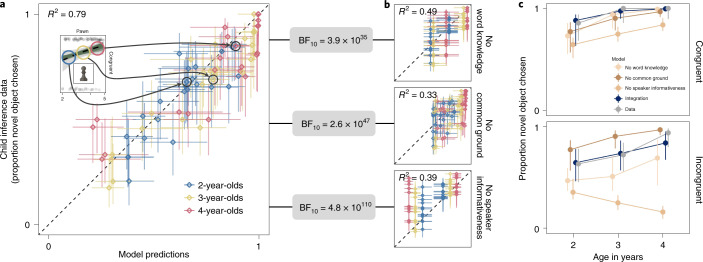
Before formal education begins, children typically acquire a vocabulary of thousands of words. This learning process requires the use of many different information sources in their social environment, including their current state of knowledge and the context in which they hear words used. How is this information integrated? We specify a developmental model according to which children consider information sources in an age-specific way and integrate them via Bayesian inference. This model accurately predicted 2-5-year-old children's word learning across a range of experimental conditions in which they had to integrate three information sources. Model comparison suggests that the central locus of development is an increased sensitivity to individual information sources, rather than changes in integration ability. This work presents a developmental theory of information integration during language learning and illustrates how formal models can be used to make a quantitative test of the predictive and explanatory power of competing theories.
在正式教育开始之前,儿童通常会掌握数千个单词的词汇量。这个学习过程需要在他们的社会环境中使用许多不同的信息来源,包括他们当前的知识状态和听到单词使用的上下文。这些信息是如何整合的?我们根据该模型指定了一个发展模型,根据该模型,儿童会以特定年龄的方式考虑信息来源,并通过贝叶斯推理将它们整合在一起。该模型准确地预测了 2 至 5 岁儿童在一系列实验条件下的单词学习情况,这些实验条件要求他们整合三个信息来源。模型比较表明,发展的核心要点是对单个信息来源的敏感性增加,而不是整合能力的变化。这项工作提出了语言学习过程中信息整合的发展理论,并说明了如何使用正式模型对竞争理论的预测和解释能力进行定量测试。