F. Hoffmann-La Roche Ltd, Basel, Switzerland.
Analysis Group, Los Angeles, CA, USA.
J Alzheimers Dis. 2021;82(4):1667-1682. doi: 10.3233/JAD-210305.
Progression trajectories of patients with mild cognitive impairment (MCI) are currently not well understood.
To classify patients with incident MCI into different latent classes of progression and identify predictors of progression class.
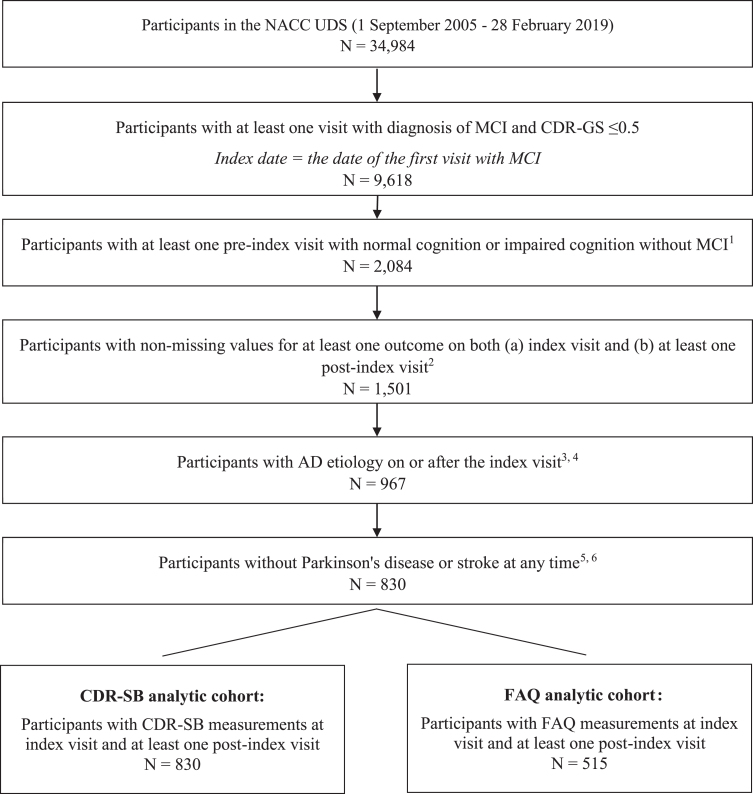
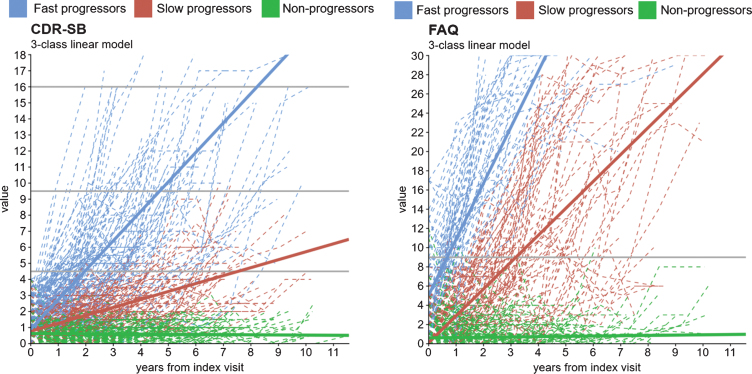
Participants with incident MCI were identified from the US National Alzheimer's Coordinating Center Uniform Data Set (09/2005-02/2019). Clinical Dementia Rating (CDR®) Dementia Staging Instrument-Sum of Boxes (CDR-SB), Functional Activities Questionnaire (FAQ), and Mini-Mental State Examination (MMSE) score longitudinal trajectories from MCI diagnosis were fitted using growth mixture models. Predictors of progression class were identified using multivariate multinomial logistic regression models; odds ratios (ORs) and 95% confidence intervals (CIs) were reported.
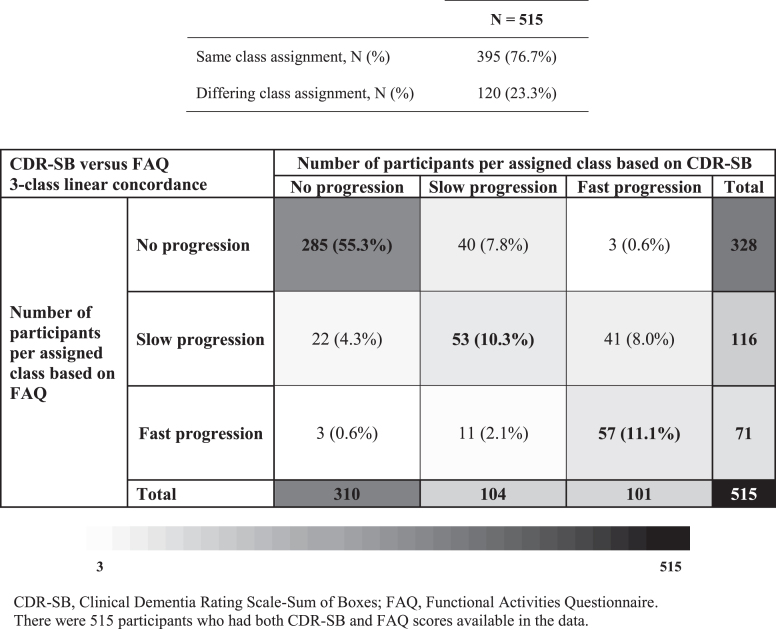
In total, 21%, 22%, and 57% of participants (N = 830) experienced fast, slow, and no progression on CDR-SB, respectively; for FAQ, these figures were 14%, 23%, and 64%, respectively. CDR-SB and FAQ class membership was concordant for most participants (77%). Older age (≥86 versus≤70 years, OR [95% CI] = 5.26 [1.78-15.54]), one copy of APOE ɛ4 (1.94 [1.08-3.47]), higher baseline CDR-SB (2.46 [1.56-3.88]), lower baseline MMSE (0.85 [0.75-0.97]), and higher baseline FAQ (1.13 [1.02-1.26]) scores were significant predictors of fast progression versus no progression based on CDR-SB (all p < 0.05). Predictors of FAQ class membership were largely similar.
Approximately a third of participants experienced progression based on CDR-SB or FAQ during the 4-year follow-up period. CDR-SB and FAQ class assignment were concordant for the vast majority of participants. Identified predictors may help the selection of patients at higher risk of progression in future trials.
目前,轻度认知障碍(MCI)患者的进展轨迹尚不清楚。
将发生 MCI 的患者分为不同的进展潜在类别,并确定进展类别的预测因素。
参与者为美国国家阿尔茨海默病协调中心统一数据集(2005 年 9 月至 2019 年 2 月)中的新发病例 MCI 患者。使用增长混合模型拟合从 MCI 诊断开始的临床痴呆评定量表(CDR®)痴呆分期工具-总框数(CDR-SB)、功能活动问卷(FAQ)和简易精神状态检查(MMSE)评分的纵向轨迹。使用多元多项逻辑回归模型确定进展类别的预测因素;报告优势比(OR)和 95%置信区间(CI)。
共有 21%、22%和 57%的参与者(N=830)在 CDR-SB 上分别经历了快速、缓慢和无进展;对于 FAQ,这些数字分别为 14%、23%和 64%。CDR-SB 和 FAQ 类别的成员资格对大多数参与者是一致的(77%)。年龄较大(≥86 岁与≤70 岁相比,OR[95%CI]为 5.26[1.78-15.54])、携带 APOE ε4 基因 1 个拷贝(1.94[1.08-3.47])、基线 CDR-SB 较高(2.46[1.56-3.88])、基线 MMSE 较低(0.85[0.75-0.97])和基线 FAQ 较高(1.13[1.02-1.26])是基于 CDR-SB 预测快速进展与无进展的显著预测因素(均 p<0.05)。FAQ 类别的预测因素基本相似。
大约三分之一的参与者在 4 年的随访期间基于 CDR-SB 或 FAQ 经历了进展。CDR-SB 和 FAQ 类别的分配在绝大多数参与者中是一致的。确定的预测因素可能有助于在未来的试验中选择进展风险较高的患者。