Koyuncu Hasan, Barstuğan Mücahid
Konya Technical University, Faculty of Engineering and Natural Sciences, Electrical & Electronics Engineering Department, Konya, Turkey.
Signal Process Image Commun. 2021 Sep;97:116359. doi: 10.1016/j.image.2021.116359. Epub 2021 Jun 17.
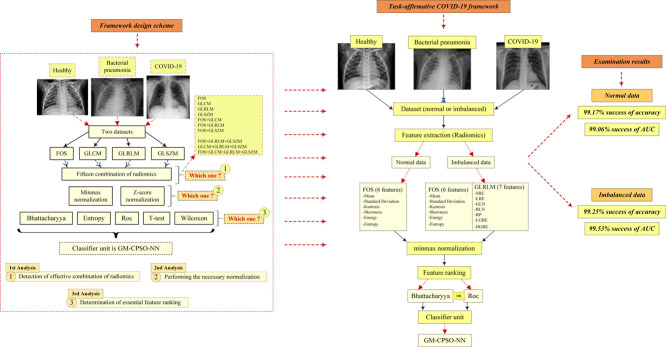
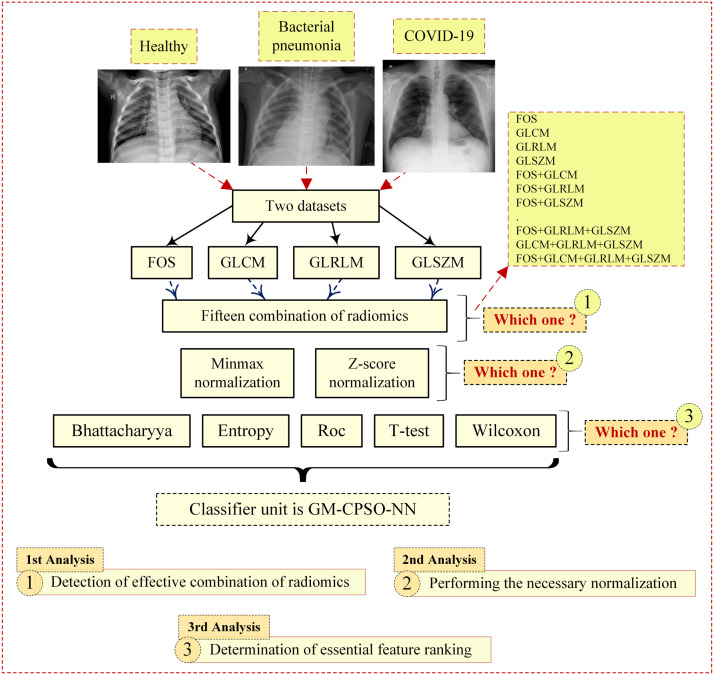
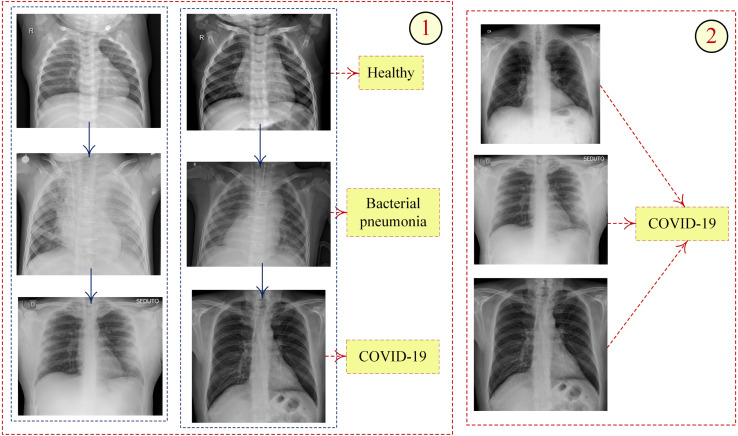
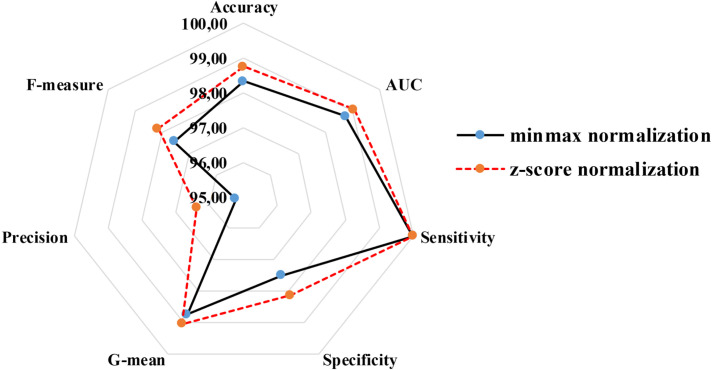
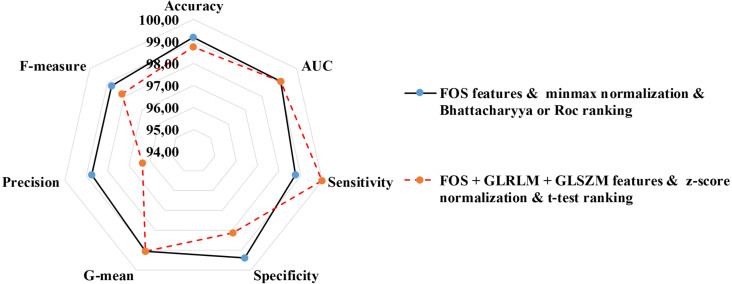
In medical imaging procedures for the detection of coronavirus, apart from medical tests, approval of diagnosis has special significance. Imaging procedures are also useful for detecting the damage caused by COVID-19. Chest X-ray imaging is frequently used to diagnose COVID-19 and different pneumonias. This paper presents a task-specific framework to detect coronavirus in X-ray images. Binary classification of three different labels (healthy, bacterial pneumonia, and COVID-19) was performed on two differentiated data sets in which corona is stated as positive. First-order statistics, gray level co-occurrence matrix, gray level run length matrix, and gray level size zone matrix were analyzed to form fifteen sub-data sets and to ascertain the necessary radiomics. Two normalization methods are compared to make the data meaningful. Furthermore, five feature ranking approaches (, , , , and ) are mentioned to provide necessary information to a state-of-the-art classifier based on Gauss-map-based chaotic particle swarm optimization and neural networks. The proposed framework was designed according to the analyses about radiomics, normalization approaches, and filter-based feature ranking methods. In experiments, seven metrics were evaluated to objectively determine the results: accuracy, area under the receiver operating characteristic (ROC) curve, sensitivity, specificity, g-mean, precision, and f-measure. The proposed framework showed promising scores on two X-ray-based data sets, especially with the accuracy and area under the ROC curve rates exceeding 99% for the classification of coronavirus . others.
在用于检测冠状病毒的医学成像程序中,除医学检测外,诊断的批准具有特殊意义。成像程序对于检测由COVID-19造成的损害也很有用。胸部X光成像常用于诊断COVID-19和不同类型的肺炎。本文提出了一个特定任务框架,用于在X光图像中检测冠状病毒。在两个将冠状病毒标记为阳性的不同数据集上,对三种不同标签(健康、细菌性肺炎和COVID-19)进行了二元分类。分析了一阶统计量、灰度共生矩阵、灰度游程长度矩阵和灰度尺寸区域矩阵,以形成15个子数据集并确定必要的放射组学特征。比较了两种归一化方法以使数据有意义。此外,还提到了五种特征排序方法(,,,,和),以便为基于高斯映射的混沌粒子群优化和神经网络的先进分类器提供必要信息。所提出的框架是根据对放射组学、归一化方法和基于滤波器的特征排序方法的分析设计的。在实验中,评估了七个指标以客观地确定结果:准确率、受试者工作特征(ROC)曲线下面积、灵敏度、特异性、几何均值、精确率和F值。所提出的框架在两个基于X光的数据集上显示出了不错的分数,尤其是对于冠状病毒的分类,准确率和ROC曲线下面积率超过了99%。其他情况。