Zhao Ning, Cao Yinghao, Yang Jia, Li Hang, Wu Ke, Wang Jiliang, Peng Tao, Cai Kailin
Department of Gastrointestinal Surgery, Union Hospital, Tongji Medical College, Huazhong University of Science and Technology, Wuhan, China.
Department of Gastrointestinal Surgery, The Central Hospital of Wuhan, Tongji Medical College, Huazhong University of Science and Technology, Wuhan, China.
Front Oncol. 2021 Jun 17;11:582244. doi: 10.3389/fonc.2021.582244. eCollection 2021.
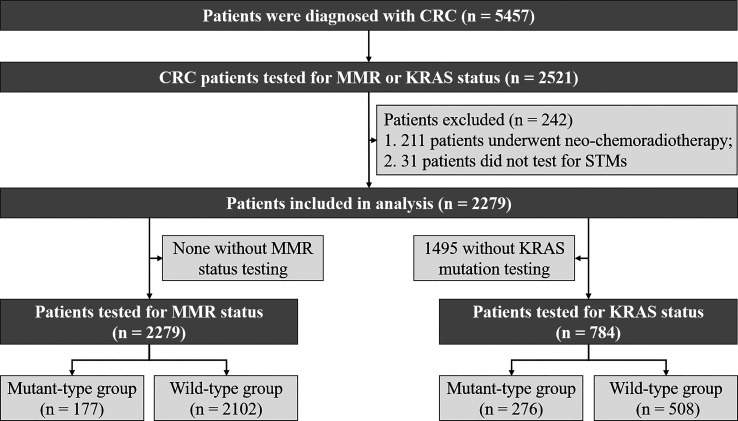
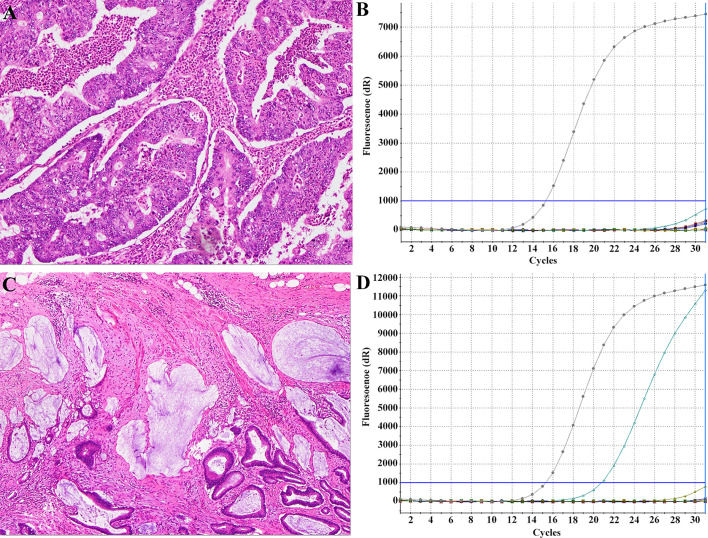
Although serum tumor markers (STMs), clinicopathological characteristics and the status of KRAS and MMR play an important role in optimizing the treatment and prognosis of colorectal cancer, their interrelationships remain largely unknown. A retrospective analysis of 2279 patients who tested for KRAS and MMR status, and STM measurements prior to treatment over the past four years was conducted. Of the 784 patients tested for KRAS and 2279 patients tested for MMR status, KRAS mutations and dMMR were identified in 276 patients (35.20%) and 177 patients (7.77%), respectively. Logistic regression analysis demonstrated that right colon, well and moderate differentiation and negative CA19-9 were independent predictors for KRAS mutations. The ROC curve yielded an AUC of 0.609 through the combination of these three factors. Age < 65 was an independent predictive factor for dMMR, along with tumor size > 4.6 cm, right colon, poor differentiation, harvested lymph nodes ≥ 22, no lymph node metastasis, no perineural invasion, negative CEA and positive CA72-4. When the nine criteria were used together, the AUC was 0.849. In summary, both STMs and clinicopathological characteristics were found to be significantly associated with the status of KRAS and MMR. The combination of these two factors possessed a strong predictive power for KRAS mutations and dMMR among CRC patients.
尽管血清肿瘤标志物(STMs)、临床病理特征以及KRAS和错配修复(MMR)状态在优化结直肠癌的治疗和预后方面发挥着重要作用,但其相互关系仍 largely未知。对过去四年中2279例接受KRAS和MMR状态检测以及治疗前STM测量的患者进行了回顾性分析。在784例接受KRAS检测的患者和2279例接受MMR状态检测的患者中,分别有276例(35.20%)和177例(7.77%)检测到KRAS突变和错配修复缺陷(dMMR)。逻辑回归分析表明,右半结肠、高分化和中分化以及CA19-9阴性是KRAS突变的独立预测因素。通过这三个因素的组合,ROC曲线得出的曲线下面积(AUC)为0.609。年龄<65岁是dMMR的独立预测因素,同时还包括肿瘤大小>4.6 cm、右半结肠、低分化、清扫淋巴结≥22枚、无淋巴结转移、无神经侵犯、CEA阴性和CA72-4阳性。当这九个标准一起使用时,AUC为0.849。总之,发现STMs和临床病理特征均与KRAS和MMR状态显著相关。这两个因素的组合对结直肠癌患者的KRAS突变和dMMR具有很强的预测能力。