Department of Gastroenterology, Zhongnan Hospital of Wuhan University, Wuhan 430071, Hubei Province, China.
Department of Respiratory and Critical Care Medicine, Zhongnan Hospital of Wuhan University, Wuhan 430071, Hubei Province, China.
World J Gastroenterol. 2021 Jun 28;27(24):3502-3515. doi: 10.3748/wjg.v27.i24.3502.
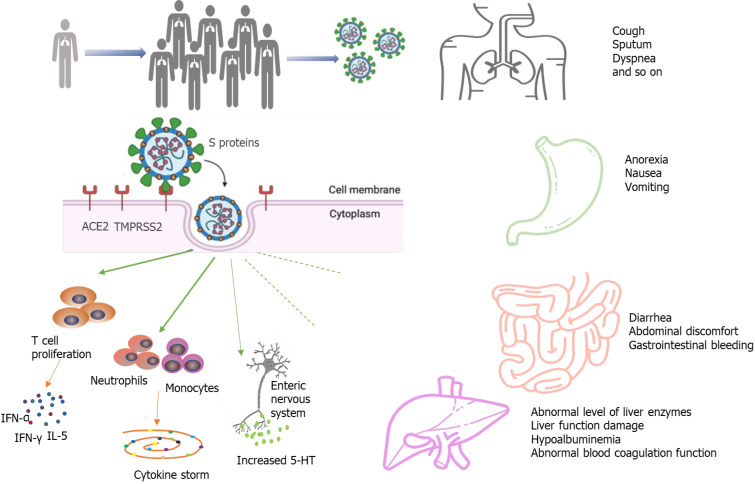
Coronavirus disease 2019 (COVID-19) is caused by infection of the coronavirus severe acute respiratory syndrome coronavirus 2 (SARS-CoV-2) with typical respiratory symptoms. SARS-CoV-2 invades not only the respiratory system, but also other organs expressing the cell surface receptor angiotensin converting enzyme 2. In particular, the digestive system is a susceptible target of SARS-CoV-2. Gastrointestinal symptoms of COVID-19 include anorexia, nausea, vomiting, diarrhea, abdominal pain, and liver damage. Patients with digestive damage have a greater chance of progressing to severe or critical illness, a poorer prognosis, and a higher risk of death. This paper aims to summarize the digestive system symptoms of COVID-19 and discuss fecal-oral contagion of SARS-CoV-2. It also describes the characteristics of inflammatory bowel disease patients with SARS-CoV-2 infection and discusses precautions for preventing SARS-CoV-2 infection during gastrointestinal endoscopy procedures. Improved attention to digestive system abnormalities and gastrointestinal symptoms of COVID-19 patients may aid health care providers in the process of clinical diagnosis, treatment, and epidemic prevention and control.
新型冠状病毒病(COVID-19)是由冠状病毒严重急性呼吸系统综合征冠状病毒 2(SARS-CoV-2)感染引起的,具有典型的呼吸道症状。SARS-CoV-2 不仅侵袭呼吸系统,还侵袭表达细胞表面受体血管紧张素转换酶 2 的其他器官。特别是,消化系统是 SARS-CoV-2 的易感靶器官。COVID-19 的胃肠道症状包括食欲不振、恶心、呕吐、腹泻、腹痛和肝损伤。有消化损伤的患者进展为重症或危重症的机会更大,预后更差,死亡风险更高。本文旨在总结 COVID-19 的消化系统症状,并讨论 SARS-CoV-2 的粪-口传播。还描述了感染 SARS-CoV-2 的炎症性肠病患者的特征,并讨论了在胃肠内镜检查过程中预防 SARS-CoV-2 感染的注意事项。提高对 COVID-19 患者消化系统异常和胃肠道症状的关注,可能有助于医疗保健提供者进行临床诊断、治疗和疫情防控。