Swarbrick Dana, Seibt Beate, Grinspun Noemi, Vuoskoski Jonna K
RITMO Centre for Interdisciplinary Studies in Rhythm, Time and Motion, University of Oslo, Oslo, Norway.
Department of Musicology, University of Oslo, Oslo, Norway.
Front Psychol. 2021 Jun 22;12:648448. doi: 10.3389/fpsyg.2021.648448. eCollection 2021.
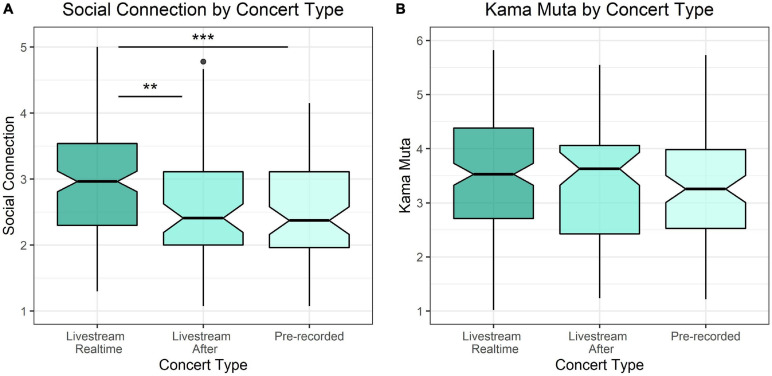
The popularity of virtual concerts increased as a result of the social distancing requirements of the coronavirus pandemic. We aimed to examine how the characteristics of virtual concerts and the characteristics of the participants influenced their experiences of social connection and (often labeled "being moved"). We hypothesized that concert liveness and the salience of the coronavirus would influence social connection and . We collected survey responses on a variety of concert and personal characteristics from 307 participants from 13 countries across 4 continents. We operationalized social connection as a combination of feelings and behaviors and was measured using the short scale (Zickfeld et al., 2019). We found that (1) social connection and were related and predicted by empathic concern, (2) live concerts produced more social connection, but not , than pre-recorded concerts, and (3) the salience of the coronavirus during concerts predicted and this effect was completely mediated by social connection. Exploratory analyses also examined the influence of social and physical presence, motivations for concert attendance, and predictors of donations. This research contributes to the understanding of how people can connect socially and emotionally in virtual environments.
由于新冠疫情对社交距离的要求,虚拟音乐会的受欢迎程度有所增加。我们旨在研究虚拟音乐会的特点以及参与者的特点如何影响他们的社交联系体验和(通常被称为“被感动”)体验。我们假设音乐会的现场感和新冠病毒的显著性会影响社交联系和。我们收集了来自四大洲13个国家的307名参与者对各种音乐会和个人特征的调查反馈。我们将社交联系定义为情感和行为的结合,并使用简短量表(齐克费尔德等人,2019年)来衡量。我们发现:(1)社交联系和由共情关注相关并预测;(2)现场音乐会比预录制音乐会产生更多的社交联系,但不是更多的;(3)音乐会期间新冠病毒的显著性预测了,并且这种影响完全由社交联系介导。探索性分析还考察了社交和身体在场、参加音乐会的动机以及捐赠的预测因素。这项研究有助于理解人们如何在虚拟环境中进行社交和情感联系。