Shoaib Muhammad, Salahudin Hamza, Hammad Muhammad, Ahmad Shakil, Khan Alamgir Akhtar, Khan Mudasser Muneer, Baig Muhammad Azhar Inam, Ahmad Fiaz, Ullah Muhammad Kaleem
Agricultural Engineering Department, Bahauddin Zakariya University, Multan, Pakistan.
Department of Agricultural Engineering, Bahauddin Zakariya University, Multan, Pakistan.
SN Comput Sci. 2021;2(5):372. doi: 10.1007/s42979-021-00764-9. Epub 2021 Jul 9.
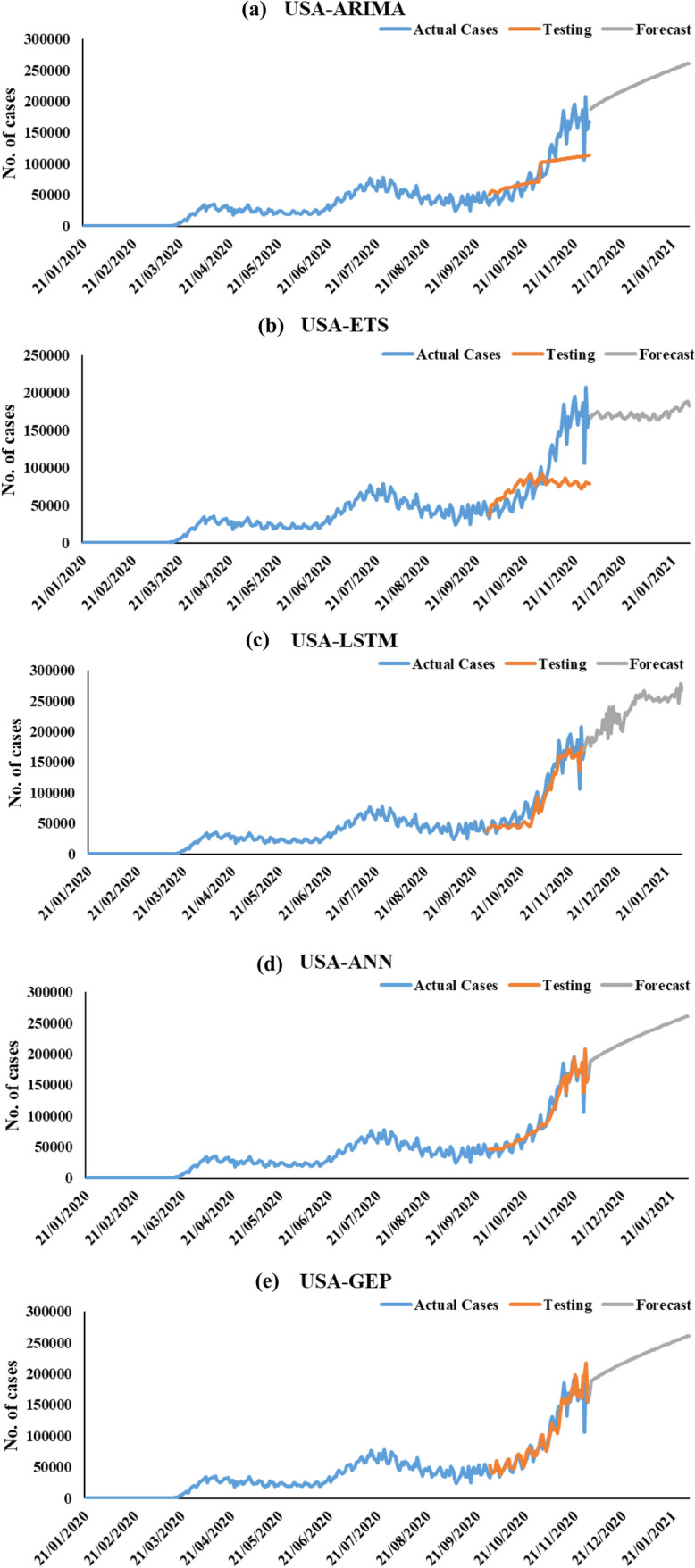
An unexpected outbreak of deadly Covid-19 in later part of 2019 not only endangered the economies of the world but also posed threats to the cultural, social and psychological barriers of mankind. As soon as the virus emerged, scientists and researchers from all over the world started investigating the dynamics of this disease. Despite extensive investments in research, no cure has been officially found to date. This uncertain situation rises severe threats to the survival of mankind. An ultimate need of the time is to investigate the course of disease transfer and suggest a future projection of the disease transfer to be enabled to effectively tackle the always evolving situations ahead. In the present study daily new cases of COVID-19 was predicted using different forecasting techniques; Autoregressive Integrated Moving Average (ARIMA), Exponential Smoothing/Error Trend Seasonality (ETS), Artificial Neural Network Models (ANN), Gene Expression Programming (GEP), and Long Short-Term Memory (LSTM) in four countries; Pakistan, USA, India and Brazil. The dataset of new daily confirmed cases of COVID-19 from the date on which first case was registered in the respective country to 30 November 2020 is analyzed through these five forecasting models to forecast the new daily cases up to 31st January 2020. The forecasting efficiency of each model was evaluated using well known statistical parameters , RMSE, and NSE. A comparative analysis of all above-mentioned models was performed. Finally, the study concluded that Long Short-Term Memory (LSTM) neural network-based forecasting model projected the future cases of COVID-19 pandemic best in all the selected four stations. The accuracy of the model ranges from coefficient of determination value of 0.85 in Brazil to 0.96 in Pakistan. NSE value for the model in India is 0. 99, 0.98 in USA and Pakistan and 0.97 in Brazil. This high-accuracy forecast of COVID-19 cases enables the projection of possible peaks in near future in the aforementioned countries and, therefore, prove to be helpful in formulating strategies to get prepared for the potential hard times ahead.
2019年末意外爆发的致命新冠疫情不仅危及世界经济,还对人类的文化、社会和心理屏障构成威胁。病毒一出现,来自世界各地的科学家和研究人员就开始研究这种疾病的动态。尽管在研究方面投入巨大,但迄今为止尚未正式找到治愈方法。这种不确定的情况对人类的生存构成了严重威胁。当务之急是研究疾病传播过程,并对疾病传播进行未来预测,以便能够有效应对未来不断变化的形势。在本研究中,使用不同的预测技术对四个国家(巴基斯坦、美国、印度和巴西)的新冠每日新增病例进行了预测,这些技术包括自回归积分滑动平均模型(ARIMA)、指数平滑/误差趋势季节性模型(ETS)、人工神经网络模型(ANN)、基因表达式编程(GEP)和长短期记忆模型(LSTM)。通过这五种预测模型,分析了从各国首例病例登记之日至2020年11月30日的新冠每日新增确诊病例数据集,以预测截至2021年1月31日的每日新增病例。使用著名的统计参数、均方根误差(RMSE)和纳什效率系数(NSE)评估了每个模型的预测效率。对上述所有模型进行了比较分析。最后,研究得出结论,基于长短期记忆(LSTM)神经网络的预测模型在所有选定的四个站点中对新冠疫情未来病例的预测效果最佳。该模型的准确率范围从巴西的决定系数值0.85到巴基斯坦的0.96。该模型在印度的NSE值为0.99,在美国和巴基斯坦为0.98,在巴西为0.97。对新冠病例的这种高精度预测能够预测上述国家近期可能出现的峰值,因此,有助于制定战略,为未来可能的艰难时期做好准备。