Department of Poultry Science, University of Arkansas, Fayetteville, AR 72701, USA.
Department of Poultry Science, University of Georgia, Athens, GA 30602, USA.
Poult Sci. 2021 Sep;100(9):101330. doi: 10.1016/j.psj.2021.101330. Epub 2021 Jun 16.
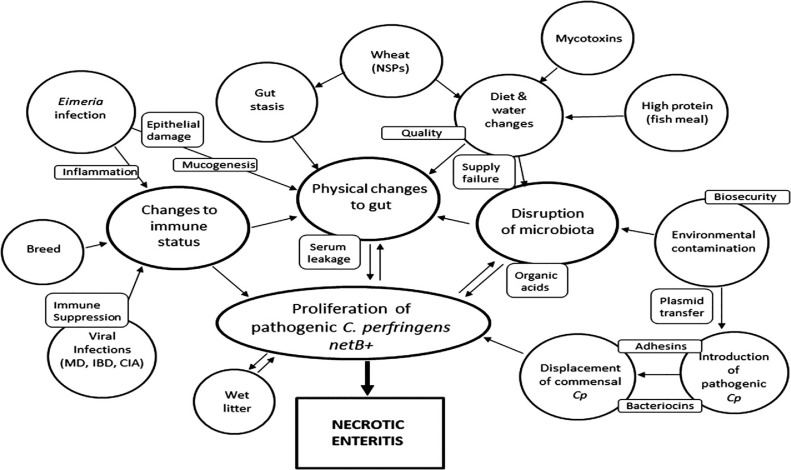
Necrotic enteritis (NE) is a significant enteric disease in commercial poultry with considerable economic effect on profitability manifested by an estimated $6 billion in annual losses to the global industry. NE presents a unique challenge, being a complex enteric disease that often leads to either clinical (acute) or subclinical (chronic) form. The latter typically results in poor performance (reduced feed intake, weight gain and eventually higher feed conversion ratio [FCR]) with low mortality rates, and represents the greatest economic impact on poultry production. The use of antibiotic growth promoters (AGPs) has been an effective tool in protecting birds from enteric diseases by maintaining enteric health and modifying gut microbiota, thus improving broilers' production efficiency and overall health. The removal of AGPs presented the poultry industry with several challenges, including reduced bird health and immunity as well as questioning the safety of poultry products. Consequently, research on antibiotic alternatives that can support gut health was intensified. Probiotics, prebiotics, essential oils, and organic acids were among various additives that have been tested for their efficacy against NE with some being effective but not to the level of AGPs. The focus of this review is on the relationship between NE pathogenesis, microbiome, and host immune responses, along with references to recent reviews addressing production aspects of NE. With a comprehensive understanding of these dynamic changes, new and programmed strategies could be developed to make use of the current products more effectively or build a stepping stone toward the development of a new generation of supplements.
坏死性肠炎(NE)是商业家禽中一种重要的肠道疾病,对盈利能力有相当大的经济影响,估计全球行业每年因此损失 60 亿美元。NE 是一种独特的挑战,它是一种复杂的肠道疾病,通常导致临床(急性)或亚临床(慢性)形式。后者通常表现为性能下降(采食量减少、体重增加,最终饲料转化率[FCR]升高),死亡率低,但对家禽生产的经济影响最大。抗生素生长促进剂(AGPs)的使用是通过维持肠道健康和改变肠道微生物群来保护鸟类免受肠道疾病的有效工具,从而提高肉鸡的生产效率和整体健康水平。AGPs 的禁用给家禽业带来了一些挑战,包括鸟类健康和免疫力下降,以及对家禽产品安全性的质疑。因此,人们加强了对抗生素替代品的研究,这些替代品可以支持肠道健康。益生菌、益生元、精油和有机酸是已被测试用于防治 NE 的各种添加剂之一,其中一些具有一定的效果,但不如 AGPs 有效。本综述的重点是 NE 发病机制、微生物组和宿主免疫反应之间的关系,并参考了最近关于 NE 生产方面的综述。全面了解这些动态变化,可以开发新的和有计划的策略,以更有效地利用现有产品,或为新一代补充剂的开发奠定基础。