Department of Applied Pharmaceutical Sciences and Clinical Pharmacy, Faculty of Pharmacy, Isra University, Amman 11622, Jordan.
Faculty of Medicine, Umm Alqura University, Mecca 21514, Saudi Arabia.
Int J Environ Res Public Health. 2021 Jul 1;18(13):7041. doi: 10.3390/ijerph18137041.
The aim of this study was to explore the trend of ischemic heart disease (IHD) admission and the prescriptions of IHD medications in England and Wales.
A secular trends study was conducted during the period of 1999 to 2019. We extracted hospital admission data for patients from all age groups from the Hospital Episode Statistics database in England and the Patient Episode Database for Wales. Prescriptions of IHD medications were extracted from the Prescription Cost Analysis database from 2004 to 2019. The chi-squared test was used to assess the difference between the admission rates and the difference between IHD medication prescription rates. The trends in IHD-related hospital admission and IHD-related medication prescription were assessed using a Poisson model. The correlation between hospital admissions for IHD and its IHD medication-related prescriptions was assessed using the Pearson correlation coefficient.
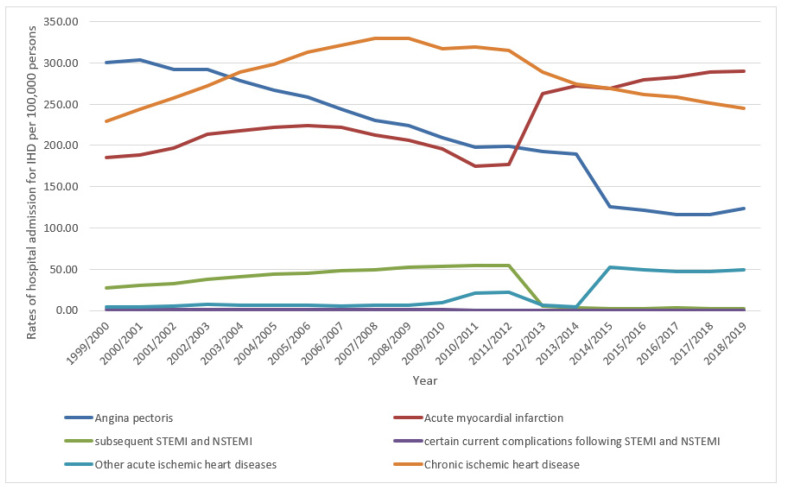
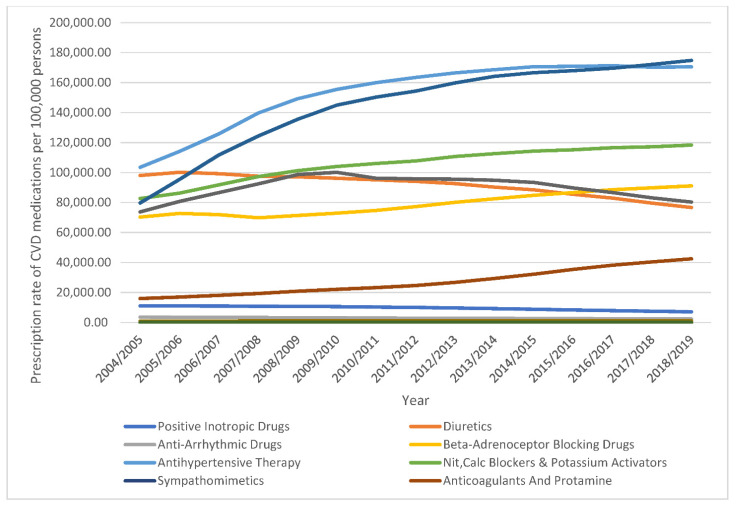
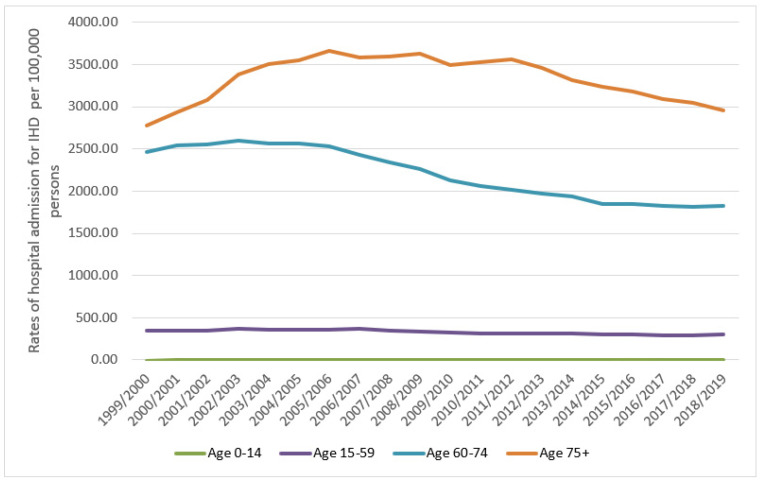
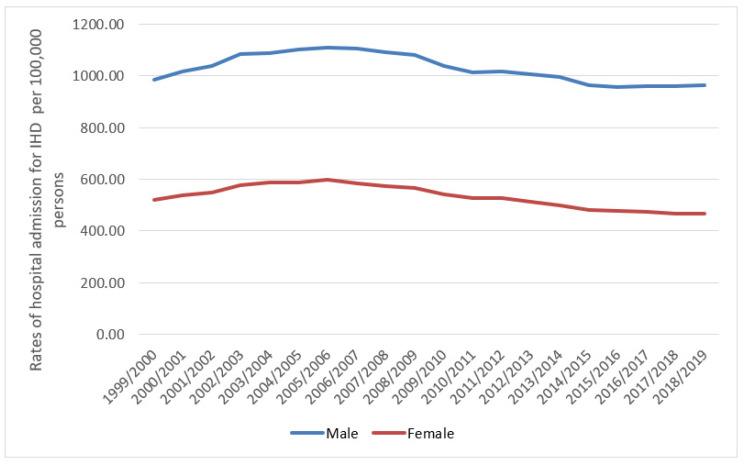
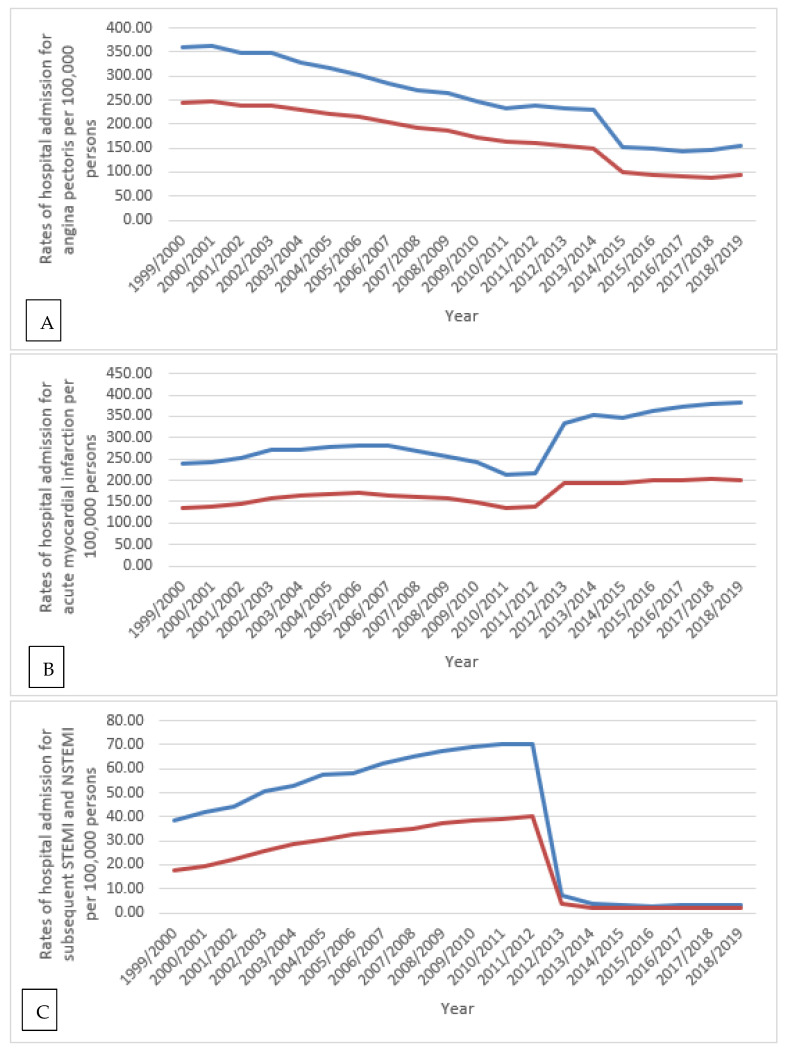
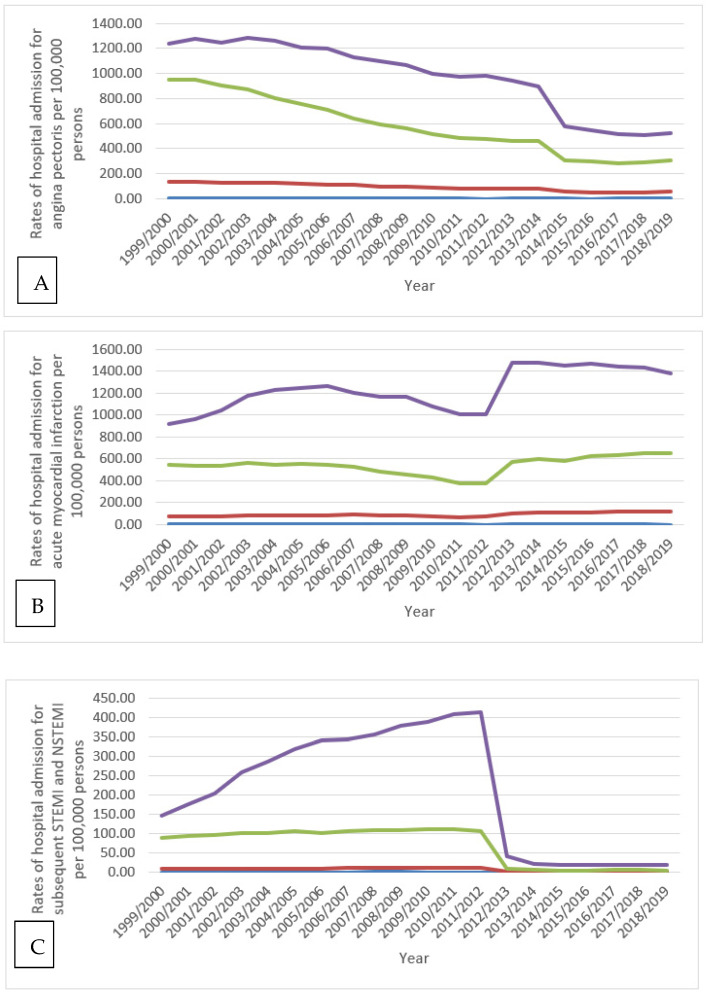
Our study detected a significant increase in the rate of cardiovascular disease (CVD) medication prescriptions in England and Wales, representing a rise in the CVD medications prescription rate of 41.8% (from 539,334.95 (95% CI = 539,286.30-539,383.59) in 2004 to 764,584.55 (95% CI = 764,545.55-764,623.56) in 2019 prescriptions per 100,000 persons), with a mean increase of 2.8% per year during the past 15 years. This increase was connected with a reduction in the IHD hospital admission rate by 15.4% (from 838.50 (95% CI = 836.05-840.94) in 2004 to 709.78 (95% CI = 707.65-711.92) in 2019 per 100,000 persons, trend test, < 0.01), with a mean decrease of 1.02% per year during the past 15 years and by 5% (from 747.43 (95% CI = 745.09-749.77) in 1999 to 709.78 (95% CI = 707.65-711.92) in 2019 per 100,000 persons, trend test, < 0.01) with a mean decrease of 0.25% per year during the past two decades in England and Wales.
The rate of hospitalisation due to IHD has decreased in England and Wales during the past two decades. Hospitalisation due to IHD was strongly and negatively correlated with the increase in the rates of dispensing of IHD-related medications. Other factors contributing to this decline could be the increase in controlling IHD risk factors during the past few years. Future studies exploring other risk factors that are associated with IHD hospitalisation are warranted.
本研究旨在探讨英格兰和威尔士缺血性心脏病(IHD)入院趋势和 IHD 药物处方情况。
本研究为 1999 年至 2019 年的时间趋势研究。我们从英格兰的医院入院统计数据库和威尔士的患者入院数据库中提取了所有年龄段患者的入院数据。从 2004 年至 2019 年,从处方成本分析数据库中提取了 IHD 药物处方数据。采用卡方检验评估入院率和 IHD 药物处方率之间的差异。采用泊松模型评估 IHD 相关住院和 IHD 相关药物处方的趋势。采用 Pearson 相关系数评估 IHD 住院与 IHD 药物相关处方之间的相关性。
我们的研究发现,英格兰和威尔士 CVD 药物的处方率显著增加,代表 CVD 药物处方率上升了 41.8%(从 2004 年的 539,334.95(95%CI=539,286.30-539,383.59)增加至 2019 年的 764,584.55(95%CI=764,545.55-764,623.56)/100,000 人),过去 15 年每年平均增长 2.8%。这种增加与 IHD 住院率下降 15.4%有关(从 2004 年的 838.50(95%CI=836.05-840.94)降至 2019 年的 709.78(95%CI=707.65-711.92)/100,000 人,趋势检验,<0.01),过去 15 年每年平均下降 1.02%,过去 20 年每年平均下降 0.25%(从 1999 年的 747.43(95%CI=745.09-749.77)降至 2019 年的 709.78(95%CI=707.65-711.92)/100,000 人,趋势检验,<0.01)。
在过去的二十年中,英格兰和威尔士因 IHD 住院的比例有所下降。IHD 住院与 IHD 相关药物配药率的增加呈强烈负相关。导致这种下降的其他因素可能是过去几年对 IHD 危险因素的控制增加。未来需要探索与 IHD 住院相关的其他风险因素的研究。