Moraes João Alfredo, Encarnação Carol, Franco Victor Aguiar, Xavier Botelho Luiz Gabriel, Rodrigues Gabriella Pacheco, Ramos-Andrade Isadora, Barja-Fidalgo Christina, Renovato-Martins Mariana
Redox Biology Laboratory, Programa de Pesquisa em Farmacologia e Inflamação, Instituto de Ciências Biomédicas, Universidade Federal do Rio de Janeiro, 21941-902 Rio de Janeiro, Brazil.
Laboratory of Inflammation and Metabolism, Departamento de Biologia Celular e Molecular, Instituto de Biologia, Universidade Federal Fluminense, 24210-201 Niterói, Brazil.
Cancers (Basel). 2021 Jul 2;13(13):3328. doi: 10.3390/cancers13133328.
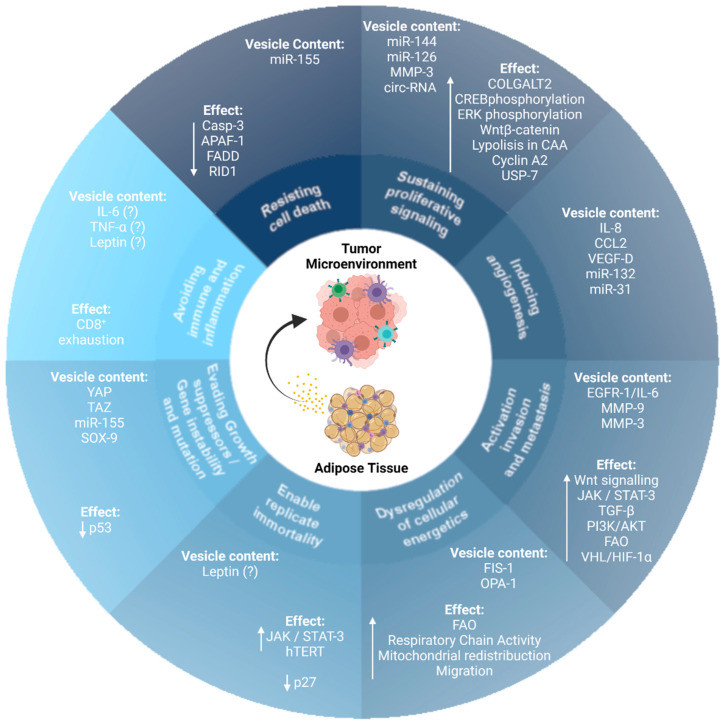
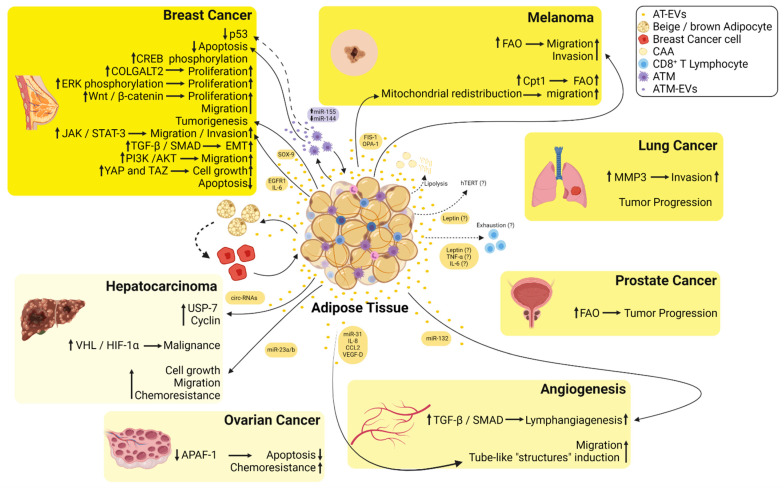
Extracellular vesicles (EVs) are crucial elements that sustain the communication between tumor cells and their microenvironment, and have emerged as a widespread mechanism of tumor formation and metastasis. In obesity, the adipose tissue becomes hypertrophic and hyperplastic, triggering increased production of pro-inflammatory adipokines, such as tumor necrosis factor α, interleukin 6, interleukin 1, and leptin. Furthermore, obese adipose tissue undergoes dysregulation in the cargo content of the released EVs, resulting in an increased content of pro-inflammatory proteins, fatty acids, and oncogenic microRNAs. These alterations drive obesity-associated inflammatory responses both locally and systemically. After being ignored for a long time, adipose tissues have recently received considerable attention as a major player in tumor microenvironment-linked obesity and cancer. The role of adipose tissue in the establishment and progression of cancer is reinforced by its high plasticity and inflammatory content. Such a relationship may be established by direct contact between adipocytes and cancer cells within the microenvironment or systemically, via EV-mediated cell-to-cell communication. Here, we highlight cues evidencing the influence of adipose tissue-derived EVs on the hallmarks of cancer, which are critical for tumor malignancy.
细胞外囊泡(EVs)是维持肿瘤细胞与其微环境之间通讯的关键要素,并且已成为肿瘤形成和转移的一种广泛机制。在肥胖状态下,脂肪组织会变得肥大和增生,引发促炎脂肪因子如肿瘤坏死因子α、白细胞介素6、白细胞介素1和瘦素的产生增加。此外,肥胖的脂肪组织所释放的细胞外囊泡的货物内容物会发生失调,导致促炎蛋白、脂肪酸和致癌性微小RNA的含量增加。这些改变在局部和全身引发与肥胖相关的炎症反应。长期以来被忽视的脂肪组织,最近作为肿瘤微环境相关的肥胖和癌症中的一个主要参与者受到了相当多的关注。脂肪组织在癌症发生和发展中的作用因其高可塑性和炎症成分而得到加强。这种关系可能通过微环境内脂肪细胞与癌细胞之间的直接接触或通过细胞外囊泡介导的细胞间通讯在全身建立。在此,我们强调证明脂肪组织衍生的细胞外囊泡对癌症特征有影响的线索,这些特征对肿瘤恶性程度至关重要。