Tufts Medical Center, 800 Washington Street Box #63, MA, 02111, Boston, USA.
Tufts University School of Medicine, 145 Harrison Ave, MA, 02111, Boston, USA.
BMC Health Serv Res. 2021 Jul 21;21(1):719. doi: 10.1186/s12913-021-06741-5.
Studies on the impact of the novel SARS-CoV-2 virus (COVID) for healthcare workers (HCWs) rarely include the full spectrum of hospital workers, including less visible patient support roles. In the early days of the pandemic, COVID testing was preferentially available to HCWs. The objective of this study was to understand how individual experiences for all HCWs during the pandemic were associated with perceptions of access to, and receipt of COVID testing .
All hospital employees (n = 6736) in a single academic medical center in Boston, Massachusetts were invited to participate in a cross-sectional survey regarding perceived access to, and receipt of COVID testing during the first wave of the pandemic (March - August 2020). Responses were linked to human resources data. Log binomial univariate and multivariable models were used to estimate associations between individual and employment variables and COVID testing.
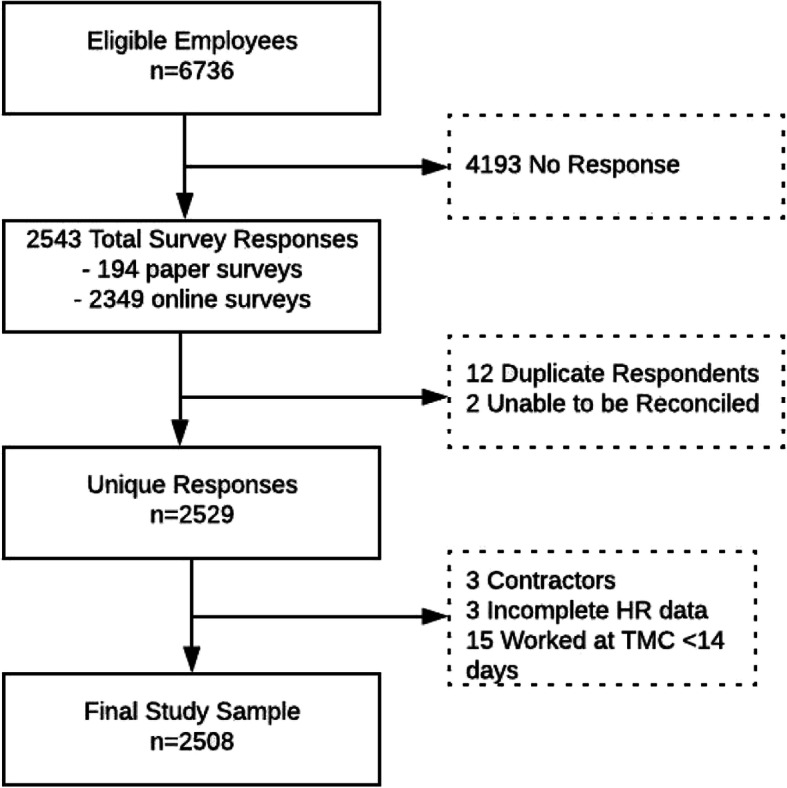
A total of 2543 employees responded to the survey (38 %). The mean age was 40 years (± 14). Respondents were female (76 %), white (55 %), worked as nurses (27 %), administrators (22 %) and patient support roles (22 %); 56 % of respondents wanted COVID testing. Age (RR 0.91, CI 0.88-0.93), full time status (RR 0.85, CI 0.79-0.92), employment tenure (RR 0.96, CI 0.94-0.98), changes in quality of life (RR 0.94, CI 0.91-0.96), changes in job duties (RR 1.19, CI 1.03-1.37), and worry about enough paid sick leave (RR 1.21, CI 1.12-1.30) were associated with interest in testing. Administrators (RR 0.64, CI 0.58-0.72) and patient support staff (RR 0.85, CI 0.78-0.92) were less likely than nurses to want testing. Age (RR 1.04, CI 1.01-1.07), material hardships (RR 0.87, CI 0.79-0.96), and employer sponsored insurance (RR 1.10, CI 1.00-1.22) were associated with receiving a COVID test. Among all employees, only administrative/facilities staff were less likely to receive COVID testing (RR 0.69, CI 0.59-0.79).
This study adds to our understanding of how hospital employees view availability of COVID testing. Hazard pay or other supports for hospital workers may increase COVID testing rates. These findings may be applicable to perceived barriers towards vaccination receipt.
鲜有研究关注新型严重急性呼吸综合征冠状病毒 2 型(COVID)对医护人员(HCWs)的影响,且这些研究通常不包括所有医院工作人员,包括不太引人注目的患者支持角色。在大流行早期,COVID 检测优先提供给 HCWs。本研究的目的是了解在大流行期间所有 HCWs 的个人经历与他们对 COVID 检测的可及性和接受程度的看法之间的关系。
马萨诸塞州波士顿市的一家学术医疗中心的所有医院员工(n=6736)受邀参与一项横断面调查,调查内容包括大流行第一波期间(2020 年 3 月至 8 月)他们对 COVID 检测的可及性和接受程度的看法。调查结果与人力资源数据相关联。使用单变量和多变量逻辑二项式模型来估计个体和就业变量与 COVID 检测之间的关联。
共有 2543 名员工(38%)对调查做出了回应。平均年龄为 40 岁(±14 岁)。受访者为女性(76%)、白人(55%)、护士(27%)、管理人员(22%)和患者支持人员(22%);56%的受访者希望进行 COVID 检测。年龄(RR0.91,CI0.88-0.93)、全职状态(RR0.85,CI0.79-0.92)、工作年限(RR0.96,CI0.94-0.98)、生活质量变化(RR0.94,CI0.91-0.96)、工作职责变化(RR1.19,CI1.03-1.37)和担心带薪病假不足(RR1.21,CI1.12-1.30)与检测意愿相关。与护士相比,管理人员(RR0.64,CI0.58-0.72)和患者支持人员(RR0.85,CI0.78-0.92)不太可能希望进行检测。年龄(RR1.04,CI1.01-1.07)、经济困难(RR0.87,CI0.79-0.96)和雇主赞助的保险(RR1.10,CI1.00-1.22)与接受 COVID 检测有关。在所有员工中,只有行政/设施人员接受 COVID 检测的可能性较低(RR0.69,CI0.59-0.79)。
本研究增进了我们对医院员工如何看待 COVID 检测可及性的理解。为医院工作人员提供危险津贴或其他支持可能会提高 COVID 检测率。这些发现可能适用于对疫苗接种接受程度的感知障碍。