Cologne Center for Ethics, Rights, Economics, and Social Sciences of Health (CERES), University of Cologne and Research Unit Ethics, Faculty of Medicine and University Hospital Cologne, 50931, Cologne, Germany.
Medical Psychology | Neuropsychology and Gender Studies & Center for Neuropsychological Diagnostics and Intervention (CeNDI), Faculty of Medicine and University Hospital Cologne, University of Cologne, 50937, Cologne, Germany.
BMC Health Serv Res. 2021 Jul 21;21(1):716. doi: 10.1186/s12913-021-06614-x.
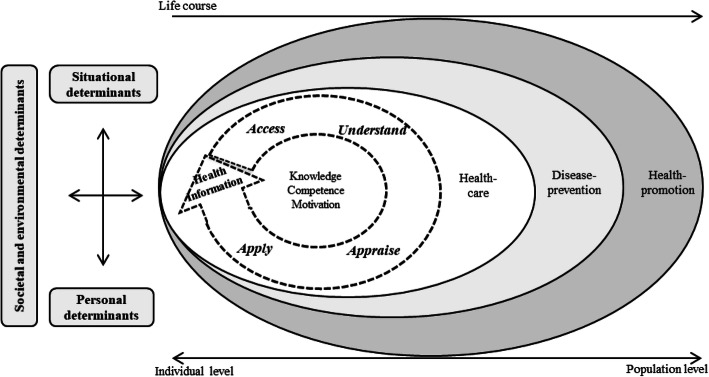
Effective communication is a central aspect of organizational health literacy. Healthcare professionals are expected to ensure an effective and satisfactory flow of information and to support their patients in accessing, understanding, appraising, and applying health information. This qualitative study aimed to examine the health literacy-related challenges, needs, and applied solutions of healthcare professionals when engaging with persons with a migrant background. Based on the integrated model of health literacy (Sørensen et al., BMC Public Health 12:80, 2012), we focused on environmental, personal, and situational factors that shape health literacy in transcultural treatment settings.
We conducted five focus group discussions with healthcare professionals (N = 31) who are in regular contact with persons with a migrant background. Discussions were transcribed verbatim and analyzed using qualitative content analysis by applying a deductive-inductive categorization procedure. Deductive categories were derived from the integrated model of health literacy.
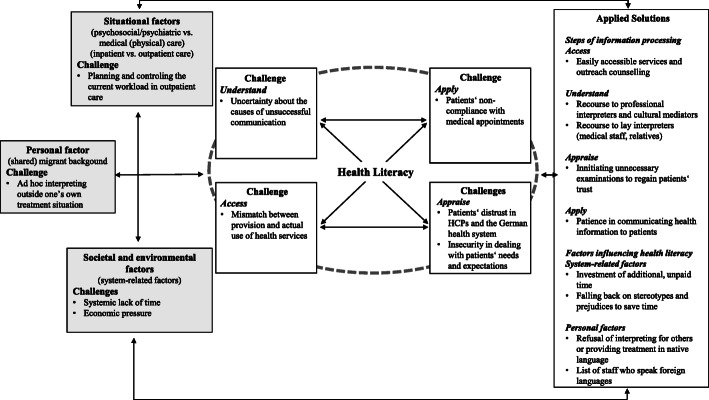
Challenges included a mismatch in the provision and use of health services. Participants regarded easily accessible services and outreach counselling as helpful solutions. Further challenges were the migrant patients' distrust in healthcare professionals and the German healthcare system, the participants' uncertainty in dealing with patients' expectations and needs, and the patients' non-compliance with appointments. Environmental factors included systemic lack of time and economic pressure. Both were reported as impeding the flow of information in all treatment settings. Participants with a migrant background themselves (n = 16) regarded this personal factor as an opportunity that increased patients' trust in them. They also reported challenges such as high levels of responsibility felt when ad hoc interpreting for colleagues.
Known issues observed in the delivery of healthcare for the majority population (i.e., systemic lack of time, economic pressure) appear to be intensified in the context of migration. An increasingly diverse patient clientele indicates a growing need for culture-sensitive, health-literate healthcare organizations. A corresponding diversity of the health workforce is desirable and should be strengthened by national finance and educational programs. Healthcare professionals who interpret for colleagues should be given the necessary time. Further studies are needed to develop appropriate interventions for improving health literacy at individual and organizational levels. Funding for interpreting services should be expanded.
有效的沟通是组织健康素养的一个核心方面。医疗保健专业人员的期望是确保信息的有效和令人满意的流动,并支持他们的患者获取、理解、评估和应用健康信息。这项定性研究旨在检查医疗保健专业人员在与具有移民背景的人交往时所面临的与健康素养相关的挑战、需求和应用解决方案。基于健康素养的综合模型(Sørensen 等人,BMC 公共卫生 12:80, 2012),我们专注于塑造跨文化治疗环境中健康素养的环境、个人和情境因素。
我们与经常与具有移民背景的人接触的医疗保健专业人员(N=31)进行了五次焦点小组讨论。讨论内容逐字记录,并通过应用演绎-归纳分类程序进行定性内容分析进行分析。演绎类别源自健康素养的综合模型。
挑战包括医疗服务的提供和使用不匹配。参与者认为易于获取的服务和外展咨询很有帮助。进一步的挑战是移民患者对医疗保健专业人员和德国医疗保健系统的不信任,参与者在处理患者的期望和需求方面的不确定性,以及患者不遵守预约。环境因素包括系统缺乏时间和经济压力。这两者都被报告为在所有治疗环境中阻碍信息流动的因素。具有移民背景的参与者(n=16)认为这一个人因素是一个机会,可以增加患者对他们的信任。他们还报告了一些挑战,例如为同事临时翻译时感到的高度责任感。
在提供医疗保健方面观察到的已知问题(即系统缺乏时间、经济压力)在移民背景下似乎更加严重。越来越多样化的患者群体表明,需要更加敏感文化、健康素养的医疗保健组织。相应的卫生劳动力多样性是可取的,应该通过国家财政和教育计划加以加强。为同事翻译的医疗保健专业人员应该有必要的时间。需要进一步研究以制定提高个人和组织层面健康素养的适当干预措施。应该扩大口译服务的资金。