Institute of Anatomy, Rostock University Medical Center, Rostock, Germany.
Center for Transdisciplinary Neurosciences Rostock (CTNR), Rostock University Medical Center, Rostock, Germany.
Immunology. 2021 Nov;164(3):450-466. doi: 10.1111/imm.13395. Epub 2021 Aug 2.
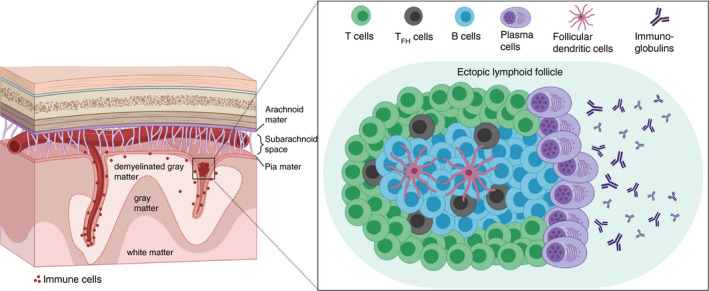
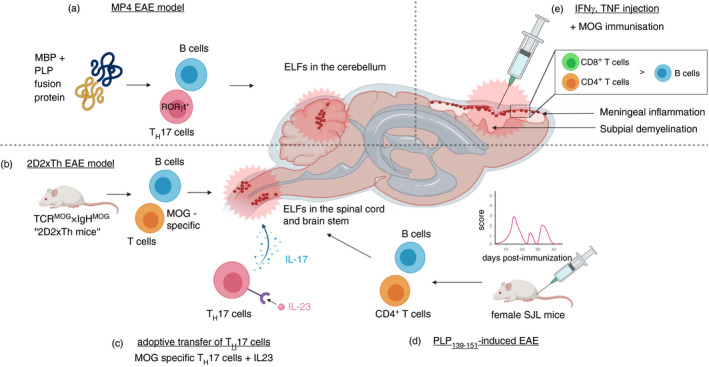
Ectopic lymphoid follicles (ELFs), resembling germinal centre-like structures, emerge in a variety of infectious and autoimmune and neoplastic diseases. ELFs can be found in the meninges of around 40% of the investigated progressive multiple sclerosis (MS) post-mortem brain tissues and are associated with the severity of cortical degeneration and clinical disease progression. Of predominant importance for progressive neuronal damage during the progressive MS phase appears to be meningeal inflammation, comprising diffuse meningeal infiltrates, B-cell aggregates and compartmentalized ELFs. However, the absence of a uniform definition of ELFs impedes reproducible and comparable neuropathological research in this field. In this review article, we will first highlight historical aspects and milestones around the discovery of ELFs in the meninges of progressive MS patients. In the next step, we discuss how animal models may contribute to an understanding of the mechanisms underlying ELF formation. Finally, we summarize challenges in investigating ELFs and propose potential directions for future research.
异位淋巴滤泡(ELF)类似于生发中心样结构,出现在多种感染性、自身免疫性和肿瘤性疾病中。在大约 40%的经调查的进行性多发性硬化症(MS)死后脑组织的脑膜中可以发现 ELF,并且与皮质退变的严重程度和临床疾病进展相关。在进行性 MS 阶段期间进行性神经元损伤的主要重要因素似乎是脑膜炎症,包括弥漫性脑膜浸润、B 细胞聚集和分隔的 ELF。然而,ELF 的定义缺乏统一,这妨碍了该领域可重复和可比的神经病理学研究。在这篇综述文章中,我们将首先强调在发现进行性 MS 患者脑膜中的 ELF 方面的历史方面和里程碑。在下一个步骤中,我们将讨论动物模型如何有助于理解 ELF 形成的机制。最后,我们总结了研究 ELF 所面临的挑战,并为未来的研究提出了潜在的方向。