Paul Katharina T, Eberl Jakob-Moritz, Partheymüller Julia
Department of Political Science, University of Vienna, Vienna, Austria.
Department of Communication, University of Vienna, Vienna, Austria.
Front Public Health. 2021 Jul 6;9:671896. doi: 10.3389/fpubh.2021.671896. eCollection 2021.
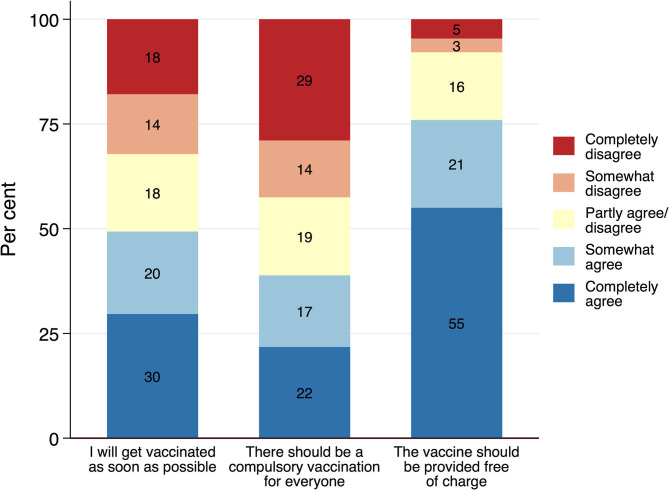
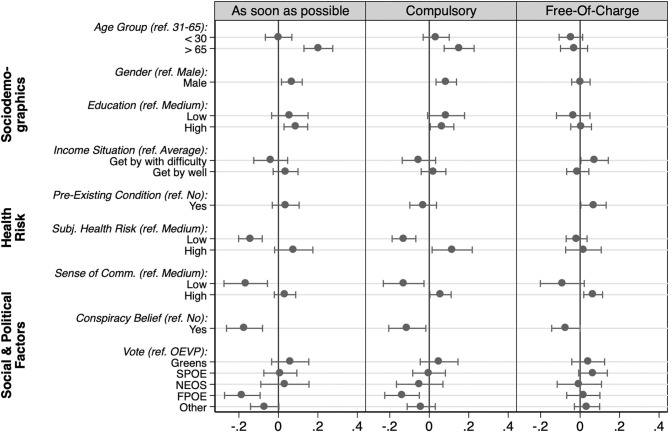
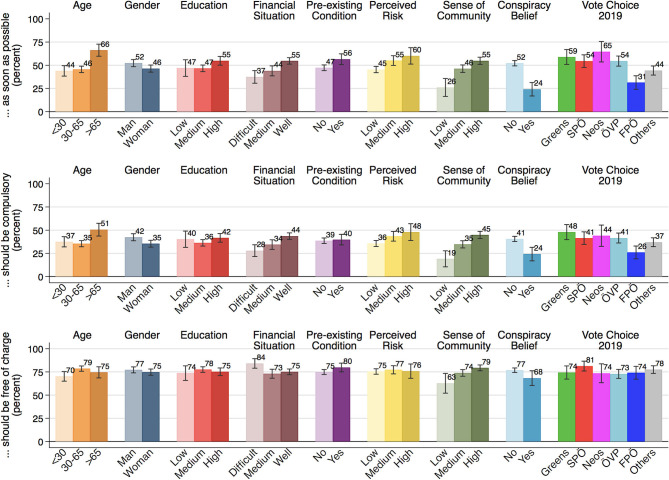
Vaccination is considered to be a key public health intervention to end the COVID-19 pandemic. Yet, the success of the intervention is contingent on attitudes toward vaccination and the design of vaccination policies. We conduct cross-sectional analyses of policy-relevant attitudes toward COVID-19 vaccination using survey data of a representative sample of Austrian residents collected by the Austrian Corona Panel Project (ACPP). As outcomes, we examine the individual readiness to get vaccinated, the support for compulsory vaccinations, and the preference for making the vaccine available free of charge. The independent variables include demographics, objective and perceived health risks, and social and political factors. Although there is broad public support for making the vaccine available free of charge, vaccine hesitancy and the opposition to a vaccine mandate are widespread. The protective function of the vaccine for the individual only motivates limited support for vaccinations. Opposition to COVID-19 vaccination also stems from a lack of sense of community and an ongoing politicization of the issue through conspiracy theories and party politics. We propose that overcoming the inherent free-rider problem of achieving sufficiently high vaccination rates poses a potential dilemma for policymakers: Given the politicized nature of the issue, they may find themselves having to choose between making vaccinations compulsory at political costs and a lingering pandemic at high costs for public health and the economy. We propose that promoting a sense of community and addressing potential practical constraints will be key in designing an effective COVID-19 vaccination policy.
疫苗接种被视为结束新冠疫情的一项关键公共卫生干预措施。然而,该干预措施的成功取决于人们对疫苗接种的态度以及疫苗接种政策的设计。我们利用奥地利新冠病毒小组项目(ACPP)收集的奥地利居民代表性样本的调查数据,对与新冠疫苗接种政策相关的态度进行了横断面分析。作为研究结果,我们考察了个人接种疫苗的意愿、对强制接种疫苗的支持程度以及对免费提供疫苗的偏好。自变量包括人口统计学特征、客观和感知到的健康风险以及社会和政治因素。尽管公众普遍支持免费提供疫苗,但疫苗犹豫和反对疫苗强制令的现象却很普遍。疫苗对个人的保护作用仅促使有限的人支持接种疫苗。对新冠疫苗接种的反对还源于缺乏社区意识以及通过阴谋论和党派政治使该问题持续政治化。我们认为,克服实现足够高疫苗接种率所固有的搭便车问题,对政策制定者来说是一个潜在的两难困境:鉴于该问题的政治化性质,他们可能会发现自己不得不在以政治成本强制接种疫苗和以公共卫生和经济的高成本让疫情持续之间做出选择。我们建议,在设计有效的新冠疫苗接种政策时,促进社区意识并解决潜在的实际限制将是关键。