Department of Neurology, Taipei Veterans General Hospital, Taipei City 11217, Taiwan.
Department of Medicine, Taipei Veterans General Hospital, Taipei City 11217, Taiwan.
Int J Environ Res Public Health. 2021 Jul 18;18(14):7635. doi: 10.3390/ijerph18147635.
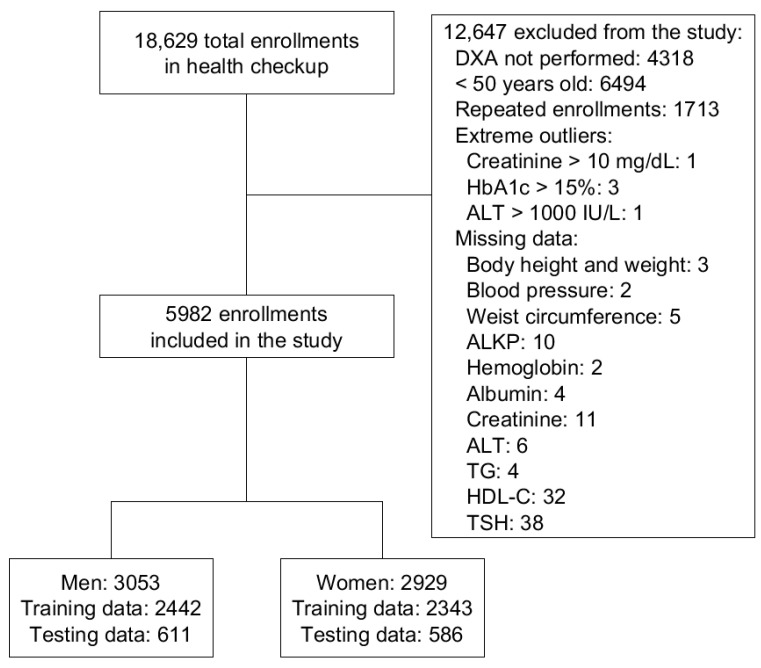
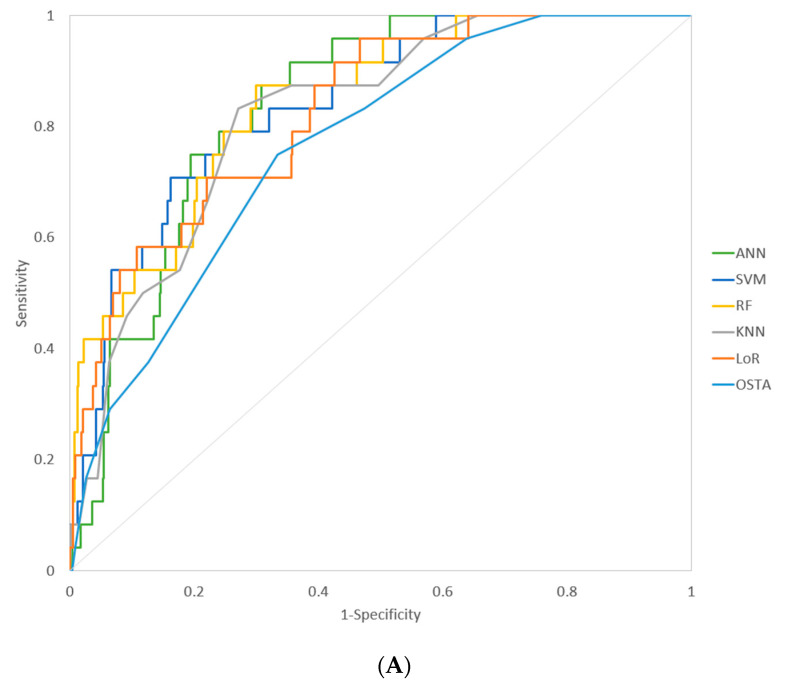
Osteoporosis is treatable but often overlooked in clinical practice. We aimed to construct prediction models with machine learning algorithms to serve as screening tools for osteoporosis in adults over fifty years old. Additionally, we also compared the performance of newly developed models with traditional prediction models. Data were acquired from community-dwelling participants enrolled in health checkup programs at a medical center in Taiwan. A total of 3053 men and 2929 women were included. Models were constructed for men and women separately with artificial neural network (ANN), support vector machine (SVM), random forest (RF), k-nearest neighbor (KNN), and logistic regression (LoR) to predict the presence of osteoporosis. Area under receiver operating characteristic curve (AUROC) was used to compare the performance of the models. We achieved AUROC of 0.837, 0.840, 0.843, 0.821, 0.827 in men, and 0.781, 0.807, 0.811, 0.767, 0.772 in women, for ANN, SVM, RF, KNN, and LoR models, respectively. The ANN, SVM, RF, and LoR models in men, and the ANN, SVM, and RF models in women performed significantly better than the traditional Osteoporosis Self-Assessment Tool for Asians (OSTA) model. We have demonstrated that machine learning algorithms improve the performance of screening for osteoporosis. By incorporating the models in clinical practice, patients could potentially benefit from earlier diagnosis and treatment of osteoporosis.
骨质疏松症是可以治疗的,但在临床实践中常常被忽视。我们旨在构建基于机器学习算法的预测模型,作为 50 岁以上成年人骨质疏松症的筛查工具。此外,我们还比较了新开发的模型与传统预测模型的性能。数据来自台湾一家医学中心的健康检查计划中居住在社区的参与者。共纳入 3053 名男性和 2929 名女性。我们分别为男性和女性构建了人工神经网络(ANN)、支持向量机(SVM)、随机森林(RF)、k-最近邻(KNN)和逻辑回归(LoR)模型,以预测骨质疏松症的发生。使用受试者工作特征曲线下面积(AUROC)比较模型的性能。我们在男性中获得了 0.837、0.840、0.843、0.821 和 0.827 的 AUROC,女性中获得了 0.781、0.807、0.811、0.767 和 0.772 的 AUROC,分别用于 ANN、SVM、RF、KNN 和 LoR 模型。男性中的 ANN、SVM、RF 和 LoR 模型,以及女性中的 ANN、SVM 和 RF 模型,均显著优于传统的亚洲人骨质疏松症自我评估工具(OSTA)模型。我们已经证明,机器学习算法可以提高骨质疏松症筛查的性能。通过将这些模型纳入临床实践,患者可能会受益于更早的骨质疏松症诊断和治疗。