Lin Chin, Lin Chin-Sheng, Lee Ding-Jie, Lee Chia-Cheng, Chen Sy-Jou, Tsai Shi-Hung, Kuo Feng-Chih, Chau Tom, Lin Shih-Hua
Graduate Institute of Life Sciences, National Defense Medical Center, Taipei 114, Taiwan, R.O.C.
School of Medicine, National Defense Medical Center, Taipei 114, Taiwan, R.O.C.
J Endocr Soc. 2021 Jun 29;5(9):bvab120. doi: 10.1210/jendso/bvab120. eCollection 2021 Sep 1.
Thyrotoxic periodic paralysis (TPP) characterized by acute weakness, hypokalemia, and hyperthyroidism is a medical emergency with a great challenge in early diagnosis since most TPP patients do not have overt symptoms.
This work aims to assess artificial intelligence (AI)-assisted electrocardiography (ECG) combined with routine laboratory data in the early diagnosis of TPP.
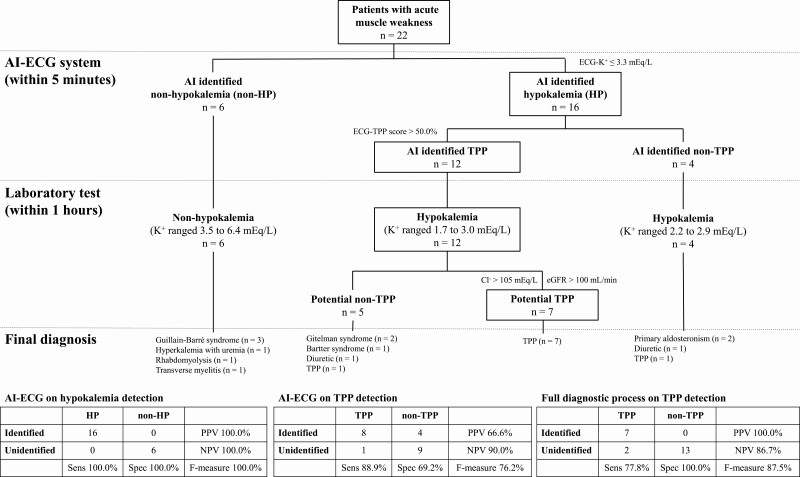
A deep learning model (DLM) based on ECG12Net, an 82-layer convolutional neural network, was constructed to detect hypokalemia and hyperthyroidism. The development cohort consisted of 39 ECGs from patients with TPP and 502 ECGs of hypokalemic controls; the validation cohort consisted of 11 ECGs of TPP patients and 36 ECGs of non-TPP individuals with weakness. The AI-ECG-based TPP diagnostic process was then consecutively evaluated in 22 male patients with TTP-like features.
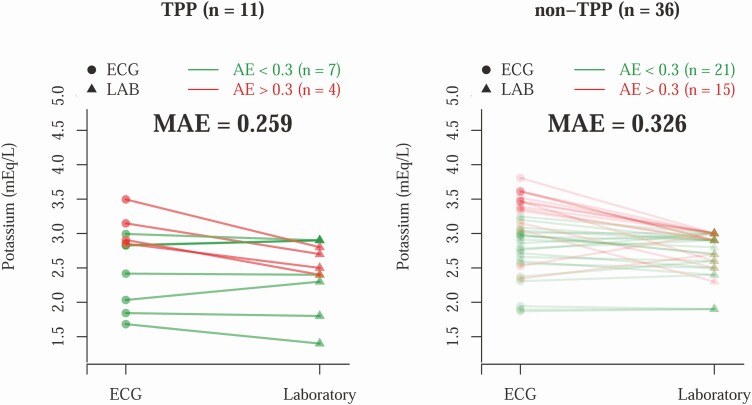
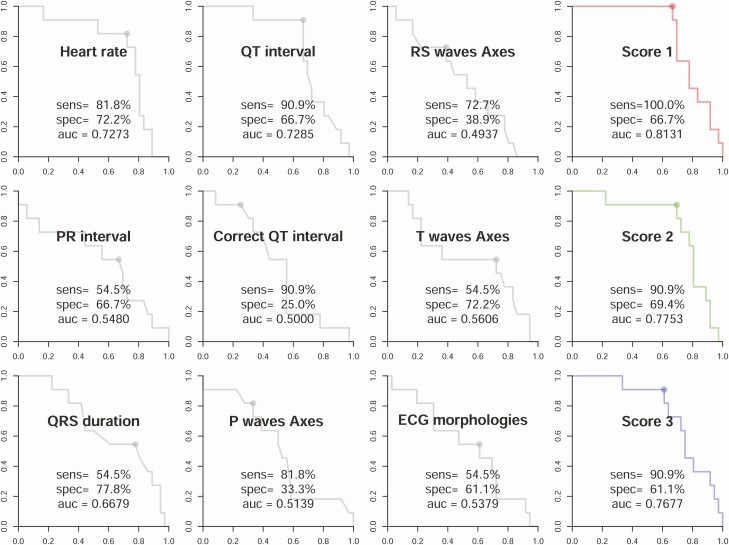
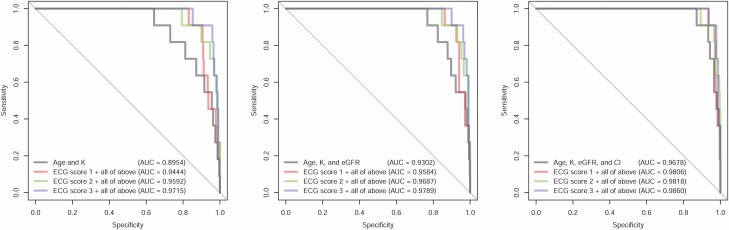
In the validation cohort, the DLM-based ECG system detected all cases of hypokalemia in TPP patients with a mean absolute error of 0.26 mEq/L and diagnosed TPP with an area under curve (AUC) of approximately 80%, surpassing the best standard ECG parameter (AUC = 0.7285 for the QR interval). Combining the AI predictions with the estimated glomerular filtration rate and serum chloride boosted the diagnostic accuracy of the algorithm to AUC 0.986. In the prospective study, the integrated AI and routine laboratory diagnostic system had a PPV of 100% and -measure of 87.5%.
An AI-ECG system reliably identifies hypokalemia in patients with paralysis, and integration with routine blood chemistries provides valuable decision support for the early diagnosis of TPP.
甲状腺毒症性周期性瘫痪(TPP)以急性肌无力、低钾血症和甲状腺功能亢进为特征,是一种医疗急症,由于大多数TPP患者没有明显症状,早期诊断面临巨大挑战。
本研究旨在评估人工智能(AI)辅助心电图(ECG)结合常规实验室数据在TPP早期诊断中的作用。
构建基于82层卷积神经网络ECG12Net的深度学习模型(DLM),用于检测低钾血症和甲状腺功能亢进。开发队列包括39例TPP患者的心电图和502例低钾血症对照者的心电图;验证队列包括11例TPP患者的心电图和36例有肌无力症状的非TPP个体的心电图。然后,对22例具有TPP样特征的男性患者连续评估基于AI-ECG的TPP诊断过程。
在验证队列中,基于DLM的心电图系统检测出TPP患者所有低钾血症病例,平均绝对误差为0.26 mEq/L,诊断TPP的曲线下面积(AUC)约为80%,超过最佳标准心电图参数(QR间期的AUC = 0.7285)。将AI预测结果与估计肾小球滤过率和血清氯相结合,可将算法的诊断准确性提高到AUC 0.986。在前瞻性研究中,集成AI和常规实验室诊断系统的阳性预测值为100%,F值为87.5%。
AI-ECG系统能够可靠地识别瘫痪患者的低钾血症,与常规血液化学指标相结合可为TPP的早期诊断提供有价值的决策支持。