Department of Cardiovascular Medicine (Z.I.A., P.A.F., P.A.N., F.L-.J., P.A.P., T.M.M., S.J.A., S.K.), Mayo Clinic College of Medicine, Rochester, MN.
Department of Business Development (D.J.L., G.S.), Mayo Clinic College of Medicine, Rochester, MN.
Circ Arrhythm Electrophysiol. 2019 Sep;12(9):e007284. doi: 10.1161/CIRCEP.119.007284. Epub 2019 Aug 27.
Sex and age have long been known to affect the ECG. Several biologic variables and anatomic factors may contribute to sex and age-related differences on the ECG. We hypothesized that a convolutional neural network (CNN) could be trained through a process called deep learning to predict a person's age and self-reported sex using only 12-lead ECG signals. We further hypothesized that discrepancies between CNN-predicted age and chronological age may serve as a physiological measure of health.
We trained CNNs using 10-second samples of 12-lead ECG signals from 499 727 patients to predict sex and age. The networks were tested on a separate cohort of 275 056 patients. Subsequently, 100 randomly selected patients with multiple ECGs over the course of decades were identified to assess within-individual accuracy of CNN age estimation.
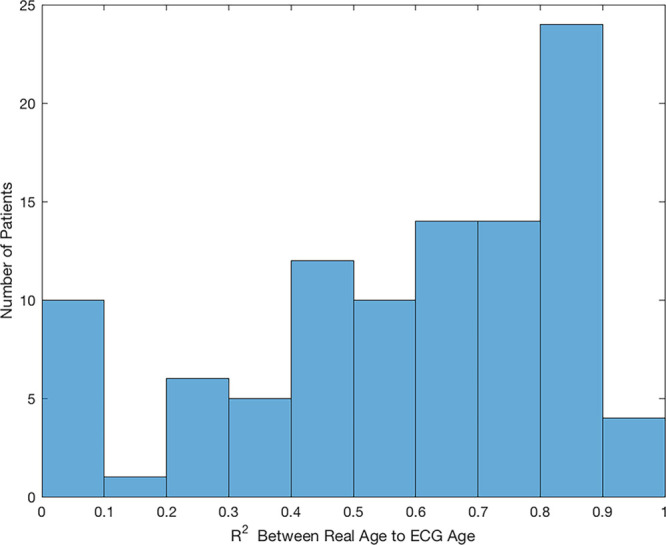
Of 275 056 patients tested, 52% were males and mean age was 58.6±16.2 years. For sex classification, the model obtained 90.4% classification accuracy with an area under the curve of 0.97 in the independent test data. Age was estimated as a continuous variable with an average error of 6.9±5.6 years (R-squared =0.7). Among 100 patients with multiple ECGs over the course of at least 2 decades of life, most patients (51%) had an average error between real age and CNN-predicted age of <7 years. Major factors seen among patients with a CNN-predicted age that exceeded chronologic age by >7 years included: low ejection fraction, hypertension, and coronary disease (P<0.01). In the 27% of patients where correlation was >0.8 between CNN-predicted and chronologic age, no incident events occurred over follow-up (33±12 years).
Applying artificial intelligence to the ECG allows prediction of patient sex and estimation of age. The ability of an artificial intelligence algorithm to determine physiological age, with further validation, may serve as a measure of overall health.
性别和年龄一直以来都被认为会影响心电图。一些生物学变量和解剖因素可能会导致心电图出现与性别和年龄相关的差异。我们假设,卷积神经网络(CNN)可以通过深度学习过程进行训练,仅使用 12 导联心电图信号来预测个体的年龄和自我报告的性别。我们进一步假设,CNN 预测年龄与实际年龄之间的差异可以作为衡量健康状况的生理指标。
我们使用来自 499727 名患者的 12 导联心电图信号的 10 秒样本训练 CNN 以预测性别和年龄。该网络在一个包含 275056 名患者的独立队列中进行了测试。随后,确定了 100 名在几十年中进行了多次心电图检查的随机患者,以评估 CNN 年龄估计的个体内准确性。
在 275056 名接受测试的患者中,52%为男性,平均年龄为 58.6±16.2 岁。对于性别分类,该模型在独立测试数据中的分类准确率为 90.4%,曲线下面积为 0.97。年龄被估计为一个连续变量,平均误差为 6.9±5.6 岁(R-squared=0.7)。在 100 名在至少 20 年的时间内进行了多次心电图检查的患者中,大多数患者(51%)的实际年龄与 CNN 预测年龄之间的平均误差<7 岁。在 CNN 预测年龄比实际年龄大>7 岁的患者中,主要发现的因素包括:射血分数低、高血压和冠心病(P<0.01)。在 CNN 预测年龄与实际年龄相关性>0.8 的 27%的患者中,在随访期间(33±12 年)未发生任何事件。
将人工智能应用于心电图可以预测患者的性别和年龄。人工智能算法确定生理年龄的能力,如果进一步验证,可能成为衡量整体健康状况的指标。