Reference Center for Biological Markers of Dementia (BIODEM), Laboratory of Neurochemistry and Behavior, University of Antwerp, Antwerp, Belgium.
Center for Neurosciences (C4N), Vrije Universiteit Brussel (VUB), Brussels, Belgium.
J Alzheimers Dis. 2021;83(2):623-639. doi: 10.3233/JAD-210450.
Magnetic resonance imaging (MRI) has become important in the diagnostic work-up of neurodegenerative diseases. icobrain dm, a CE-labeled and FDA-cleared automated brain volumetry software, has shown potential in differentiating cognitively healthy controls (HC) from Alzheimer's disease (AD) dementia (ADD) patients in selected research cohorts.
This study examines the diagnostic value of icobrain dm for AD in routine clinical practice, including a comparison to the widely used FreeSurfer software, and investigates if combined brain volumes contribute to establish an AD diagnosis.
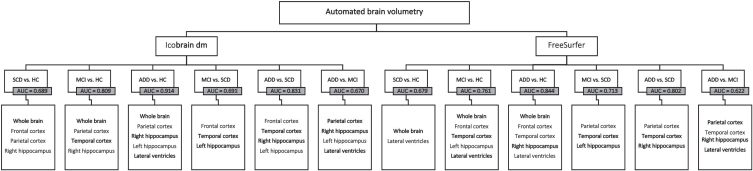
The study population included HC (n = 90), subjective cognitive decline (SCD, n = 93), mild cognitive impairment (MCI, n = 357), and ADD (n = 280) patients. Through automated volumetric analyses of global, cortical, and subcortical brain structures on clinical brain MRI T1w (n = 820) images from a retrospective, multi-center study (REMEMBER), icobrain dm's (v.4.4.0) ability to differentiate disease stages via ROC analysis was compared to FreeSurfer (v.6.0). Stepwise backward regression models were constructed to investigate if combined brain volumes can differentiate between AD stages.
icobrain dm outperformed FreeSurfer in processing time (15-30 min versus 9-32 h), robustness (0 versus 67 failures), and diagnostic performance for whole brain, hippocampal volumes, and lateral ventricles between HC and ADD patients. Stepwise backward regression showed improved diagnostic accuracy for pairwise group differentiations, with highest performance obtained for distinguishing HC from ADD (AUC = 0.914; Specificity 83.0%; Sensitivity 86.3%).
Automated volumetry has a diagnostic value for ADD diagnosis in routine clinical practice. Our findings indicate that combined brain volumes improve diagnostic accuracy, using real-world imaging data from a clinical setting.
磁共振成像(MRI)在神经退行性疾病的诊断中变得非常重要。icobrain dm 是一款获得 CE 认证和 FDA 批准的自动脑容量测量软件,在一些研究队列中已显示出在区分认知健康对照(HC)和阿尔茨海默病(AD)痴呆(ADD)患者方面的潜力。
本研究在常规临床实践中检查 icobrain dm 对 AD 的诊断价值,包括与广泛使用的 FreeSurfer 软件的比较,并研究是否联合脑容量有助于建立 AD 诊断。
研究人群包括 HC(n=90)、主观认知下降(SCD,n=93)、轻度认知障碍(MCI,n=357)和 ADD(n=280)患者。通过对来自回顾性、多中心研究(REMEMBER)的 820 例临床脑 MRI T1w 图像(n=820)进行自动容积分析,比较了 icobrain dm(v.4.4.0)通过 ROC 分析区分疾病阶段的能力与 FreeSurfer(v.6.0)。构建逐步向后回归模型,以研究联合脑容量是否可以区分 AD 阶段。
icobrain dm 在处理时间(15-30 分钟与 9-32 小时)、稳健性(0 与 67 次失败)以及 HC 和 ADD 患者之间的全脑、海马体体积和侧脑室的诊断性能方面优于 FreeSurfer。逐步向后回归显示,对于成对组间差异的诊断准确性有所提高,其中区分 HC 和 ADD 的性能最高(AUC=0.914;特异性 83.0%;敏感性 86.3%)。
自动容积测量在常规临床实践中对 ADD 诊断具有诊断价值。我们的研究结果表明,使用来自临床环境的真实成像数据,联合脑容量可提高诊断准确性。