Shankar Subramanian, Mohakuda Sourya Sourabh, Kumar Ankit, Nazneen P S, Yadav Arun Kumar, Chatterjee Kaushik, Chatterjee Kaustuv
Consultant (Medicine & Clinical Immunology), Air Cmde AFMS (P&T), O/o DGAFMS, New Delhi, India.
Assistant Professor, Department of Internal Medicine, Air Force Hospital, Kanpur, India.
Med J Armed Forces India. 2021 Jul;77(Suppl 2):S385-S392. doi: 10.1016/j.mjafi.2021.05.005. Epub 2021 Jul 26.
Various mathematical models were published to predict the epidemiological consequences of the COVID-19 pandemic. This systematic review has studied the initial epidemiological models.
Articles published from January to June 2020 were extracted from databases using search strings and those peer-reviewed with full text in English were included in the study. They were analysed as to whether they made definite predictions in terms of time and numbers, or contained only mathematical assumptions and open-ended predictions. Factors such as early vs. late prediction models, long-term vs. curve-fitting models and comparisons based on modelling techniques were analysed in detail.
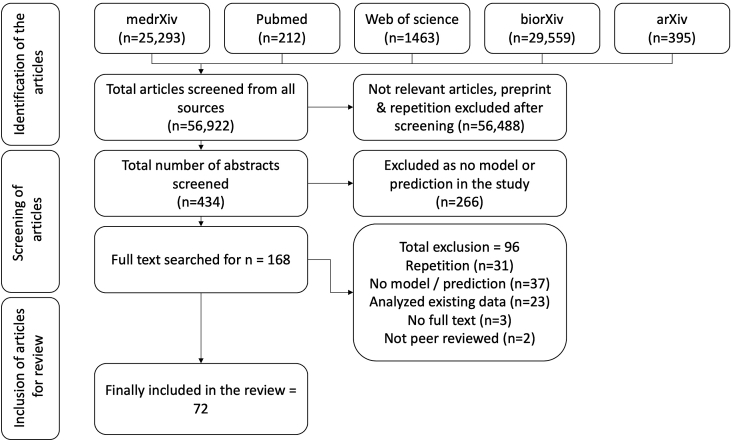
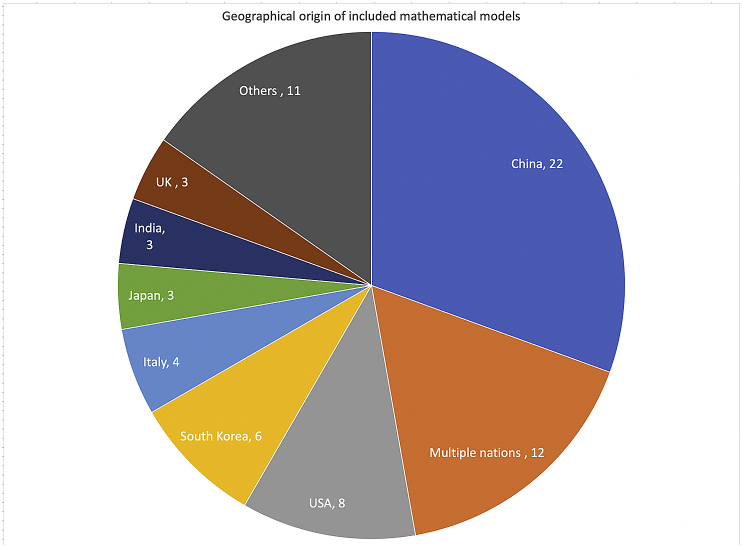
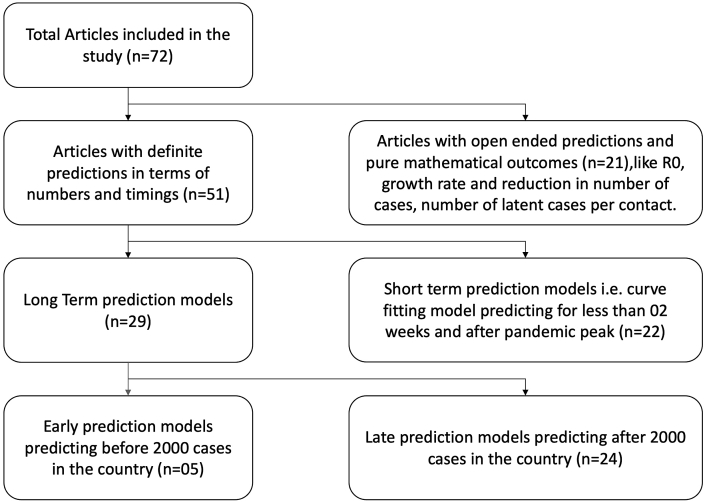
Among 56,922 hits in 05 databases, screening yielded 434 abstracts, of which 72 articles were included. Predictive models comprised over 70% (51/72) of the articles, with susceptible, exposed, infectious and recovered (SEIR) being the commonest type (mean duration of prediction being 3 months). Common predictions were regarding cumulative cases (44/72, 61.1%), time to reach total numbers (41/72, 56.9%), peak numbers (22/72, 30.5%), time to peak (24/72, 33.3%), hospital utilisation (7/72, 9.7%) and effect of lockdown and NPIs (50/72, 69.4%). The commonest countries for which models were predicted were China followed by USA, South Korea, Japan and India. Models were published by various professionals including Engineers (12.5%), Mathematicians (9.7%), Epidemiologists (11.1%) and Physicians (9.7%) with a third (32.9%) being the result of collaborative efforts between two or more professions.
There was a wide diversity in the type of models, duration of prediction and the variable that they predicted, with SEIR model being the commonest type.
已发表了各种数学模型来预测新冠疫情的流行病学后果。本系统评价对最初的流行病学模型进行了研究。
使用检索词从数据库中提取2020年1月至6月发表的文章,纳入经同行评审的英文全文文章。分析这些文章是否在时间和数量方面做出了明确预测,或者是否仅包含数学假设和开放式预测。详细分析了早期与晚期预测模型、长期与曲线拟合模型以及基于建模技术的比较等因素。
在5个数据库的56922条命中记录中,筛选得到434篇摘要,其中72篇文章被纳入。预测模型占文章总数的70%以上(51/72),易感、暴露、感染和康复(SEIR)模型是最常见的类型(平均预测持续时间为3个月)。常见的预测包括累计病例数(44/72,61.1%)、达到总数的时间(41/72,56.9%)、峰值数量(22/72,30.5%)、达到峰值的时间(24/72,33.3%)、医院利用率(7/72,9.7%)以及封锁和非药物干预措施的效果(50/72,69.4%)。预测模型涉及的最常见国家是中国,其次是美国、韩国、日本和印度。模型由包括工程师(12.5%)、数学家(9.7%)、流行病学家(11.1%)和医生(9.7%)在内的各种专业人员发表,三分之一(32.9%)是两个或多个专业合作的成果。
模型类型、预测持续时间及其预测的变量存在广泛差异,SEIR模型是最常见的类型。