Institut National de Recherche pour l'Agriculture, l'alimentation et l'Environnement (INRAE) Pays de la Loire, UR1268 BIA, Impasse Thérèse Bertrand-Fontaine, Nantes, France.
Centre de Recherche en Transplantation et Immunologie UMR1064, INSERM, Université de Nantes, Institut de Transplantation Urologie Néphrologie (ITUN), CHU Nantes, Labex IGO, Nantes, France.
Front Immunol. 2021 Jul 14;12:712614. doi: 10.3389/fimmu.2021.712614. eCollection 2021.
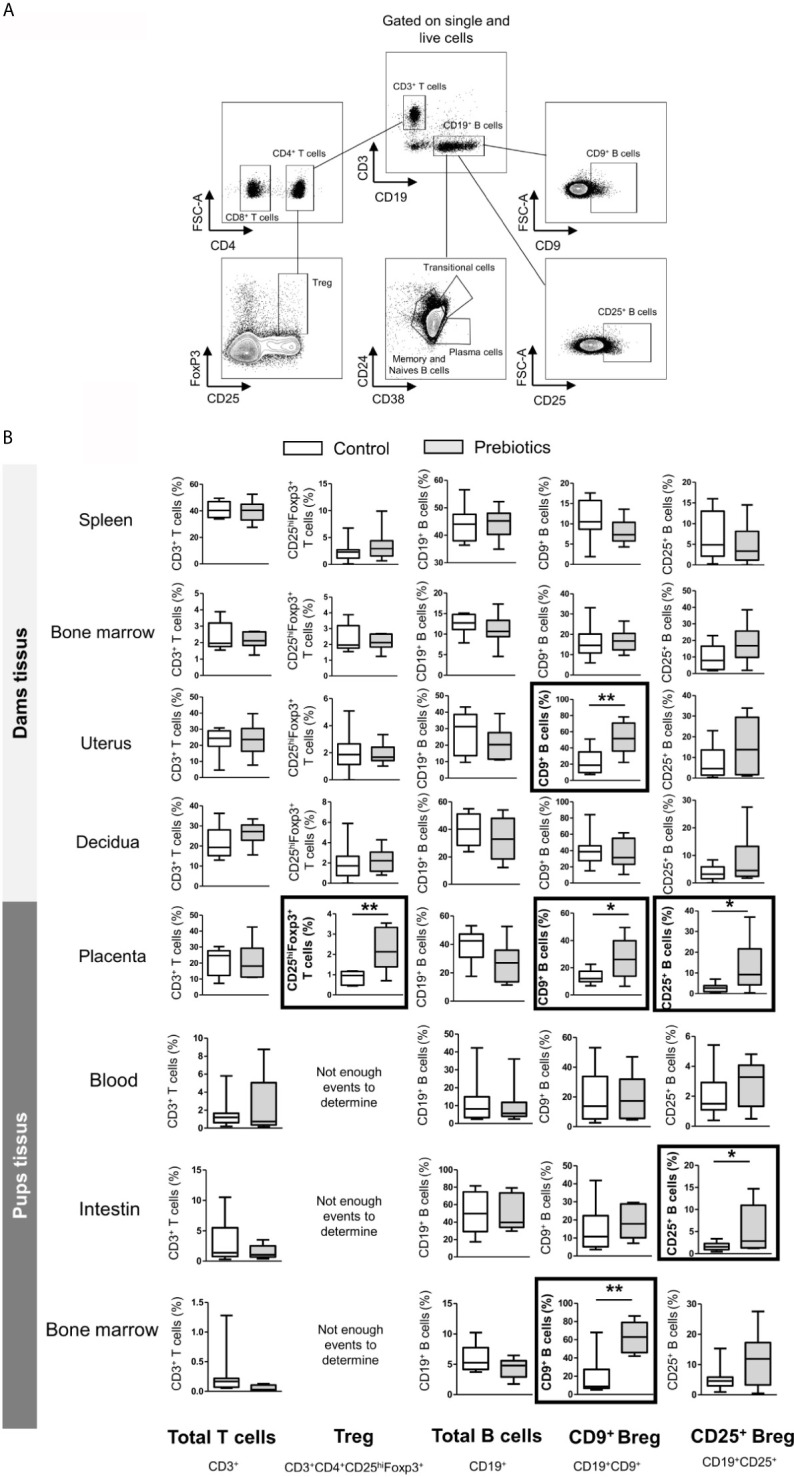
The gut microbiota is influenced by environmental factors such as food. Maternal diet during pregnancy modifies the gut microbiota composition and function, leading to the production of specific compounds that are transferred to the fetus and enhance the ontogeny and maturation of the immune system. Prebiotics are fermented by gut bacteria, leading to the release of short-chain fatty acids that can specifically interact with the immune system, inducing a switch toward tolerogenic populations and therefore conferring health benefits. In this study, pregnant BALB/cJRj mice were fed either a control diet or a diet enriched in prebiotics (Galacto-oligosaccharides/Inulin). We hypothesized that galacto-oligosaccharides/inulin supplementation during gestation could modify the maternal microbiota, favoring healthy immune imprinting in the fetus. Galacto-oligosaccharides/inulin supplementation during gestation increases the abundance of and decreases that of in the gut microbiota, leading to increased production of fecal acetate, which was found for the first time in amniotic fluid. Prebiotic supplementation increased the abundance of regulatory B and T cells in gestational tissues and in the fetus. Interestingly, these regulatory cells remained later in life. In conclusion, prebiotic supplementation during pregnancy leads to the transmission of specific microbial and immune factors from mother to child, allowing the establishment of tolerogenic immune imprinting in the fetus that may be beneficial for infant health outcomes.
肠道微生物群受环境因素的影响,如食物。母体在怀孕期间的饮食会改变肠道微生物群的组成和功能,导致产生特定的化合物,这些化合物会转移到胎儿身上,并增强免疫系统的发育和成熟。益生元被肠道细菌发酵,导致短链脂肪酸的释放,这些脂肪酸可以与免疫系统特异性相互作用,诱导向耐受种群的转变,从而带来健康益处。在这项研究中,BALB/cJRj 怀孕小鼠被喂食对照饮食或富含益生元(半乳糖寡糖/菊粉)的饮食。我们假设在怀孕期间补充半乳糖寡糖/菊粉可以改变母体微生物群,有利于胎儿健康的免疫印迹。在怀孕期间补充半乳糖寡糖/菊粉增加了肠道微生物群中 和 的丰度,导致粪便乙酸盐的产生增加,这是首次在羊水样本中发现。补充益生元增加了妊娠期组织和胎儿中调节性 B 和 T 细胞的丰度。有趣的是,这些调节性细胞在以后的生活中仍然存在。总之,在怀孕期间补充益生元会导致特定的微生物和免疫因子从母亲传递给孩子,从而使胎儿建立耐受免疫印迹,这可能对婴儿的健康结果有益。