Xiao Kaihu, Yang Haiyan, Liu Bin, Pang Xiaohua, Du Jianlin, Liu Mengqi, Liu Yajie, Jing Xiaodong, Chen Jing, Deng Songbai, Zhou Zheng, Du Jun, Yin Li, Yan Yuling, Mou Huaming, She Qiang
Department of Cardiology, The Second Affiliated Hospital of Chongqing Medical University, Chongqing, China.
Department of Cardiology, Chongqing University Three Gorges Hospital, Chongqing, China.
Front Med (Lausanne). 2021 Jul 16;8:684864. doi: 10.3389/fmed.2021.684864. eCollection 2021.
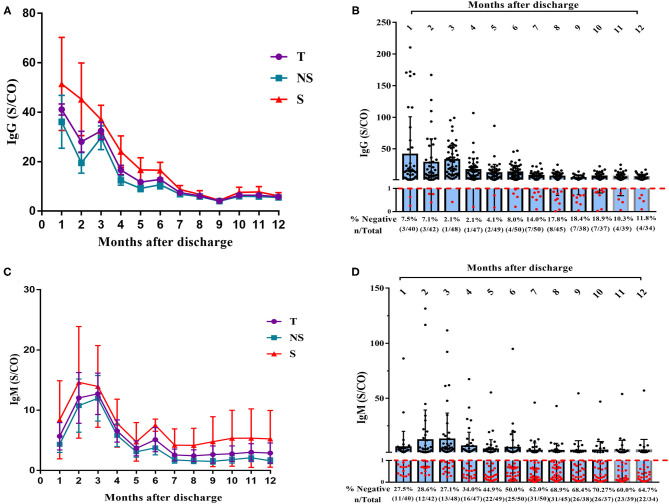
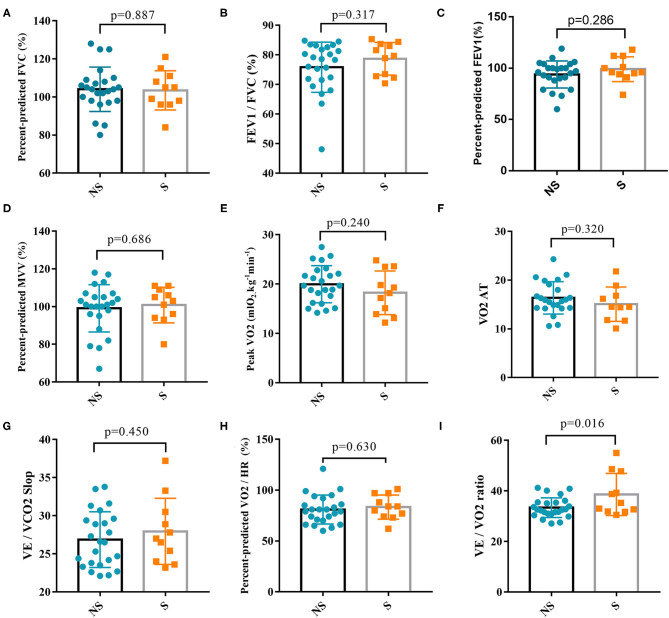
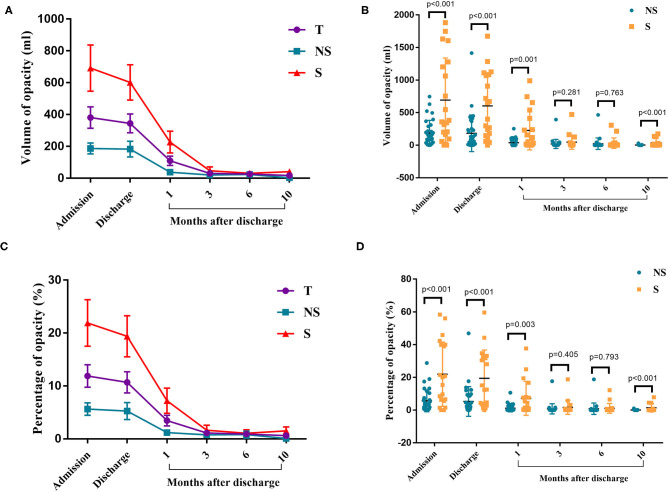
COVID-19 is a global pandemic. The prevention of SARS-CoV-2 infection and the rehabilitation of survivors are currently the most urgent tasks. However, after patients with COVID-19 are discharged from the hospital, how long the antibodies persist, whether the lung lesions can be completely absorbed, and whether cardiopulmonary abnormalities exist remain unclear. A total of 56 COVID-19 survivors were followed up for 12 months, with examinations including serum virus-specific antibodies, chest CT, and cardiopulmonary exercise testing. The IgG titer of the COVID-19 survivors decreased gradually, especially in the first 6 months after discharge. At 6 and 12 months after discharge, the IgG titer decreased by 68.9 and 86.0%, respectively. The IgG titer in patients with severe disease was higher than that in patients with non-severe disease at each time point, but the difference did not reach statistical significance. Among the patients, 11.8% were IgG negative up to 12 months after discharge. Chest CT scans showed that at 3 and 10 months after discharge, the lung opacity had decreased by 91.9 and 95.5%, respectively, as compared with that at admission. 10 months after discharge, 12.5% of the patients had an opacity percentage >1%, and 18.8% of patients had pulmonary fibrosis (38.5% in the severe group and 5.3% in the non-severe group, < 0.001). Cardiopulmonary exercise testing showed that 22.9% of patients had FEV1/FVC%Pred <92%, 17.1% of patients had FEV1%Pred <80%, 20.0% of patients had a VO AT <14 mlO/kg/min, and 22.9% of patients had a VE/VCO slope >30%. IgG antibodies in most patients with COVID-19 can last for at least 12 months after discharge. The IgG titers decreased significantly in the first 6 months and remained stable in the following 6 months. The lung lesions of most patients with COVID-19 can be absorbed without sequelae, and a few patients in severe condition are more likely to develop pulmonary fibrosis. Approximately one-fifth of the patients had cardiopulmonary dysfunction 6 months after discharge.
新型冠状病毒肺炎(COVID-19)是一场全球大流行疾病。目前,预防严重急性呼吸综合征冠状病毒2(SARS-CoV-2)感染以及康复者的康复是最为紧迫的任务。然而,COVID-19患者出院后,抗体能持续多久、肺部病变是否能完全吸收以及是否存在心肺异常仍不明确。对56名COVID-19康复者进行了为期12个月的随访,检查项目包括血清病毒特异性抗体、胸部CT和心肺运动试验。COVID-19康复者的IgG滴度逐渐下降,尤其是在出院后的前6个月。出院后6个月和12个月时,IgG滴度分别下降了68.9%和86.0%。在每个时间点,重症患者的IgG滴度均高于非重症患者,但差异未达到统计学意义。在这些患者中,11.8%的患者在出院后12个月时IgG仍为阴性。胸部CT扫描显示,出院后3个月和10个月时,肺部实变分别较入院时下降了91.9%和95.5%。出院10个月后,12.5%的患者实变百分比>1%,18.8%的患者出现肺纤维化(重症组为38.5%,非重症组为5.3%,<0.001)。心肺运动试验显示,22.9%的患者第一秒用力呼气容积/用力肺活量(FEV1/FVC)%预计值<92%,17.1%的患者FEV1%预计值<80%,20.0%的患者无氧阈(VO AT)<14 mlO/kg/min,22.9%的患者每分钟二氧化碳排出量与每分钟通气量比值(VE/VCO)斜率>30%。大多数COVID-19患者的IgG抗体在出院后至少可持续12个月。IgG滴度在前6个月显著下降,在随后6个月保持稳定。大多数COVID-19患者的肺部病变可吸收且无后遗症,少数重症患者更易发生肺纤维化。约五分之一的患者在出院6个月后存在心肺功能障碍。