Chae Minjeong, Park Kyong
Department of Food and Nutrition, Yeungnam University, Gyeongsan 38541, Korea.
Nutr Res Pract. 2021 Aug;15(4):468-478. doi: 10.4162/nrp.2021.15.4.468. Epub 2021 Mar 8.
BACKGROUND/OBJECTIVES: This study aimed to analyze the association between dietary omega-3 fatty acid intake and depression in postmenopausal women using data from the Korea National Health and Nutrition Examination Survey (KNHANES) VI.
SUBJECTS/METHODS: The KNHANES is a cross-sectional nationwide health and nutrition survey. Dietary data, including omega-3 fatty acids, were assessed using the 24-h recall method. Depression was evaluated using a survey questionnaire. The association between dietary omega-3 fatty acids and depression was evaluated using multivariate logistic regression analysis. Depression, according to the dietary omega-3 fatty acid intake, was expressed as the odds ratio (OR) with a 95% confidence interval (CI). A total of 4,150 postmenopausal women were included in the analysis.
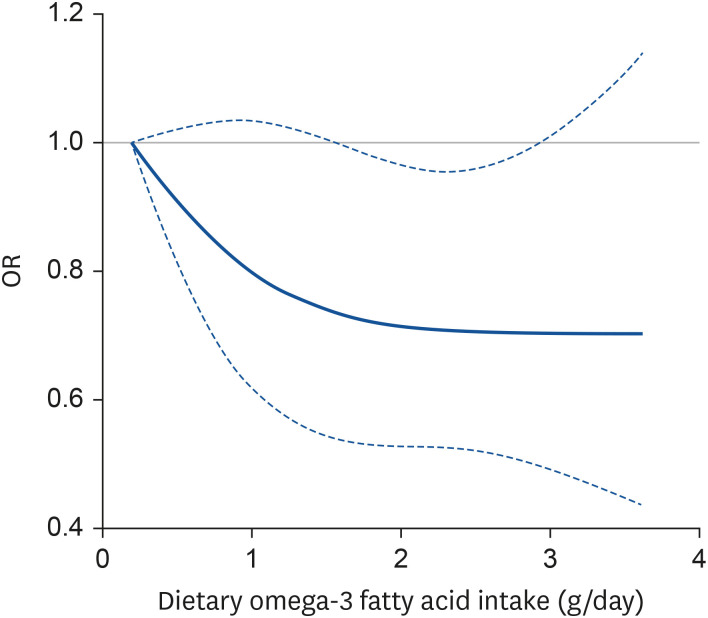
In the fully-adjusted model, the group with the highest dietary omega-3 fatty acid intake significantly showed lower prevalence of depression than the group with the lowest intake (OR, 0.52; 95% CI, 0.33-0.83); a significant linear trend was detected ( for trend = 0.04). According to the dose-response analysis using cubic restricted spline regression, this association was linear and monotonic ( for non-linearity = 0.32).
In this study, the dietary omega-3 fatty acid intake in postmenopausal women was inversely proportional to depression in a dose-response manner. Large cohort studies are needed to verify the causality between omega-3 fatty acids and depression in Korean postmenopausal women.
背景/目的:本研究旨在利用韩国国家健康与营养检查调查(KNHANES)VI的数据,分析绝经后女性膳食中ω-3脂肪酸摄入量与抑郁症之间的关联。
对象/方法:KNHANES是一项全国性的横断面健康与营养调查。使用24小时回忆法评估包括ω-3脂肪酸在内的膳食数据。通过调查问卷评估抑郁症。使用多因素逻辑回归分析评估膳食ω-3脂肪酸与抑郁症之间的关联。根据膳食ω-3脂肪酸摄入量,抑郁症以比值比(OR)和95%置信区间(CI)表示。共有4150名绝经后女性纳入分析。
在完全调整模型中,膳食ω-3脂肪酸摄入量最高的组抑郁症患病率显著低于摄入量最低的组(OR为0.52;95%CI为0.33 - 0.83);检测到显著的线性趋势(趋势检验P = 0.04)。根据使用三次受限样条回归的剂量反应分析,这种关联是线性且单调的(非线性检验P = 0.32)。
在本研究中,绝经后女性膳食中ω-3脂肪酸摄入量与抑郁症呈剂量反应关系的负相关。需要大型队列研究来验证韩国绝经后女性中ω-3脂肪酸与抑郁症之间的因果关系。